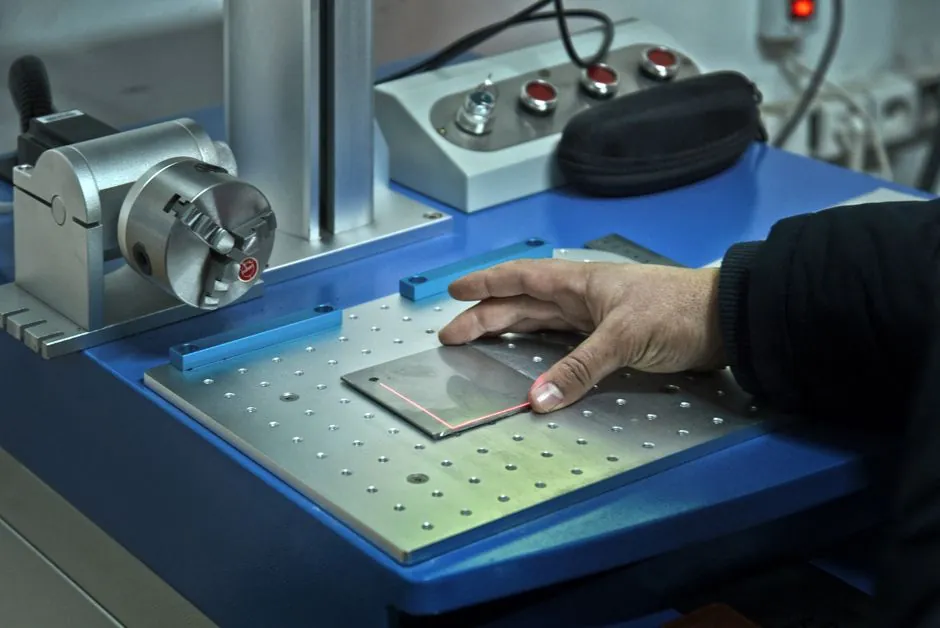
Compact laser beam-steering modules (single/dual-axis MEMS, up to 7° deflection) start at $298 with the SMEM SKU and reach $1,223 across variants, per Agiltron's 2026 product page [S3].
At the application level, 2D laser profilers collect height data across a laser line and feed 2D/3D measurements of width, height difference, and angle, the function that defines a true profile scanner versus a single-point laser displacement sensor [S6].
What "laser profile scanner" actually covers in 2026
The term spans three product tiers that share a triangulation principle but diverge sharply on price. Entry-level beam-steering units (MEMS mirrors, 0.6–2.0 mm aperture, up to 7° optical deflection) are sold as components, not as measurement systems, and the $298–$1,223 band reflects the mirror module, not a turnkey gauge [S3].
Mid-range industrial 2D laser profilers (Keyence LJ-X8000 / LJ-V7000 class) emit a fixed laser line, image it onto a 2D CMOS, and output calibrated profile points at typical rates of 1 kHz to 16 kHz, with measurement ranges commonly between 20 mm and 400 mm and stand-off distances in the 50–300 mm band [S6].
High-end gap and edge sensors (Micro-Epsilon gapCONTROL 2711 family) target welding and joining: three models measure gap depth up to 300 mm with 50 mm width, output via Ethernet or RS422, and ship with guided setup software for four gap types (edgeless, projected, general, V-gap) used in pipeline and chassis welding [S2].
Cost drivers that move the price 3× to 10×
Sensor class is the first driver. A MEMS beam-steering mirror at $298 [S3] is a photonics component; a full 2D profiler with controller, cable, and software is typically a 5–20× multiplier, and a sub-system engineered for in-line gap measurement on a welding cell adds another tier.
Measurement range and stand-off are the second driver. Triangulation accuracy scales with stand-off, so a 300 mm deep gap sensor [S2] costs more than a 20 mm lab profilometer because the optics, laser class, and detector size all change.
Interface stack is the third driver. Ethernet and RS422 are baseline on gapCONTROL [S2]; adding PROFINET, EtherNet/IP, or analog outputs, plus encoder inputs for triggered scanning, increases controller price more than sensor price.
Profile rate and resolution are the fourth driver. A 1,000 profiles/second scan head (Gridbots GB-zSCAN [S1]) is entry industrial; high-end inline profilers run 16 kHz to 64 kHz with sub-micron repeatability, and that bandwidth is what commands the premium.
Spec-first comparison of the main scanner types

For a 2026 specifier, the decision tree narrows to four archetypes. (1) MEMS beam-steering module, $298–$1,223, deflection up to 7°, used inside larger optical systems, not as a stand-alone gauge [S3]. (2) Fixed-line 2D laser profiler, mid-four-figure USD list, 20–400 mm range, 1–16 kHz, primary choice for width/height/angle on the line [S6]. (3) Gap/edge profile scanner (gapCONTROL 2711 class), 300 mm depth × 50 mm width, Ethernet/RS422, software-defined gap modes for welding [S2]. (4) High-speed 3D profile scanner (GB-zSCAN class, 1,000 profiles/s, binary/text output, capable of reading black-on-black marks) for inspection cells [S1].
Selection criteria to apply: stand-off vs accuracy, profile rate vs part speed, interface vs PLC, and IP rating vs environment. The GB-zSCAN's 1,000 profiles/s figure is a useful floor for inline inspection; anything below it usually fails fast-moving web or weld-seam tracking [S1].
Where laser profile scanners earn their keep, and where they don't
Profile scanners are the right tool when the measurement is a 2D cross-section that varies along a moving part: weld seam geometry, bead height, tire tread depth, road surface macro-texture, or printed-circuit trace profile. The gapCONTROL 2711 ships with named application templates for robot welding, chassis flushness, and pipeline V-gaps precisely because the geometry is repeatable and the cost of off-line inspection is high [S2].
They are the wrong tool when the target is a single static point (use a laser displacement sensor), when reflectivity is highly variable and the line is lost, or when the required standoff exceeds roughly 1 m, where confocal or time-of-flight sensors become more cost-effective.
Total cost of ownership beyond the list price
For a 2D laser profiler installed on a single station, the sensor is usually 40–60% of the project cost. The remainder covers the controller or interface module, mounting bracket and guarding, PROFIBUS/EtherNet/IP gateway if needed, calibration targets, and the engineering hours to integrate profiles into the PLC or vision software. For a gap measurement cell on a robotic welder, the sensor is often less than 25% of the cell cost, with fixturing, tracking software, and safety integration dominating. [S2]
Operating cost is dominated by enclosure air (for hot/wet lines), window cleaning, and laser-life on laser-diode-based units. Class 2 or 3R visible lasers are standard on industrial 2D profilers; safety integration and interlocks are non-trivial in collaborative cells. Mean time between failures on sealed industrial profile scanners is commonly measured in years, but laser diode end-of-life is the predictable wear item, not the detector.
Sourcing, standards, and what to verify before purchase
Procurement channels in 2026 split into three tiers: OEM-direct (Micro-Epsilon, Keyence, SICK, Wenglor) for full warranty and calibration certificates, industrial distributors for shorter lead times, and integrator bundles for turnkey cells. DirectIndustry catalogues such as the Gridbots GB-zSCAN listing [S1] and Agiltron's component store [S3] expose specifications, axis count, and price bands but the listed prices exclude delivery, customs, and installation, so RFQ is required for budget-grade numbers.
For the technical spec sheet, verify the profile rate at the full measurement range (it usually drops at the far end of stand-off), the interface set against the PLC, the IP rating, the laser class per IEC 60825-1, and the calibration certificate scope (factory only vs ISO 9001 traceable). Buyers comparing laser profile scanners alongside CMM bridge and vision systems should weight profile rate and in-line suitability more heavily than absolute accuracy, because CMMs win on accuracy but lose on cycle time.
Trackable signal for the next 6 months: Agiltron's SMEM family shows a published $298 starting price as of July 2026 [S3]; any change in that floor price, or new MEMS apertures above 2.0 mm, will reset the entry-tier benchmark. The gapCONTROL 2711's three-model, 300 mm × 50 mm envelope [S2] is the current ceiling for off-the-shelf gap measurement; a wider or deeper model would shift welding-cell pricing.
The underlying component specifications are covered under lighting equipment and electric lamps, and linear guide.