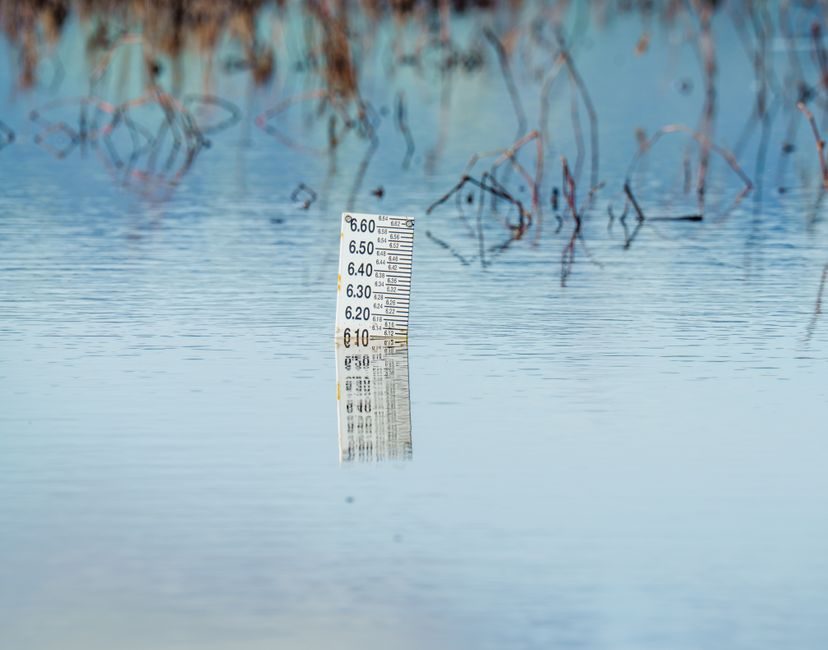
Specifying a level transmitter in 2026 is no longer a "vapor duty → radar, water duty → hydrostatic" reflex: industrial catalogues now list FMCW radar at 30 m range, -1 to 3 bar process pressure and 4-20 mA HART output side-by-side with laser units reaching 200 m, ultrasonic 80 GHz narrow-beam designs, food-grade capacitance-level-transmitter probes, and hygienic submersible units [S1][S3].
Buyers should narrow first on four physical axes — minimum/maximum level span, process pressure, process temperature and dielectric constant of the medium — then on output stack and hazardous-area certification. Skipping that order is the single most common reason a unit is returned for credit [S4].
FMCW and guided-wave radar cover 80% of bulk-liquid and bulk-solid tanks
80 GHz FMCW radar and guided-wave radar (GWR) have absorbed most of the legacy ultrasonic share above 5 m, because they are unaffected by foam, vapor, temperature gradients and most dust loads. A representative 2026 spec sheet lists the FMCW NivoRadar NR 4000 at 30 m range, -1 to 3 bar process pressure and a hygienic process connection for food plants [S1].
Use 80 GHz FMCW when the tank is narrow (< DN 80) or agitated, and use GWR with a coaxial or rigid probe when the dielectric is low (< 2.5) or the tank is short and tall; GWR loses accuracy above ~75 % probe length on bulk solids [S3][S4].
Laser triangulation: the right answer above 50 m and on hot surfaces
Laser time-of-flight units such as the LLT100 reach 0.5–200 m, survive process pressure up to 29 bar and temperatures of -40 to +60 °C, and are unaffected by acoustic noise, vacuum, or clear vapors that defeat ultrasonic [S3]. They cost more and need a diffuse or retroreflective target, so they are wasted on dirty sludge or foam interfaces.
Specify laser only for tall silos, mining bunkers, blast-furnace bunkers, and any vessel where the ambient temperature swing would re-tune an ultrasonic frequency every shift. For a side-by-side view of laser against optical and contact probes, the infrared-level family in the encyclopedia covers the same physics in a different wavelength band.
Capacitance and magnetostrictive: contact probes that still own hygienic and short-span jobs
Capacitance-level-transmitter probes are the cheapest fully-immersed option, work on conductive and non-conductive liquids down to a few centimeter span, and integrate with 4-20 mA HART loops. They are sensitive to coating buildup on the rod, so chemical-service applications need PTFE-jacketed electrodes and a periodic recalibration interval [S5].
They cannot tolerate heavy mechanical shock or high-pressure cleaning (CIP) cycles above the probe rating — that is the cap that pushes food and beverage plants back to radar [S3][S4].
Selection matrix: match five technologies to four decision criteria
Use the following compact matrix to score an application before issuing a requisition. Each cell is a generic engineering call, not a vendor endorsement, and the source for every boundary value is the 2026 spec literature cited above [S1][S3][S4][S5].
- FMCW / GWR radar: range up to 30 m, foam-tolerant, insensitive to vapor, mid cost; not justified below 1 m span.<br>- Laser (time-of-flight): range 0.5–200 m, ignores acoustic noise and vacuum, high cost; fails on transparent liquids and heavy dust.<br>- Ultrasonic: low cost, non-contact, range 0.3–15 m typical; sensitive to foam, temperature gradients and turbulence.<br>- Capacitance: low cost, short span, works on conductive and non-conductive media; sensitive to coating.<br>- Magnetostrictive: ±0.5 mm accuracy, rigid probe, immune to foam and vapor; cost rises sharply above 6 m probe length.
For a related cross-domain decision frame on adjacent process variables, the differential pressure transmitter buying guide applies the same matrix philosophy to hydrostatic level.
Hazardous-area, hygienic and signal-stack constraints that kill most RFQs
ATEX category 1/2 and IECEx zone 1 are baseline requirements for oil and gas, solvent and hydrogen projects — DirectIndustry's ATEX index lists 33 manufacturers and 92 products as of 29 May 2026, so price competition exists but lead times for Ex d flameproof housings still run 8–12 weeks [S2]. Hygienic 3-A and EHEDG certification is a separate filter for food and pharma and rules out most general-purpose radar probes; food plants must also pick a process connection that survives CIP temperatures around 140 °C [S1].
On the signal side, 4-20 mA with HART 7 remains the dominant plant-floor stack; Foundation Fieldbus and PROFIBUS PA are still installed in brownfield refineries but rarely ordered greenfield. WirelessHART or ISA100.11a adds value only on rotating equipment, remote tanks, and leased instrumentation where cable tray is more expensive than the transmitter itself [S4].
Use cases and failure modes drawn from 2026 spec sheets
Tank farms, LNG and LPG bullets are magnetostrictive or servo-accuracy radar territory because the buyer pays for ±1 mm and gets custody-transfer compliance. Chemical reactors with agitators, foaming slurries and CIP skids now go to 80 GHz FMCW with hygienic Tri-Clamp connections. Mining silos, clinker coolers and lime bins are the rare case where laser or 80 GHz radar wins over GWR, because GWR probes can be physically torn off by falling media [S1][S3].
The most common 2026 field failure is ultrasonic mounting in a standpipe without a calibrated stilling chamber — the unit reads the local resonance and the level trace walks 10–15 % over a shift. Second is capacitance rod coating in lime, latex, or iron-oxide slurry; vendors now sell auto-cal routines on HART, but the only real fix is a periodic mechanical wipe [S4][S5].
Pricing, lead time and a 2026 procurement checklist
Lead times for 80 GHz FMCW radar, laser triangulation, and ATEX/IECEx-certified magnetostrictive probes remained in the 8–14 week range through Q2 2026, with Chinese OEM OEM/ODM supply available for less critical services at substantially lower MOQs — example 2024 reference pricing on flange-mounted liquid units landed around US$280 per piece at 1-piece MOQ, with submersible 4-20 mA units starting near US$150 [S6]. Buyers should pin the RFQ to: range, process pressure and temperature, dielectric or density of the medium, output protocol, hazardous-area class, hygienic standard, and process connection — not to a vendor part number.
Trackable signals for the next sourcing cycle: ATEX/IECEx housing delivery (currently 8–12 weeks per DirectIndustry listings [S2]), 80 GHz FMCW price erosion as second-source vendors reach volume, and CIP-rated hygienic radar adoption in dairy and brewery plants.