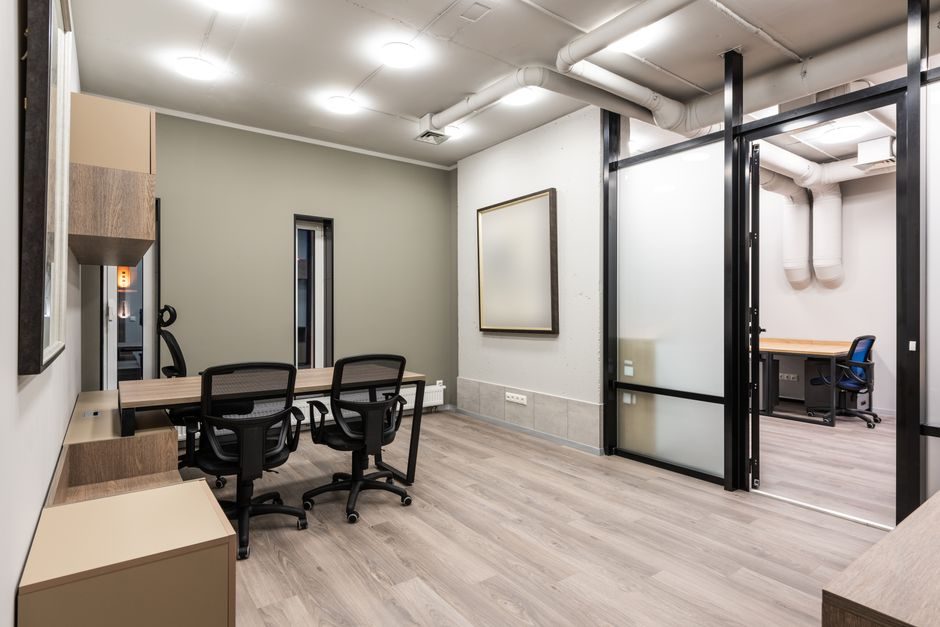
On Chinese B2B catalogues, FRP-reinforced PU foam sandwich panels — a common type of lightweight partition panel — list at US$20.00-80.00 per panel, with suppliers clustered on Made-in-China and Okorder-style wholesale platforms (2026-05-26) [S1]. The wide band reflects panel size, skin material and order volume rather than a single product grade.
The cheapest end of that range typically corresponds to 50-75 mm EPS-cement composite wall panels in 2.4-3.0 m lengths, while the top of the band covers FRP-skinned PU foam boards with higher density cores, longer spans and factory-finished edges. EPS cement sandwich panels are widely cited at 83.9 kg/m² surface density with A1 fire rating and >1000 N hanging force, useful engineering data when the spec writer is forced to triangulate from catalog snippets [S4].
Cost-driving variables: core, skin, fire class and weight
Four parameters move the bill on a lightweight partition panel order: core chemistry, face-sheet material, declared fire class, and panel weight per square metre. An EPS-cement panel quoted at 83.9 kg/m² with A1 non-combustibility behaves very differently in transport, fixing and labour cost than a 12-15 kg/m² ALC panel alternative, even when both ship as a "lightweight partition" SKU [S4].
FRP-faced PU foam sandwich panels (US$20-80) gain stiffness and impact resistance from the fibre-reinforced skin, which is the main reason they sit at the upper end of the catalog band. A 2026-05-26 Made-in-China listing for "FRP Reinforced Polyurethane PU Foam Board High Strength Light Weight Sandwich Panel" anchors that price interval and is broadly representative for export-grade boards shipped from Shandong and Hebei OEM hubs [S1].
Product families side-by-side: EPS-cement vs PU-foam vs ALC vs hollow steel/skim
The four families a spec engineer actually compares on RFQ are EPS-cement composite, FRP-PU sandwich, autoclaved aerated concrete (AAC/ALC), and steel-mesh-plus-skim hollow-core boards. Cost-per-panel typically lands in this order: EPS-cement lowest, PU sandwich low-to-mid, hollow steel-mesh mid, ALC upper-mid; ALC trades higher unit price for a much lower kg/m² and a 600 °C-class reaction-to-fire envelope in the autoclaved aerated concrete family, which is why it is the default for high-rise cores [S4].
On the decision axes that matter for tendering — surface density, fire rating, hanging capacity and thermal conductivity — EPS-cement sits at 83.9 kg/m² / A1 / >1000 N hanging force / heat-insulating; FRP-PU sandwich sits much lower on weight (often 10-20 kg/m²) but at B-class fire rating unless a mineral-foam variant is chosen. For an automation enclosure plant room where a linear guide machine base sits against the wall, EPS-cement's >1000 N hanging force means an HMI bracket can be drilled-and-anchored without back-blocking, whereas thin PU boards need through-bolts to the structural frame.
Who lightweight partition panels are FOR — and who should walk away
These panels fit interior non-load-bearing partitions, plant offices, cleanroom envelopes, modular site cabins, and drylining over a structural slab. The same product family is widely specified for fast-track builds because a 2.4 m panel can be set in minutes, eliminating wet trades on the wall line. A 2026-06-18 DAQUAN group site positions its product as a "R&D and industrialisation leading enterprise" for prefabricated wall construction, with explicit messaging on safety and install speed [S3].
They are NOT a substitute where the partition must carry superimposed floor loads, where the design requires a 2-hour fire-rated shaft wall under a US/IBC-listed assembly, or where the specifier needs an exterior rainscreen — the skins are not UV-stable and the cores are not weatherproof. Hollow steel-mesh skim boards and ALC are the right answer in those cases, with aluminum veneer panel skins specified separately on the exterior face.
Spec criteria: what to lock in the RFQ before you ask the price
Before you ask a Jinan Oyade-style Chinese OEM for an FOB Qingdao quote — Oyade lists "Lightweight partition board equipment, Light wall machine, Wall panel production line, Composite wall panel" as its main product line (2026-06-26) [S6] — the spec must lock: panel thickness (50/75/100/120/150 mm), core type (EPS-cement, PU, rockwool, magnesium-oxychloride), face sheet (calcium-silicate board, fibreglass mat, FRP, cement sheet), declared fire class with test report reference, surface density in kg/m², hanging capacity in N per point, and length/width tolerances (±2-3 mm typical for export-grade Chinese boards).
For a 2026 build with currency volatility, also lock the panel weight per pallet and the 40'HQ loading plan — an EPS-cement panel at 83.9 kg/m² will load roughly 28-32 m² per HQ depending on length, while a PU sandwich at 12-15 kg/m² can load 250-400 m² per HQ. That 8-10× freight delta is the single biggest cost surprise on a first-time Chinese panel import and the difference between a project that lands on budget and one that does not [S4][S6].
Use cases: site offices, cleanrooms, modular plants, residential interior walls
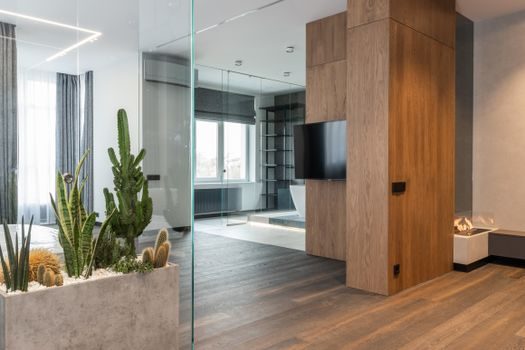
A plant office build on a 50 mm EPS-cement panel will cost less than a brick-and-plaster alternative by 30-50% on the wall line and finish faster, which is why Chinese industrial-park developers are the dominant 2026 buyer base. Cleanroom envelopes typically demand PU sandwich with food-grade silicone sealing, where the FGC light partition board product line is repeatedly requested for Russia-bound cold-chain builds (2026-05-26 inquiry) [S5].
Modular construction sites — site cabins, dormitories, marketing suites — are the third main use case. A 75 mm PU sandwich panel with 0.4-0.6 mm FRP skins on both faces hits the cost ceiling of the US$20-80 catalog band and is the only configuration that survives repeated lift cycles without core delamination. Residential interior walls, finally, are the historic market: the 2017-06-24 jc68.com introduction framing lightweight partition panels as a "new type of material" for modern home decoration still reflects the dominant end-use in Chinese tier-3/4 cities, with AAC and ALC taking the tier-1/2 share [S2].
Limitations and failure modes to engineer around
Three failure modes kill more lightweight partition installations than any spec error: water ingress at the floor track, panel-to-panel joint cracking on shrinkage, and pull-out of wall-hung fixtures. EPS-cement panels need a damp-proof course and sealed skirting; PU sandwich needs continuous gasketing on the floor track; thin PU boards need back-blocking before any HMI panel or bracket is hung, because the >1000 N hanging force benchmark applies to a distributed fix on an EPS-cement face, not a single M8 anchor in a PU foam core [S4].
Fire class is the second-most common spec trap. A1 on an EPS-cement panel is a board-level reaction-to-fire rating — it does not in itself deliver a 2-hour fire-resistance rating on the assembly, which requires the joint treatment, the plaster finish and the floor/head track detail. Anyone specifying a lightweight partition for life-safety walls must read the panel test report, the system test report, and the local building code simultaneously, not just the catalog headline [S3].
Sourcing channels, lead times and a 2026-06-28 buying map
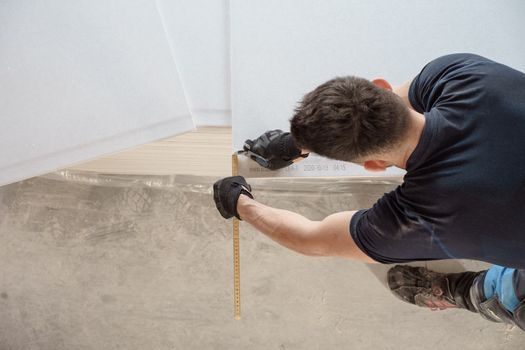
Three channels dominate 2026 sourcing: Chinese B2B wholesale platforms (Made-in-China, Okorder, Goldsupplier), direct OEM via the manufacturer's English site (DAQUAN, Jinan Oyade NC Machinery), and B2B inquiry brokers (Globalimporter, Alibaba RFQ). Made-in-China still returns "Light Weight Board Panel" as a hot-product search with verified manufacturers and wholesaler tiers, Okorder holds product-level specs and test data on the public product page, and Goldsupplier-style sites surface the machinery supplier behind the panel — useful if a buyer is also evaluating a turnkey ALC panel production line rather than finished panels (2026-05-26 / 2026-06-26) [S1][S3][S6].
For an AAC block project where the wall cost stack overlaps, EPS-cement partition panels often show up as the interior leaf while AAC carries the exterior — in which case the spec writer should price both from the same Chinese OEM hub (Shandong, Henan) to consolidate 40'HQ freight. Tracking signals to watch next: the Made-in-China and Okorder indexed panel prices for FRP-PU sandwich and EPS-cement on 2026-06-28; and any revision of the A1 / A2 fire-class declarations published by the top-five Chinese panel OEMs, since that single number moves the spec ceiling for hospital and school projects.