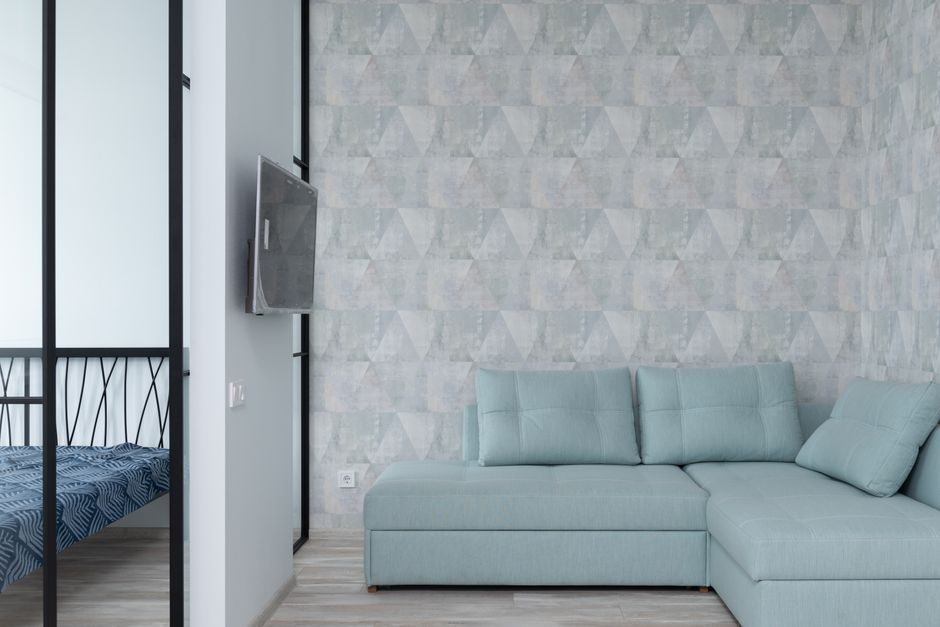
A lightweight partition panel is a factory-made board (AAC, gypsum, calcium silicate, or composite cement) used to build non-load-bearing interior walls, with typical unit weights running 60-90 kg/m² against 180-240 kg/m² for a 100 mm clay-brick wall [S4].
The category covers AAC (autoclaved aerated concrete) panels, hollow core EPS-cement panels, solid gypsum boards, calcium-silicate boards, and composite sandwich panels; selection hinges on density, fire rating, acoustic performance, and moisture resistance rather than raw strength [S4][S5].
Core Advantages: Speed, Mass, and Acoustic/Fire Performance
Lightweight partition panels are 3-5× faster to erect than brick masonry because each panel typically covers 0.5-1.0 m² per unit and is set with thin-bed mortar or tongue-and-groove joints rather than full-thickness bedding [S4]. Dry self-weight in the 60-90 kg/m² range cuts structural dead load, allowing longer spans on light floor framing and reducing foundation sizing in multi-storey builds [S4].
Most AAC and calcium-silicate panels in the 75-100 mm range deliver a fire resistance of 2-4 hours and a sound insulation index (Rw) of 35-45 dB, which meets typical office and hotel partition specs without added cladding [S4][S5]. Panels are precision-cut in the plant, so wall flatness holds within ±2 mm over 3 m, eliminating the plaster-skim step common with brick and saving 20-30 mm of floor area per partition run [S4].
Factory production also keeps the wet-trade footprint on site down to mortar joints, which shortens the build programme and reduces site waste versus cast-in-situ alternatives [S5].
Hard Limitations: Strength, Impact, and Moisture
Compressive strength of standard lightweight partition panels sits at 3-6 MPa, an order of magnitude below 100 mm clay brick at 7-15 MPa, so they cannot carry point loads above roughly 0.5-1.0 kN per fixing without a backing plate or steel reinforcement [S4]. Hollow-core EPS-cement variants are particularly weak in this respect and will crush if a heavy fixture (water heater, wall-hung cabinet) is anchored into a single skin.
Impact resistance is the other weak point: gypsum and low-density AAC panels scuff or dent under hard-body impact in corridors, schools, and hospital back-of-house areas, which is why many specifiers switch to fibre-reinforced boards or solid calcium silicate in high-abuse zones [S4]. Moisture-sensitive products (standard gypsum, untreated AAC) also lose rigidity in wet areas, so they are NOT a fit for bathroom partitions, plant rooms, or exterior walls without a waterproof render or membrane [S4].
Comparison of Main Lightweight Partition Types
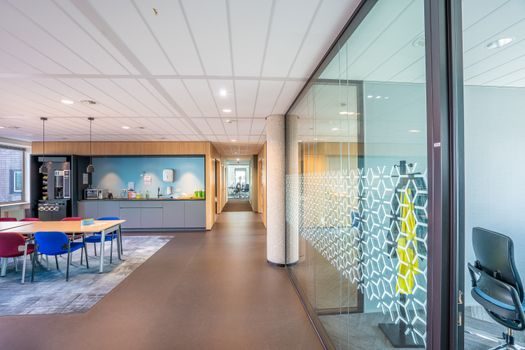
Five panel families dominate the category, and they line up against four decision criteria (density, fire, moisture, point-load capacity) as follows: AAC panels weigh 70-90 kg/m², give 3-4 h fire, are moisture-sensitive without coating, and carry up to ~0.8 kN per anchor; calcium-silicate boards weigh 80-110 kg/m², give 2-4 h fire, tolerate moisture better, and carry ~1.0 kN; solid gypsum panels weigh 60-80 kg/m², give 1-2 h fire, are moisture-sensitive, and carry ~0.5 kN; hollow EPS-cement panels weigh 40-60 kg/m², give 1-2 h fire, are moisture-tolerant, but carry only ~0.3 kN; fibre-cement composite panels weigh 90-130 kg/m², give 2-4 h fire, are fully moisture-stable, and carry ~1.5 kN [S4][S5].
Cost per m² in 2026 sourcing from Chinese panel lines such as DAQUAN's wallboard line runs roughly CNY 35-80 for EPS-cement and CNY 80-160 for AAC, before fixing and finishing are added [S5].
Where Lightweight Panels Fit — and Where They Do Not
Lightweight partition panels are FOR: office fit-outs, hotel guestroom dividers, residential internal walls, school classrooms (non-abuse side), dry-area hospital partitions, and modular/prefab housing where low dead load and speed matter [S4][S5]. They are NOT for: external envelope walls (unless a full weathering system is added), basements with hydrostatic pressure, shower rooms and wet kitchens, load-bearing shear walls, or zones requiring hard-body impact resistance above IK06 [S4].
Designers comparing lightweight panels against masonry often pair them with complementary products: an aluminum veneer panel for decorative or exterior-cladding zones, an alc-panel family member where higher load or better moisture behaviour is required, or a dedicated hmi-panel in plant-room interfaces — selection hinges on matching the panel's density and water tolerance to the room's exposure class.
Installation and Fixing Constraints
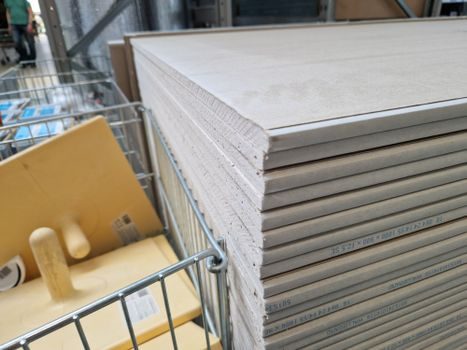
Fixing into lightweight panels demands a defined anchor strategy: standard plastic wall-plugs hold 0.05-0.15 kN in AAC, whereas chemical anchors or through-bolts with steel backing plates reach 0.5-1.5 kN, and engineers should pre-define heavy-fixture locations before panels are set [S4]. Panel-to-panel joints must be sealed with compatible thin-bed mortar or PU foam and finished with alkali-resistant mesh + skim coat to control shrinkage cracking at the 0.2-0.5 mm/m range typical for AAC [S4].
The thinness that makes these walls fast to install also leaves them with poor acoustic mass at low frequencies; for cinema walls, mechanical plant rooms, or boardrooms, double-leaf construction with a 50-100 mm air gap and mineral wool inlay is needed to push Rw above 50 dB [S4].
Standards, Sourcing, and Trackable Signals
Reference standards most often cited for lightweight partition performance are the AAC panel series under GB/T 15762 in China and the EN 12602 AAC-element standard in Europe, with fire testing per the relevant furnace curve in each jurisdiction [S4][S5]. For a balanced comparison of construction-equipment trade-offs, the slab-finishing logic in power trowel selection carries the same principle: spec by site-driven duty class, not by headline cost.
Trackable next signals: (1) tightening fire-rating demands in high-rise residential (2026 code revisions in tier-1 China cities are pushing 100 mm AAC partitions to demand 3 h integrity), and (2) growing adoption of fibre-cement composite panels in wet-area hospitality fit-outs as a moisture-stable alternative to standard gypsum [S4][S5].