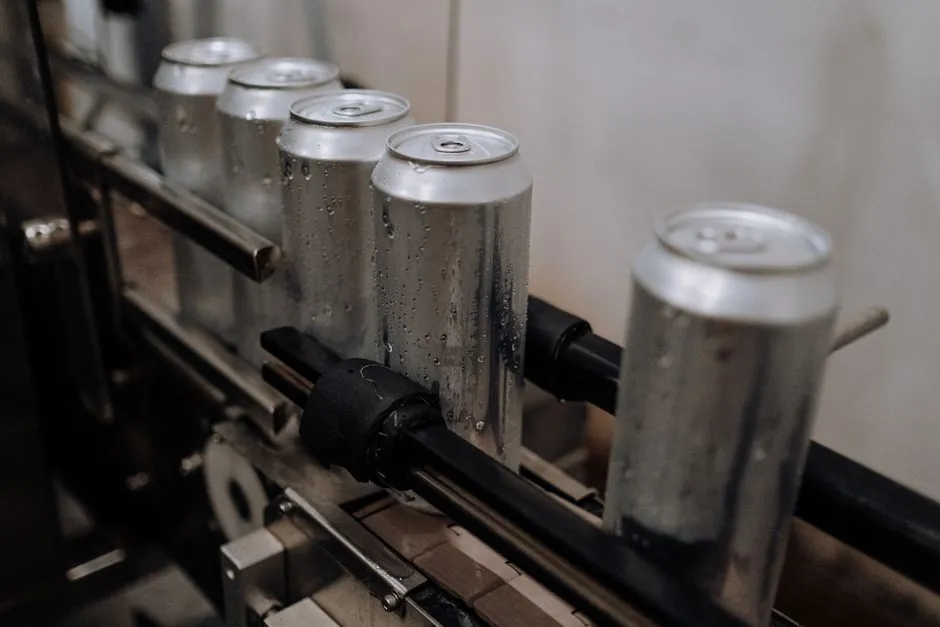
Linear-bearing failures on packaging lines are dominated by contamination ingress, washdown chemical attack, and stroke-speed mismatch rather than basic load rating, so 2026 selection work shifts upstream to architecture, sealing, and lubrication class before any C or N number is computed.
Packaging lines in 2026 still run three distinct motion profiles: high-cycle crosshead travel on horizontal form-fill-seal heads, slow heavy format-adjustment slides on changeover rails, and continuous conveyor guidance in wet zones. Each profile pulls the linear bearing family in a different direction, and a single vendor part number rarely covers all three without trade-offs in speed, stroke, or cleanability.
Closed-Block Profiled-Rail vs Round-Shaft Ball Bushing
Profiled-rail (square rail) carriages deliver the highest dynamic load and moment capacity per unit volume, and they tolerate cantilevered loads from timing-belt pulls on crossheads, with typical basic dynamic load ratings in the 15-50 kN range for a 25-45 mm rail size and full-length ball recirculation paths [S1][S4]. Round-shaft ball bushings on supported 60 Case shafting remain the cheaper, more contamination-tolerant choice for format-adjustment slides, where stroke rarely exceeds 600 mm and speed stays below 1.5 m/s [S1][S5].
For packaging cells with frequent washdown, polymer plain bearings (iglide/drylin style) eliminate grease migration onto film and paper web, at the cost of a lower PV limit and a service life driven by sliding speed in m/min rather than by rotation count [S2]. A useful gate: specify polymer plain only where continuous linear speed stays below 1 m/s and stroke does not push the slider past its wear limit in fewer than 12 months.
Contamination, Sealing, and Lubrication Class
Bottom-line sealing choice dictates bearing life on a packaging floor: standard end seals plus optional longitudinal scrapper seals keep out flour dust, label trim, and PET flake fines that dominate early-life failure modes on bakery, snack, and bottle lines [S4]. A caged runner block design in a profiled-rail carriage has been documented to reduce operating noise by up to 84% and add up to 19% load capacity versus a comparable full-complement design, by separating adjacent balls and storing oil micro-reservoirs in the cage geometry [S4].
Grease specification matters as much as seal choice. Food-area lines tend to call for H1 NSF-registered grease on stainless or zinc-nickel coated components, while dry-zone HFFS jaws can run standard lithium-complex grease with longer relube intervals. On stainless-steel linear bushings (SS304/SS316 raceways and balls), the move to polymer or solid-lube cages removes the relube event entirely, which simplifies PM routes but requires confirmation that the dry-lube layer is compatible with line-side cleaning chemistry, especially chlorine-releasing sanitizers [S5].
Stroke Length, Speed, and Critical Velocity

Stroke length rules out unsupported round-shaft installations above roughly 1 m of unsupported length for typical LM16-LM25 bushing sizes, where sag and natural frequency drag accuracy off-spec and risk resonance at higher cycles per minute [S1]. Fully supported shafting or dual-rail profile systems are the gate for any HFFS or cartoning crosshead stroke past 1 m, and most 2026 packaging OEM drawings call this out explicitly in their maintenance manuals [S1][S4].
Critical shaft velocity is a hard upper gate for round-shaft bushing lines: the formula is roughly 3,820 multiplied by the natural-frequency factor over the supported span, but the practical limit on packaging lines is set by ball skidding at high acceleration, not by whip. For polymer plain bearings, continuous linear speed is the binding limit, with many 2026 catalog lines capping service speed at 1 m/s and a short-term peak of 2 m/s, after which interface temperature climbs past the polymer's continuous-use rating [S2].
Format-Change Slides, Cantilevered Loads, and Moment Capacity
Format-change rails on a packaging line carry cantilevered moment rather than pure thrust, so a single basic-load C number misleads the spec. A 25 mm profile carriage with 4-row ball circulation typically handles a 50-200 Nm moment load about the vertical and pitch axes, while a 25 mm round-shaft bushing on simple support rails handles only a fraction of that before deflection becomes visible at the format dial [S1][S4].
For machines that re-size every shift, the right answer is usually a dual-rail profile system on a single precision-machined sub-plate, with the bearing housings pre-aligned by the OEM to within 0.02 mm parallelism. Loose rail alignment is the most common field-found cause of premature carriage wear on packaging OEM rebuilds, and a quick optical-flat or laser sweep during install is the cheapest insurance on the project.
Selection by Machine Station: Crosshead, Adjust, Conveyor
Crosshead stations (HFFS jaw, horizontal cartoner, tray former) call for profiled-rail carriages in 25-35 mm rail size, caged ball design where available, and IP54 sealing minimum, with H1 grease on food contact [S1][S4]. Format-adjust slides call for round-shaft ball bushings on fully supported case-hardened shafting, with 2-hole pillow-block supports at each end and a center support above 800 mm span [S1][S5].
Conveyor guidance in wet zones is a different problem and pairs more naturally with linear actuator belt-driven modules and polymer plain slides than with rolling-element bearings, because lubricant migration onto the conveyor belt is a HACCP and FDA-compliance problem in food packaging [S2]. In the dry end, stainless or aluminum round-shaft linear guides survive the dust load of a snack or coffee line far better than profile rails, which trap fines in the ball return path and accelerate raceway brinelling.
Materials, Coatings, and Washdown Chemistry
Standard raceway steel is 52100 or equivalent through-hardened to HRC 60+, induction-hardened case for shafting, with black-oxide or chrome plating as the default surface finish [S1][S4]. Where chlorinated cleaners and acidic product residue (sauces, dairy, citrus juice) drive the washdown regime, 440C stainless raceways and balls extend useful life at a 2-4x cost premium over chrome-plated carbon steel, and 316 stainless offers further corrosion margin for high-salt or bleach-heavy sanitation [S5].
Aluminum and polymer plain bearings (Simplicity/drylin style) make sense in MRI, X-ray, and other non-magnetic or low-outgassing stations that show up on pharmaceutical and medical packaging lines, but they are not interchangeable with rolling-element bearings on the same axis because of the lower speed, lower load, and lack of moment rigidity [S4]. Surface finish on a precision round shaft is a hidden gate: a Ra 0.4 µm or better ground finish is the norm for ball bushings, while polymer plain bearings tolerate Ra 0.8 µm in most catalog lines, which simplifies shaft sourcing.
Failure Modes, Sourcing Signals, and 2026 Trackers
The three failure modes that show up repeatedly on packaging-line bearing tickets are: (1) brinelling or raceway flaking from particle ingress past a damaged seal, (2) cage fracture or migration on a starved-lube caged carriage, and (3) polymer slider creep on a washdown plain bearing run past its speed rating. A trackable signal for each: rising drive torque on the servo (1), elevated noise floor above 5 kHz band (2), and increasing pneumatic backpressure on the cylinder return stroke (3). Watch also the secondary effects on packaging machine throughput, because a 1% rise in cycle-time variance often precedes a bearing alarm by 200-400 hours on a caged carriage [S4].
Useful 2026 sourcing signals to track on the next quarterly review: Chinese OEM shifts in stainless-linear-bushing lead times, with Ningbo-based suppliers reporting 15-20 day standard lead times on SS304 LM8-LM25 sizes versus longer for fully caged variants [S5]; igus drylin catalog updates for FDA-cleared polymer liners used in vacuum packaging machine chamber slides [S2]; and a cross-reference on a recent cement-plant spec walk-through, where dust load and vibration were solved with sealed caged profile carriages rather than the round-shaft path that packaging lines default to (cement plant linear bearing spec map). When the next RFQ lands, gate the spec on sealing class, lubrication class, stroke-to-speed ratio, and washdown chemistry before any C or N dynamic-load number is discussed.