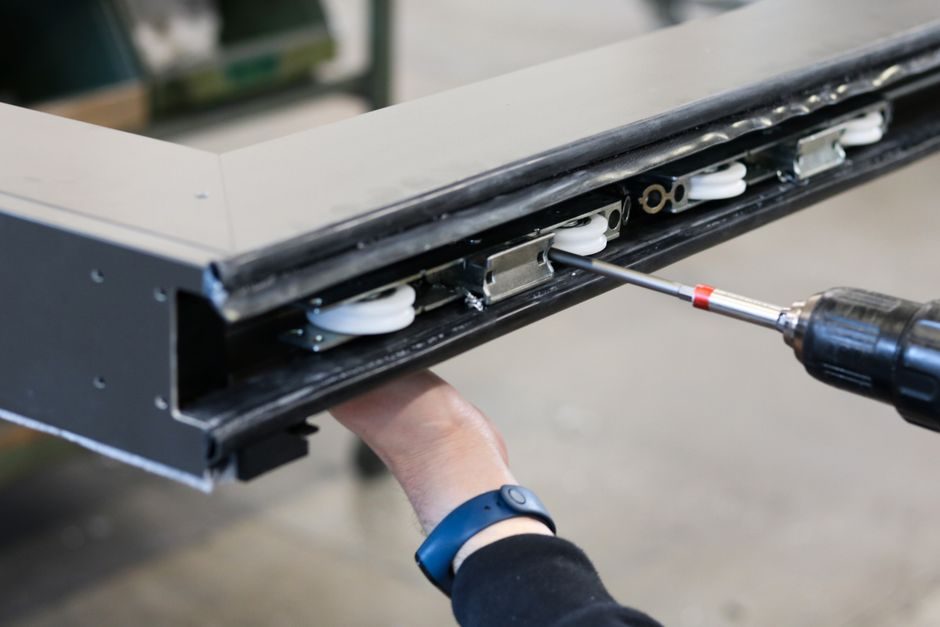
Specifying a linear guide is a six-gate engineering exercise, not a brand comparison: load, accuracy class, travel, environment, lubrication, and rated life are evaluated against the ISO 14728 dynamic load rating before a rail size or block count is fixed [S6].
Buyers who run only the load gate routinely over-spec the rail cross-section or under-size the block count; those who skip accuracy class end up rejecting assembled stages at final inspection. The six gates below are the same logic a builder of precision stages, gantries, and machine-tool axes runs internally, and most catalogue search tools — including Ewellix's Linear Guide Select calculator — expose them as separate selectors [S6].
Gate 1 — Dynamic Load and Static Safety Factor
The first gate is the basic dynamic load rating C (N) and the static load rating C0 (N), per ISO 14728-1 for ball-type and ISO 14728-2 for roller-type linear guides, expressed for a nominal travel of 50 km. Required life is then back-calculated from C, the equivalent load P, and a safety factor f_c that defaults to 1.0–1.5 for vibration-free machinery, 1.5–2.0 for machine tools, and 2.0–3.0 for presses and impact-loaded stages. [S1]
A 25 mm rail with a four-row ball block (C ≈ 30 kN, C0 ≈ 55 kN typical for the size class) will not survive a 15 kN radial punching load in a press application even though the static safety factor reads 3.6 — impact loading and shock direction must be checked separately, and most calculator tools prompt for this as a distinct input [S6].
Gate 2 — Accuracy Class and Preload
Linear guide accuracy is graded under ISO 14728-2 (formerly JIS B 1192-1) into Normal (N), High (H), Precision (P), Super Precision (SP), and Ultra Precision (UP) classes; running parallelism over full travel ranges from roughly 20 µm/m for N down to 2 µm/m for UP, and height H tolerance is held to ±20 µm at the UP tier. [S2]
Preload is a separate decision from accuracy: light preload (Z0) for smooth-running handling stages, medium (Z1) for general machine-tool axes, heavy (Z3) for high-rigidity cutting, and a "no preload" (Z0-clearance) option exists only for measuring or low-vibration gantries. A common 2026-era mistake is locking SP-class accuracy with a Z1 preload block on a column-type machining centre where Z3 is the rule — the result reads correctly on a laser interferometer but deflects under cut [S3].
Gate 3 — Travel Length, Rail Jointing, and Block Count

Rail length is selected first as a single-piece span; if it exceeds the longest stocked mill cut (commonly 4,000 mm for 25–45 mm rail), a butt-jointed rail is used and the joint must be specified with a master-and-slave dowel to hold step-off below the accuracy class limit. Block count is then chosen: single block for compact slides, two blocks spaced L apart for moment loading, three or four blocks for long-stroke gantries where tipping moments dominate. [S3]
MISUMI's inCAD Library "High Accuracy XY Table Unit" (No.000031) shows a 20 mm screw shaft, 10–20 mm ball-screw diameter envelope, and stroke windows of 300–1,500 mm on a compact stage — the kind of stroke envelope a 15 mm or 20 mm rail will cover as a single piece without a joint [S3].
Gate 4 — Environment, Sealing, and Material
Cleanroom and semiconductor stages call for stainless steel rails (1.4034 / X46Cr13 or 1.4112 / X90CrMoV18 equivalent) with low-particle lubrication greases; machine-tool, wood-working, and food lines call for scraper seals plus side-seal end-caps to keep chips and coolant out of the recirculation path. Clean-room and vacuum ratings push the choice toward dry-film (WS2, DLC) lubrication, which extends life at low speed but limits continuous duty to roughly 60 °C block temperature. [S4]
For washdown or chemical-exposure duty, only 400-series stainless blocks with EPDM seals and a stainless end-cap can be specified — carbon-steel rails with a zinc-nickel flash (typical 5–8 µm thickness) are for factory-ambient use only, and any field-installed washdown will lift the plating in under a year [S6].
Gate 5 — Lubrication Interval and Grease Porting
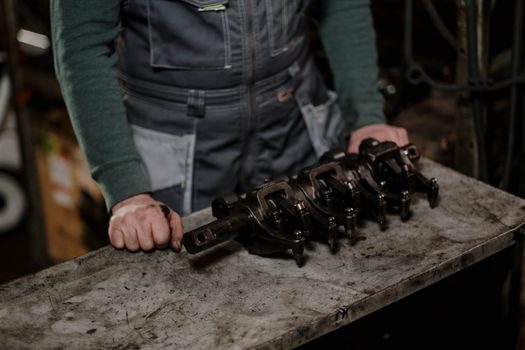
Lubrication interval is a function of speed, load, and ambient; for a 25 mm ball-type guide at 1 m/s under 0.1C equivalent load, the standard re-lube interval is roughly 4,000–6,000 hours with NLGI #2 lithium grease, dropping to 1,500–2,000 hours for oil-bath or oil-mist designs run at 3 m/s. Centralised lubrication ports (M6×1 or G1/8) are mandatory on multi-block stages because each block on a gantry needs its own grease path, not a shared channel. [S5]
Oil-mist and oil-air systems (1–5 cm³/h per block) extend re-lube intervals by roughly 4–6× over grease and are now common on high-speed machine-tool axes; for reference, the linear bearing catalogue typically quotes a baseline 100 km life with no contamination factor applied, which a real factory line rarely achieves [S6].
Gate 6 — Life Calculation and the Contamination Factor
Rated life L is given by the ISO 14728 formula: L = (C/P)^p × 50 km, with p = 3 for ball-type and 10/3 for roller-type. A contamination factor fc is then applied — typically 1.0 (clean), 1.5 (light chips), 2.0 (heavy chips/dust), 3.0 (foundry/wood dust) — to convert nominal life to operating life, and this is where most procurement specs go wrong because the contamination factor is often omitted in the RFQ. [S6]
Buyers running the Ewellix calculator (or its Bosch Rexroth / NSK equivalents) get this as an explicit prompt: stroke length, frequency, load case, and environment are separate inputs, and the calculator returns a recommended block-and-rail size in one click — useful for sanity-checking a manual selection [S6].
Crossed-Roller vs Ball-Bearing vs Linear Module: Which When

Three families cover most 2026 stage builds, and the choice is driven by moment load, accuracy, and stroke envelope rather than brand: [S1]
Ball-type linear guide: the default for travel above 200 mm, speeds above 1 m/s, and any long-axis machine-tool slide. Lowest cost per metre, widest accuracy spread, runs with grease or oil-mist.
Crossed-roller guide: chosen for short stroke (under ~150 mm), high moment load, and precision stages — typified by MISUMI's inCAD "Slide Table" (No.000227) and the "Cylinder Stroke with Rack and Gear Mechanism" (No.000160), which combine a crossed-roller slide with a small mechanism for compact, high-rigidity sub-assemblies. Higher cost per block, finer accuracy, no recirculation path to fail.
Linear module (actuator-class): when a Z-axis column, pick-and-place gantry, or linear actuator needs a fully housed drive, the assembly is a linear module — ball-screw or belt drive, sealed bellows, limit switches, and a pre-engineered block. The press-fitting fixture inCAD (No.000073) shows the same architecture on a smaller scale, where the slide is integrated into a tool body rather than a standalone axis [S2][S4].
When a Linear Guide Is the Wrong Choice
Linear guides are not the answer for very high loads in a small envelope (sliding bearings or hydrostatic pads win), for ultra-high vacuum without specialty greases, or for sub-micron straightness over more than 1 m (where air-bearing or hydrostatic rails are specified). They are also the wrong choice when the application is a one-off short-stroke clamp with no moment load — a crossed-roller guide or a simple bushing-and-rod pair is cheaper and more rigid for that case. [S2]
Conversely, trying to replace a linear guide with a recirculating ball bushing on a long-stroke (over 500 mm), high-speed (above 2 m/s) axis usually fails on life: bushings carry load through a small contact patch, and the L10 result at 50 km drops below the rail-block alternative by a factor of 3–5 in side-load conditions [S6].
Standards, Documentation, and Sourcing Signals
Three documents control the specification: ISO 14728-1 (ball type, dynamic and static load ratings), ISO 14728-2 (roller type, accuracy classes, running parallelism), and the manufacturer's own contamination and lubrication tables. RFQs that quote only the basic load rating C without naming ISO 14728 are usually underspecified and should be returned for revision. [S3]
Trackable signals to watch in 2026: the Ewellix Linear Guide Select online tool now exposes contamination, lubrication interval, and moment loading as separate selectors rather than buried defaults [S6]; for build-side context, the MISUMI inCAD Library continues to publish worked examples (No.000031, No.000073, No.000160, No.000227) that pair a stage geometry with a specific rail-and-block selection — useful as sanity references when a buyer is locked in on dimensions but unsure about size class [S2][S3][S4].
For broader industrial cost context on rails, frames, and steel structure backing the gantry, the steel pipe selection frame covers similar gate logic for the structural side, and buyers who already run a variable speed drive selection workflow will recognise the same six-gate structure applied to motion components.