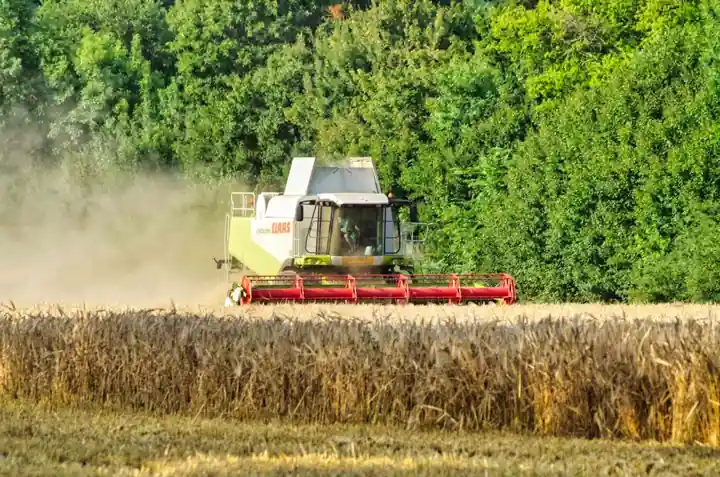
Linear guides specified for tractors, sprayers, seeders, and harvesters differ from CNC-machine selections in three places: sealing class against dust and fertilizer mist, corrosion resistance to spray chemistries, and a higher static safety factor to absorb shock and vibration from field operation [S2][S3].
The dominant rail widths in agricultural duty cycles fall in the 20 to 45 mm band, since most moving booms, header lift arms, and seeding-tool carriages sit in the sub-15 kN load range; standard square-rail sizes of 15, 20, 25, 30, 35, 45, 55, and 65 mm cover this span with off-the-shelf blocks [S4].
Why Agriculture Duty Cycle Changes the Selection Math
Agricultural equipment runs in dust, chaff, fertilizer prill, and high-humidity environments, so the working-environment checklist (cleanliness, corrosiveness, temperature) carries more weight than on a clean factory floor [S2].
Field shock loads from ground-following wheels, lifted implements, and combine header reversals routinely exceed the steady-state value by a factor of 1.5 to 2, which is why the static safety factor window for general industrial service (fS = C0 / P ≥ 2 to 5) is normally pushed toward the high end on farm machinery, with fS ≥ 5 to 7 specified for shock- and vibration-loaded axes [S2].
Stroke lengths on boom sprayers and folding headers commonly push the rail past a single-piece length, so a confirmed end-distance per rail and a butted-rail joint plan are part of the design, not a shop-floor detail [S1][S4].
Sealing Class and Contamination: Where Field Use Breaks Guides
Standard end-cap scrapers on a general-purpose linear guide will not survive a tillage or harvesting season; field experience is that dust ingress past the lips accelerates raceway wear long before the catalog fatigue life is reached. [S2]
The practical upgrade is a double-lip end seal plus a side scraper, with stainless-steel end caps on stainless or zinc-nickel plated rails for sprayer booms that see liquid fertilizer and glyphosate exposure; this combination extends re-lubrication intervals and is now the default on most OEM header-lift axes [S2].
For machines that pressure-wash down at the end of a shift, an additional bellows or telescopic cover is the right call, since high-pressure water strips grease from the raceway faster than the seal can hold it [S2].
Load Direction and Slider Choice on Farm Axes
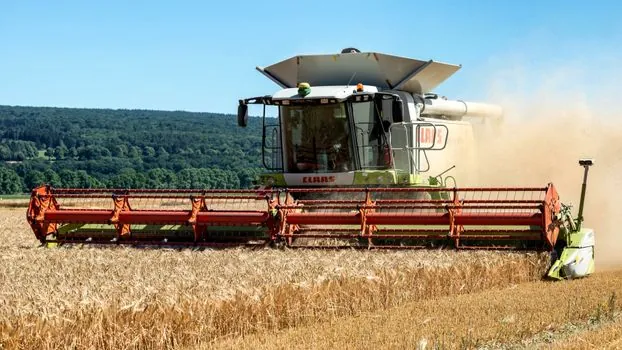
Header lift arms apply a combined radial and moment load; seeding-tool slides apply high reversing radial loads as the toolbar flexes over uneven ground, so the slider type must be selected against the worst-case load vector, not just the static weight [S2][S3].
A flange-type, extended-length block on a 30 or 35 mm rail is the usual answer for header-lift and boom-swing axes because the wider footprint resists the moment better than a standard-length square block in the same width [S4].
Roller-type guides, which use line contact rather than ball contact, give 2 to 3 times the load capacity and rigidity of an equivalently sized ball guide, at the cost of a slightly lower top speed, and are a sensible pick on heavy primary-lift cylinders and steering-knuckle actuators where rigidity matters more than velocity [S2].
Accuracy, Preload, and Stroke Length
Positioning repeatability on most agricultural axes sits at N (normal) or P (precision) grade; C3 and C5 are reserved for planter singulators, GPS-guided toolbar shifters, and seed-meter servo slides, not for general lift cylinders [S2][S4].
Preload selection is a direct trade: higher preload removes internal clearance and raises rigidity, but raises sliding torque and heat, which on a field machine that already runs hot in summer sun becomes a service-life problem rather than a stiffness problem [S4].
Stroke length determines total rail length using the rule: total length = effective travel + slider pitch + (slider length × slider count) + safety distance at both ends, plus any compressed bellows length on each end; most standard 25 to 45 mm rails top out near 4000 mm per piece, and longer strokes need butted rails with end-distance confirmed against the supplier [S1][S4].
Corrosion Resistance: Material and Plating Choices
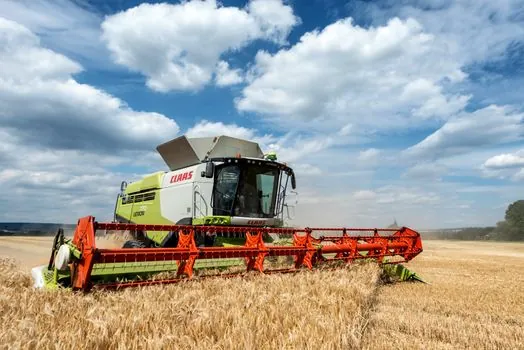
Martensitic stainless rails and blocks (commonly 440C / 1.4125 raceways with 304 or 316 components) are now the default for sprayer booms, manure scrapers, and any machine that sits in livestock barns with ammonia-laden air [S2].
For less aggressive exposure, a zinc-nickel plated carbon-steel rail with stainless end caps is the cost-effective middle ground, holding up to fertilizer mist and salt spray far better than the standard black-oxide or chrome-plated finish that ships on most general-purpose guides.
Machined length tolerances tighten with size: ±1 to 2 mm below 2000 mm rail length, and ±2 to 3 mm between 2000 and 4000 mm; for header booms that bolt to a pre-machined frame, this tolerance window usually requires a contract-specified drawing rather than the catalog default [S4].
Comparison: Ball vs Roller, Square vs Flange, Steel vs Stainless
The three options that matter most for an agricultural spec line up against four criteria: load capacity per unit width, top running speed, corrosion resistance, and unit cost, and the right answer depends on which axis of the machine is being designed. [S4]
A 30 mm ball-type square rail with standard-length block is the workhorse for seeding-tool slides and general-purpose lift arms: 15 to 25 kN dynamic load rating, up to 3 m/s running speed, plain steel, and the lowest cost in the lineup [S2][S4].
A 30 to 45 mm roller-type extended block on a square rail is the heavy-duty pick for primary header-lift and steering axes: roughly 2 to 3× the dynamic load rating of the ball equivalent, top speed closer to 1.5 to 2 m/s, plain steel, and roughly 1.5 to 2× the cost of the ball version [S2].
A 25 to 35 mm stainless-steel ball-type flange block is the corrosion-resistant pick for sprayer booms and barn-side equipment: 10 to 20 kN dynamic load rating, up to 2 to 3 m/s, full stainless raceways and housing, and 2 to 3× the cost of the standard steel version, with sealing upgraded to double-lip scrapers [S2][S4].
Failure Modes and Field Service Signals
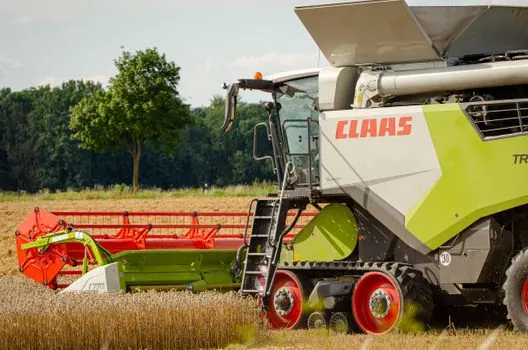
The three field failures that show up on a linear guide in agricultural service are: raceway brinelling from shock overload past the static load rating, raceway wear from dust ingress past damaged seals, and corrosion pitting from chloride or ammonia exposure faster than the lubricant film can reform [S2].
A trackable signal that the seal stack is failing is a shortened re-lubrication interval: a guide rated for 6 months between greasings in a clean plant will need monthly greasing on a tillage machine, and a doubling of grease consumption over two service intervals is the practical field indicator that the seal stack is past its useful life.
For a related material-handling case where load and dust overlap in similar ways, see Linear Guide Selection for Material Handling: Load, Accuracy, and Environment; the linear guide encyclopedia page covers the catalog mechanics behind the numbers above.
Sourcing, Lead Time, and the Catalog Splicing Gate
Standard square rails in 15 to 45 mm widths stock in 4000 mm lengths at most manufacturers, with micro rails topping out near 1000 mm and custom 85 to 120 mm widths available only on mill order [S4].
Butt-joining two rails is acceptable for non-precision booms, but the joint must be specified in the contract with the end-distance agreed against the supplier, and the mounting-hole pattern on the rail is fixed by the manufacturer, so the user cannot re-drill without voiding the warranty [S1][S4].
For marine and other high-corrosion duty cycles that overlap with fertilizer and salt exposure, the Marine Linear Guide Selection guide walks through the material and sealing logic; a broader sourcing view lives in the Linear Guide Rail 2026 sourcing map, and the linear actuator encyclopedia entry covers the integrated drive-and-guide side of header-lift cylinders.
For component-level specifications, see construction machinery and equipment.