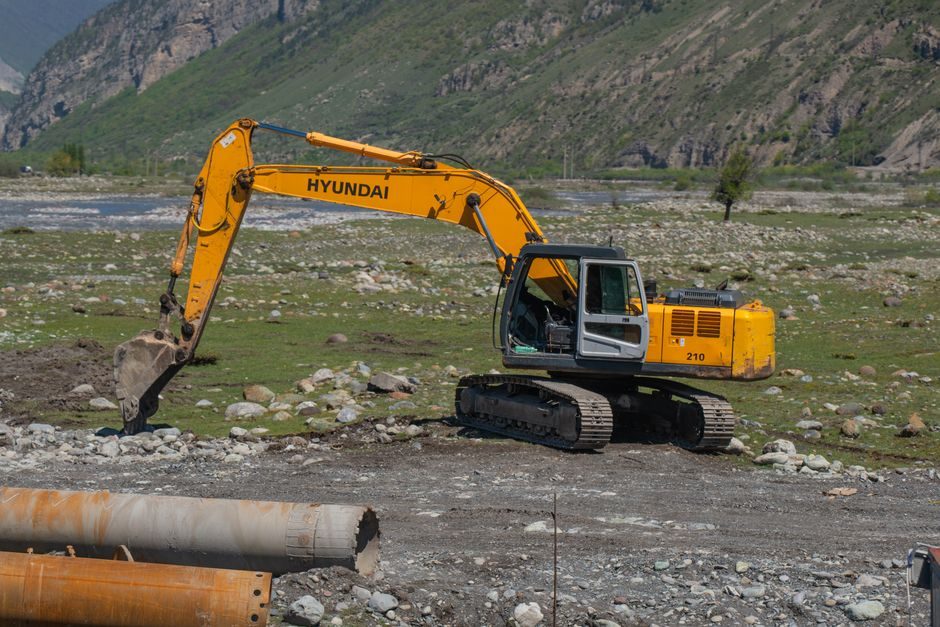
Long-reach excavator supply in 2026 splits across Japanese premium OEMs, Korean mid-tier challengers, and a growing Chinese long-boom specialist cluster, with reach bands running from ~10 m standard to 26 m+ super-long-reach demolition configurations.
Buyers evaluating long-reach excavator sourcing should anchor decisions on three measurable gates: maximum horizontal reach at ground level, pin height at max boom angle, and front undercarriage ground-bearing pressure — not on advertised operating weight alone. Hydraulic piping for attachments (shears, crushers, tilt buckets) is the second decision axis, since retrofitting auxiliary lines on a long-boom machine is materially more expensive than on a standard-reach unit.
OEM Tier Structure and 2026 Market Geometry
Tier 1 Japanese OEMs (Komatsu, Hitachi, Kobelco, Sumitomo) hold the long-reach demolition and dredging segment with factory-engineered boom-and-arm sets that carry manufacturer-issued stability and tipping-load documentation, and they publish working-range diagrams tested to ISO 10567 [S1]. Tier 2 Korean OEMs (Hyundai, Doosan) compete on operating-weight-per-metre-of-reach with the same engine-class footprint; these machines routinely appear on European river-dredging and Asian port-reclamation tenders. Tier 3 Chinese OEMs (Sany, XCMG, LiuGong, Zoomlion) now ship long-reach variants with documented reaches of 15–22 m and Stage V / EPA Tier 4 Final engine packages for export markets, closing the emissions-compliance gap that excluded them from regulated-job-site tenders before 2023.
Total 2026 supplier count for long-reach configurations is distributed roughly as: ~6 Japanese brands, ~4 Korean brands, ~10+ Chinese brands offering at least one long-reach SKU, and a long tail of regional rebranders fitting Chinese-built base units with locally fabricated booms. The structural risk in tier 3 sourcing is the boom-and-arm fatigue documentation — factory-engineered long booms carry FEM-cycle-rated welds and pin-bearing data, whereas retrofit-fabricated arms typically lack third-party verification.
Selection Criteria: Reach, Stability, and Service Radius
Reach band selection follows application: 10–14 m covers canal and pond dredging, 15–18 m is the riverbank-stabilisation and pond-desilting band, 18–22 m handles slope finishing on highways and rail cuttings, and 22 m+ is reserved for demolition of mid-rise structures from a safe stand-off. For each band, the limiting spec is not horizontal reach but pin height at maximum boom elevation, which determines vertical working envelope — typically 70–80% of horizontal reach for telescopic booms and 85–95% for fixed long booms.
Stability on a long-reach build is governed by undercarriage length, counterweight mass, and boom-down-force on the front idler. As a working rule, a 20 m-reach machine in the 25–30 t class needs an undercarriage at least 4.0 m long and 800 mm+ track-shoe width to stay within 0.5 bar ground-bearing pressure on soft substrate. Buyers should request the OEM's load-chart page for the specific working-radius envelope (e.g. 12 m radius at 6 m height) and verify the safety factor against ISO 10567 cycle ratings [S1].
Engine Emissions and Hydraulic Architecture
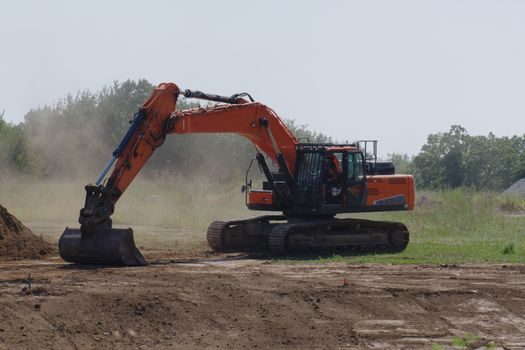
2026 export-bound long-reach machines from Japanese and Korean OEMs ship with Stage V / EPA Tier 4 Final diesels using either SCR-only or SCR+DOC/DPF aftertreatment, and power ratings cluster in the 120–270 kW band for the 20–50 t operating-weight class. Chinese OEMs exporting to Europe have converged on Stage V via SCR + DPF since 2024, with documented NOx reductions consistent with EU 2016/1628 non-road mobile machinery limits.
Hydraulic architecture on long-reach machines is dominated by load-sensing piston pumps with negative-flow or positive-flow control; flow-sharing valve banks are now standard for smooth combined motions on attachment work. Auxiliary hydraulic circuits for tilting buckets, shears, and grapples are factory-plumbed on premium builds (proportional joysticks, separate return line) and are bolt-on retrofits on mid-tier builds — a meaningful spec gap when a pressure transmitter is being added to monitor boom-pilot load.
Supplier Comparison: Tier 1 vs Tier 2 vs Tier 3 on Four Decision Criteria
Decision criteria, four-axis: (1) Reach band coverage — Tier 1 covers the full 10–26 m spectrum with factory-engineered booms; Tier 2 covers 10–20 m with factory booms and offers 22 m+ only as special order; Tier 3 catalog reach is 15–22 m with 22 m+ available but typically as modified-standard rather than a dedicated SKU. (2) Emissions compliance — Tier 1 and Tier 2 ship Stage V as standard; Tier 3 ships Stage V to EU export channels and Tier 3 / China IV to domestic, with retrofit kits available for Tier 4 Final on the US channel. (3) Dealer service radius — Tier 1 maintains 50–100 km radius service in EU/US/JP/AU; Tier 2 service is strong in EU and Middle East, patchier in Africa and South America; Tier 3 dealer networks are densest in SE Asia, Africa, and South America, thinner in EU/US.
Use Cases and Field-Proven Configurations
River-dredging fleets in the Netherlands and Germany operate 20–24 m long-reach machines on 35–50 t platforms with amphibious undercarriages, fitted with tilting ditch-cleaning buckets and GPS grade control. Coastal and inland port authorities in Singapore and the UAE run 18–22 m configurations on 30–40 t bases with clamshell or grab attachments for jetty maintenance. In slope-finishing applications, 16–20 m long-reach excavators with rotating-tilt buckets deliver the precision grading that graders cannot reach on 1:1.5 to 1:2 embankments.
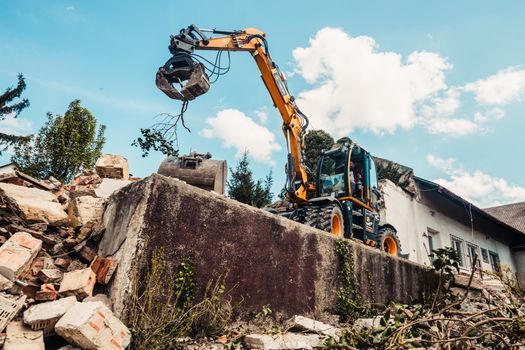
Demolition contractors in Japan and the UK specify 25–30 m ultra-long-reach configurations on 50–80 t bases with high-reach cabs or remote-control demolition packages, enabling top-down takedown of 6–8 storey structures. For buyers cross-shopping machine classes, the wheeled excavator sourcing map covers the mobility-side trade-off when long-reach work is split between two or more sites, and the long-reach reach-band application map lines the catalog SKUs against the duty cycles that actually justify each meter of added boom.
Limitations, Failure Modes, and What Spec Sheets Hide
The most common under-reported failure mode on long-reach machines is boom-pin bushing wear, driven by the moment-arm amplification of side-load forces at full reach — pin-bushing life on a 22 m build is typically 40–60% of the equivalent life on a 12 m build in the same operating-weight class. Buyers should request pin-bushing material spec (typically hardened steel with bronze or PTFE composite liners) and the OEM's recommended re-bush interval at full-reach duty. Second, hydraulic-hose routing on long booms is subject to flex-cycle fatigue; factory-spec machines use SAE 100R13 or 100R15 hoses with documented minimum bend-radius compliance, whereas retrofitted long booms often reuse R12 hose that does not meet cycle-life requirements.
Transport width is the third hidden constraint: a 22 m machine typically requires boom removal for road transport, and the disassembly-reassembly time (4–8 hours with two operators) is a real cost line on multi-site contracts. Counterweight removal adds another 1–2 hours. Buyers should verify transport dimensions against local road-regulations (e.g. EU 96/53/EC on vehicle dimensions) before signing the PO.
Standards, Documentation, and Sourcing Discipline
The governing stability and load-chart standard is ISO 10567, which defines the test method for lift-capacity and tipping-load verification on hydraulic excavators [S1]. Emissions compliance for non-road mobile machinery in the EU is governed by Regulation 2016/1628 (Stage V); in the US by EPA Tier 4 Final (40 CFR Part 1039). Buyers should request the OEM's Declaration of Conformity (CE marking for EU) and the engine family's emissions certificate before acceptance.
For attachments, the relevant standards are EN 474-1 for excavator safety and prEN 13000 for crane-related lifting operations when the machine is configured for clamshell or lifting work. Hydraulic-circuit quick-coupler compliance is covered by ISO 13031 for the coupler itself and by the OEM's own auxiliary-circuit spec for pressure/flow. The industrial valve and flow meter selection on the hydraulic pilot and return lines should reference the same OEM-published port and thread standards to avoid field-fitment delays. Contract clauses should retain 10% payment against commissioning sign-off and require the OEM's field-service-engineer presence at first 100-hour inspection.
Next sourcing node: track the Q4 2026 European rental-fleet renewal cycle (Loxam, Kiloutou, Mateco) for tier-shift data on long-reach share gains, and monitor Stage V derogation deadlines for non-road Stage IV machines on the EU register, which compresses the used-machine supply into 2027–2028.