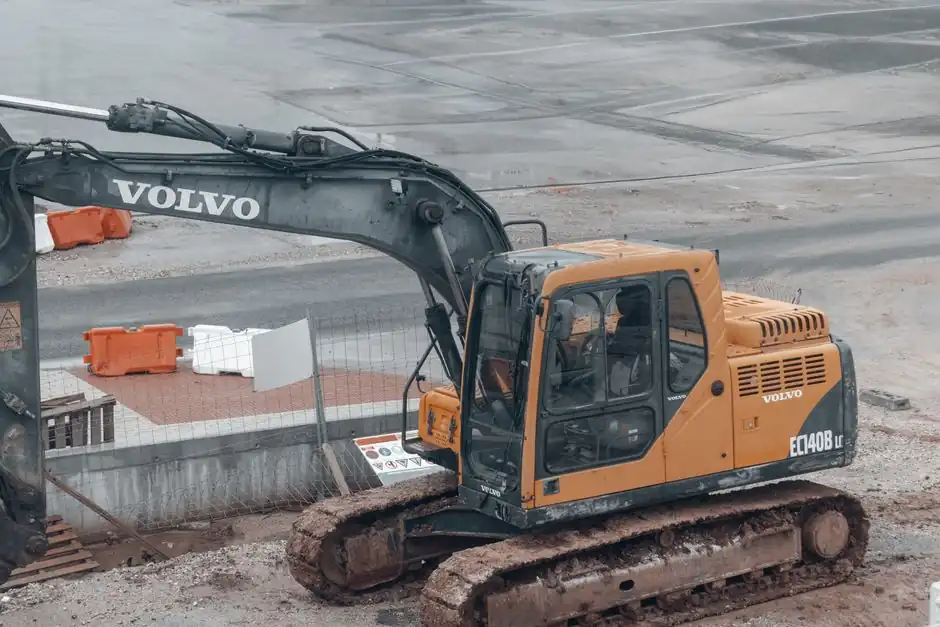
A long-reach excavator stretches the boom-and-stick envelope to 40 to 100 feet (about 12 to 30 m) at ground level, with the largest super-long-reach models clearing 100 feet and high-reach demolition booms climbing 65 to 130 feet (20 to 40 m) [S3][S4].
By comparison, a standard boom and dipper stick on a 10 to 25 ton excavator reaches 26 to 32 feet (8 to 10 m), and a heavy 30 to 40 ton unit extends to roughly 36 to 40 feet (11 to 12 m) [S2]. The long-stick configuration typically delivers 1.5x to 2.5x the horizontal working envelope of a stock arm, at the cost of lift capacity and transport width.
How a long stick extends the working envelope
A long-reach arm is a two-piece boom and stick assembly that is longer and structurally reinforced relative to the standard configuration, with the additional length concentrated in the boom section and the dipper (stick) [S1][S5]. The longer moment arm forces manufacturers to use high-tensile steel plates, heavier pins, and a matched counterweight to keep the machine inside its tipping line at full extension [S2].
The two-piece standard design is engineered as a compromise between reach and digging force, which is why stock arms on a 20 ton class machine typically stop at 26 to 32 feet (8 to 10 m) of horizontal reach [S2]. Extending the boom past that point trades bucket curl force and lift chart capacity for raw horizontal and vertical reach, which is the defining characteristic of the excavator long-reach class.
Standard arm reach by machine class
Standard-arm reach scales with operating weight, because the counterweight, undercarriage length, and boom cross-section all grow together. Mini excavators in the 1 to 6 ton class reach 12 to 20 feet (3.5 to 6 m), mid-size 10 to 25 ton units reach 26 to 32 feet (8 to 10 m), and 30 to 40 ton heavy units reach roughly 36 to 40 feet (11 to 12 m) [S2].
Top-line large excavators push dig depths past 40 feet and dump heights near 37 feet, with engine output in the 300 to 2000 hp band depending on tier and configuration [S6]. The standard arm's role is balanced trenching, truck loading, and foundation digging, where the work sits within a 25 to 40 foot radius of the machine's centerline.
Long-reach and super-long-reach envelopes
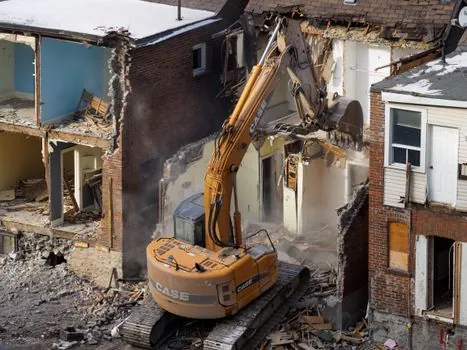
Long-reach excavators are classed separately from standard machines because the boom, stick, and hydraulic circuits are engineered for distance rather than dig force. The typical long-reach class reaches 40 to 60 feet (about 12 to 18 m) at ground level, while the super-long-reach sub-class extends from 60 feet out past 100 feet (18 to 30+ m) [S3][S4].
The added reach unlocks work that stock arms cannot perform, including river and pond dredging, slope finishing across roadways, demolition of low-rise structures from a safe standoff, and excavation across obstacles such as rail lines or waterways [S1][S3][S5]. On a 20 ton carrier converted to long-reach duty, the operating weight climbs with the heavier boom and counterweight, but the working envelope roughly doubles versus the same chassis in standard-arm trim [S1][S2].
High-reach demolition and telescopic variants
High-reach demolition excavators are a separate sub-class built around an extended boom engineered for vertical work rather than horizontal digging, with published working heights of 65 to 130 feet (20 to 40 m) [S2]. These machines carry a smaller, lighter end attachment and rely on modular boom sections that can be reconfigured for different building heights.
Telescopic boom excavators add a hydraulic extension stage inside the boom, letting the operator vary reach on demand instead of committing to a fixed long-stick geometry, which is useful on urban sites with mixed reach and dig-depth requirements [S2]. Three-piece boom configurations give up some maximum reach for tight-quarter maneuverability, which is why they show up on city foundation jobs rather than open-pit or waterway work.
Selection criteria: when a long stick beats a standard arm
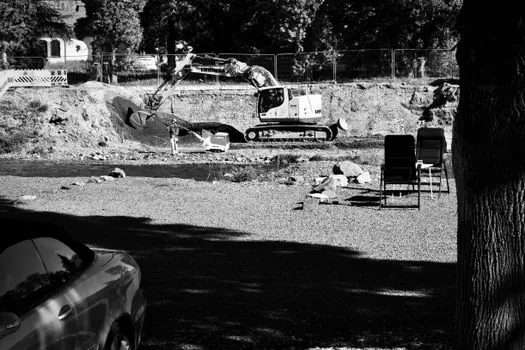
Pick a long-reach arm when the work sits beyond 32 to 40 feet (10 to 12 m) from the machine's centerline, the access path forbids repositioning, and the dig force requirement is modest. Dredging, pond and canal cleaning, riverbank shaping, slope work above a roadway, and low- to mid-rise demolition all fit this profile [S1][S3][S4].
Stay with a standard arm when the dig is inside 30 feet, the material is hard or compacted, the cycle time depends on bucket curl force, or the truck spotting distance is short. Standard arms also win on transport: a long-reach boom typically requires an oversize-load permit, an extended lowboy, and partial disassembly to move, while a standard arm stays inside most legal width envelopes [S1][S2]. The published decision rule from long-arm builders is to match the arm class to the furthest required working point, not to the average one [S4].
Side-by-side comparison: standard vs long-reach vs super-long-reach
Against four decision criteria, the three classes separate cleanly. Horizontal reach for a standard 10 to 40 ton arm lands at 26 to 40 feet (8 to 12 m); long-reach stretches to 40 to 60 feet (12 to 18 m); super-long-reach extends to 60 to 100+ feet (18 to 30+ m) [S2][S3][S4]. Dig force at the bucket drops in the same order, because the longer moment arm reduces hydraulic leverage and the bucket is typically downsized to keep the lift chart in envelope. Transport width and on-site setup time grow with each class, and high-reach demolition booms trade the horizontal reach axis for vertical reach of 65 to 130 feet (20 to 40 m) [S2][S6].
For deeper context on how arm geometry and dig force interact, see the ISO 6015 digging-force benchmark. Operators matching a carrier to a long-reach front end also need to revisit the lift chart, since rated load at full extension typically falls to 30 to 50 percent of the standard-arm value at the same radius.
Limits, failure modes, and what to watch on a long stick
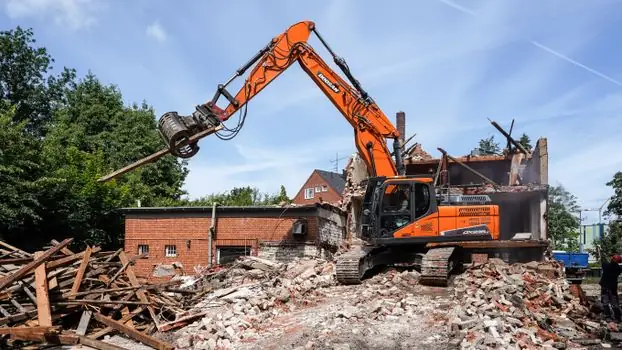
Long-reach arms have a documented set of failure modes that show up first at full extension: boom deflection under load, pin and bushing wear at the extended joints, and counterweight-induced ground-bearing pressure spikes that can submerge tracks on soft substrate [S1][S2]. Hydraulic system capacity also has to be re-sized, because the stock pump and valve bank on a carrier built for a standard arm can starve the actuators when the boom is fully extended and the bucket is loaded.
Material choice matters as much as geometry. Manufacturers use high-tensile steel in the extended sections to keep boom weight down while preserving rigidity, and the arm is paired with a heavier counterweight than the same chassis carries in standard-arm trim [S2]. Operators should size the machine to the maximum required reach plus a margin, since overreaching the design point is the fastest path to a tip-over or a bent boom.
Track the OEM long-reach boom option lists for the common 20 to 30 ton carriers (CAT 320/323, Komatsu PC200/PC210, Hitachi ZX200/ZX250, Volvo EC300) and any 2026 model-year updates to high-reach demolition booms in the 100 to 130 foot class; these are the most active spec sheets in the long-stick segment and they set the working envelope for the rest of the market.
Detailed specification references: reach truck, and pressure transmitter.