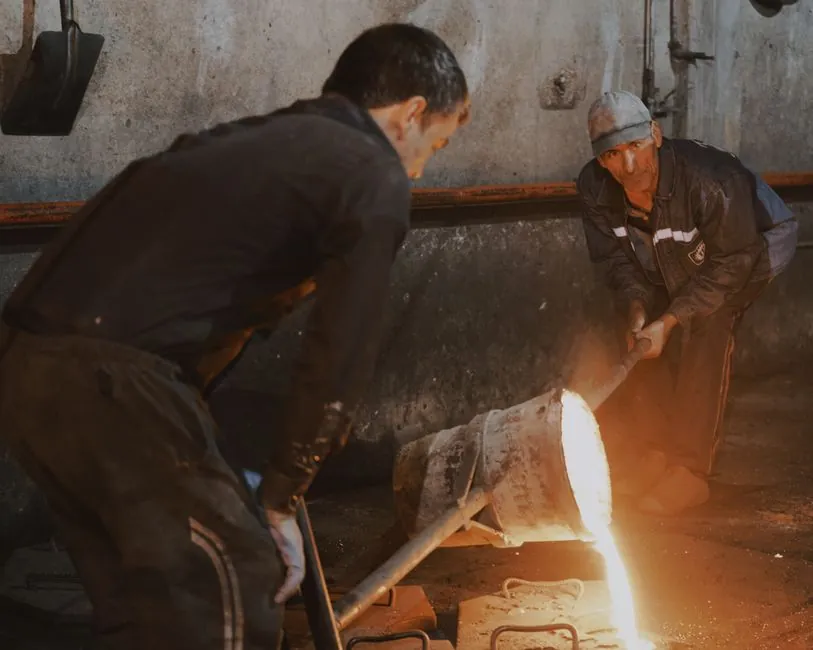
For hardware foundries weighing a lost foam casting line purchase, the decision now hinges on three numbers: a 2-4% defect window for gray and ductile iron in the 5-200 kg bracket, dry-sand recyclability near 98%, and a molding-cycle math that converts daily pattern demand into the actual count of pre-expanders, molding machines, and drying chambers [S3][S4][S5].
The process suits high-volume hardware runs in cast iron and aluminum, with unbonded sand replacing the binders, cores, and parting lines of conventional sand casting, and with pattern assemblies built from expandable polystyrene (EPS) or EPS-PMMA copolymers [S1][S2].
Process Boundary and Material Window
Lost foam casting is an evaporative-pattern method in which a polystyrene pattern is left in place, packed in dry unbonded sand, and vaporized by molten metal; the resulting cavity becomes the casting in a single pour [S1][S3]. The technique removes the parting line, draft angle, sand core, and mold-closing steps that drive the 8-15% defect band commonly accepted in green-sand and shell-molding job shops [S5].
Material compatibility is the first hard filter. Cast iron and aluminum alloys are the documented fit; stainless steel and high-melting heat-resistant alloys are flagged as problematic because vaporized foam products interact with those melt chemistries at pouring temperature [S3]. For hardware buyers whose drawings still call out 304/316 stainless or high-chrome alloys, lost foam is the wrong process regardless of how attractive the line economics look.
Volume Threshold and Economic Logic
The economic case for a dedicated lost foam line collapses below roughly 1,000 t/yr of repeatable pattern volume, because the aluminum foam dies and EPS tooling are amortized across a single-use pattern per casting [S1][S3]. A high-mix plant running 40-50 part numbers per month carries a different configuration problem entirely: a defect profile that oscillates batch-to-batch, driven by pattern changes, sand moisture swings, and manual core-setting error [S5].
The defect-rate math is the most concrete payback lever. A 5,000 t/yr line at $1,200/ton material-and-energy cost and 10% scrap writes off $600,000/yr before labor; the same line at 3% scrap lands below $180,000/yr, a 7-12 percentage-point swing tied directly to equipment choices [S5]. That swing is what most turnkey EPC buyers are actually buying, not the headline tonnage of the automatic molding line they spec into the RFP.
Line Configuration by Stage
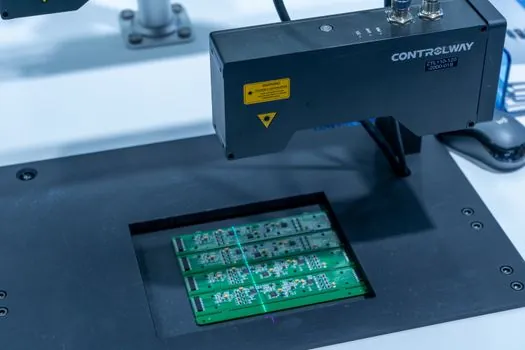
A balanced EPC line is sized from finished castings back through clusters, individual foam patterns, molding cycles, bead consumption, maturation volume, and drying load, with one practical formula driving the count: required usable patterns per hour equals daily usable-pattern demand divided by net productive hours [S4]. In a worked example, 2,400 usable patterns/day and 14 net productive hours produce a 171 patterns/hour requirement; with each mold delivering two patterns every 90 seconds and a 15% allowance for normal interruption, practical output lands near 68 patterns/hour, so three molding machines are needed rather than the two a nameplate-only calculation would suggest [S4].
The pre-expander is selected from actual bead consumption, not the standalone kg/hour rating, because density range, recipe changes, steam conditions, and downstream molding demand all shift the answer; batch systems serve a high-mix plant, continuous pre-expanders serve a dedicated single-recipe line [S4]. Drying rooms, coated-pattern cluster storage, and sand handling must be co-sized, or the bottleneck simply migrates: coated pattern clusters piling up outside an undersized drying room is the most common symptom of a misbalanced white area [S4].
Comparison Against Conventional Methods
Against green-sand casting, lost foam removes the moisture-band failure mode (above 3.5% moisture causes gas porosity, below 2.5% causes friable molds) and the ISO 8062 CT10-CT12 dimensional scatter that comes from sand-mold deformation under static head pressure [S5]. Against shell molding, lost foam avoids shell-breakage defects and binder-related gas evolution at pouring temperature, at the cost of accepting a more limited alloy window [S5]. For automotive iron and aluminum parts in particular, the lost foam casting line spec for automotive iron and aluminum parts framework uses the same defect-window and cycle-math logic, but with tighter pattern-family constraints.
Conventional jobbing foundries running manual mold assembly typically add 2-4% rejection on complex internal-cavity geometries from core shifts alone; lost foam's unbonded sand stays rigid under compaction and the polystyrene pattern is in place until displaced, eliminating core registration error and parting-line flash as failure modes [S3][S5]. The trade-off, again, is upfront tooling: aluminum foam dies are not cheap, and at low volumes the per-part cost is structurally higher than sand [S3].
Hardware Fit and Defect Modes That Still Exist

Lost foam's hardware sweet spot is gray iron and ductile iron castings from 5 kg to 200 kg, plus most aluminum hardware, where the documented defect window is 2-4% on a well-engineered equipment chain [S2][S5]. Outside that envelope, large hollow castings in the same alloy family remain workable but require tighter pattern-cluster design, slower pour rates, and longer drying cycles; the engineering effort scales with the void volume rather than with the alloy chemistry [S7].
The defect modes that survive a properly configured line are not the parting-line or core-shift family, but gas-related defects tied to refractory coating permeability, foam density, and pour rate. A coating that is too sealed traps vaporized polystyrene; a pour that is too fast collapses the unbonded sand before the pattern fully vaporizes [S1]. The 98% sand-recyclability figure assumes the refractory coating is filtered out of the return sand, so buyers should treat the coating-handling subsystem as part of the molding line cost, not an accessory.
Standards, Sourcing, and Buyer Checklist
No single ISO or ASTM standard governs the lost foam process itself; the relevant dimensional reference for sand-casting tolerance comparison is ISO 8062 CT grade, against which green-sand routinely exceeds CT10-CT12 and lost foam typically lands tighter on supported features [S5]. For buyers, the sourcing checklist collapses to: alloy family and part-mass envelope (must fit the 5-200 kg iron/aluminum window), pattern volume and change frequency (must justify aluminum die cost), defect window target (must beat the 8-15% conventional benchmark), and a configuration that converts daily pattern demand into matched pre-expander, molding, drying, and pouring capacity [S4][S5].
Trackable signals over the next sourcing cycle: published defect-rate audits from Chinese EPC line builders running 5,000+ t/yr iron campaigns, and the next wave of NQA/UKAS-certified foundry expansions in East China targeting the pneumatic-components, auto-parts, and railway-parts segments that already anchor the lost foam supply base [S2].