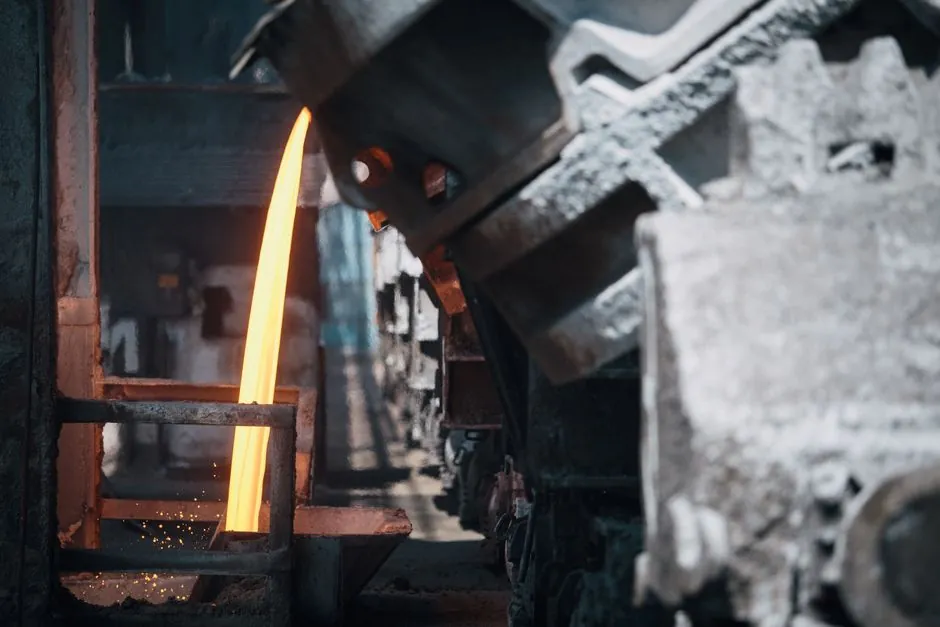
A properly engineered lost foam casting line drops scrap to 2-4% on gray and ductile iron pump and valve bodies in the 5-200 kg range, compared with the 8-15% defect window that green sand and shell molding lines routinely accept [S2].
Foundries running 5,000 metric tons per year at $1,200/ton material and energy cost write off roughly $600,000 annually at 10% scrap, versus under $180,000 at 3% [S2]. That 5 to 7 percentage-point swing is the single largest payback lever when a pump or valve producer evaluates a turnkey lost foam casting line for medium-volume production [S1][S2].
Why EPC Fits Pump and Valve Geometries
Lost foam casting eliminates the mold-sand interface by vaporizing a polystyrene (EPS) pattern on contact with molten metal, so there is no parting line flash, no core registration error, and no sand erosion on the mold wall because unbonded sand stays rigid under compaction [S2][S3]. For pump casings and valve bodies with curved internal waterways and branch ports, the absence of cores and draft angles removes the two defect pathways that dominate green-sand rejection tickets [S2].
The process holds ±0.25 mm typical tolerance with 6.3-12.5 μm Ra surface finish, sits between sand casting (looser) and investment casting (±0.13 mm, 1.6-3.2 μm Ra) on the precision ladder, and runs cycle times of 15-30 minutes per part at foam tooling cost of $1K-$8K [S3][S5]. For foundries weighing a new line against an automatic molding line retrofit, the geometry and pattern-change flexibility of EPC is the deciding factor on parts with internal cavities [S1].
Selection Criteria That Drive Line Configuration
Pattern tooling is the first decision gate. High-volume pump and valve runs use injected expandable polystyrene beads in an aluminum die with steam expansion; low-volume or prototype runs machine the pattern directly from EPS-PMMA copolymer blocks on a CNC [S1]. Foam density typically falls in the 0.015-0.030 g/cm³ band for ferrous castings, and density drift above ±5% is a leading root cause of misruns and carbon pickup in ductile iron [S3].
Refractory coating is the second gate. The water-based ceramic, zircon, or silica slurry is dipped or flow-coated onto the pattern, then dried under controlled humidity; coating thickness of 0.5-1.5 mm and permeability in the 0.5-3.0 darcy range are the two parameters most often mis-set, and both directly drive gas porosity [S3]. Vibration compaction on a flask table at 20-60 Hz for 30-90 seconds is the third gate, and dropping below 30 Hz on heavy flasks leaves low-density pockets that collapse under ferrostatic head [S3].
Pouring temperature and metal front velocity are the fourth gate. For gray iron at 1,350-1,450 °C and ductile iron at 1,360-1,480 °C, foam vaporization products must vent freely through the coating and sand or back-pressure defects appear within the first 3-5 mm of the casting skin [S2][S3].
Process Comparison for Pump and Valve Buyers
On tolerance, surface finish, and per-part cost, the three contenders line up as follows. Green sand sits at ISO 8062 CT10-CT12 and 200-500 μin Ra with per-piece tooling at the low end; lost foam delivers ±0.25 mm and 6.3-12.5 μm Ra on EPS tooling of $1K-$8K per pattern; investment casting tightens to ±0.13 mm and 1.6-3.2 μm Ra but pushes cycle time to 1-2 days per batch and per-part cost up on small runs [S2][S3][S5].
On defect profile, green sand absorbs 8-15% scrap with sand moisture and core shift as the two largest contributors, shell molding cuts surface defects but adds binder-related gas evolution, and lost foam holds 2-4% on iron castings when the equipment chain is properly set [S2]. For valve bodies, the comparison is straightforward: tight internal waterways favor EPC, decorative or mirror-finish external surfaces favor investment casting, and high-mix small-batch runs often stay on sand for changeover speed [S4][S5].
Who Should Choose EPC and Who Should Not
Foundries producing 200-5,000 tons per year of gray or ductile iron pump casings, valve bodies, and fire hydrant bodies in the 5-200 kg weight band are the sweet spot for a new molding line configured for EPC, especially when existing green-sand scrap is sitting above 8% and the casting mix has fewer than 80 part numbers per month [S1][S2]. Pattern changeover under 10 minutes and unbonded-sand reuse above 95% make the line attractive where machining is the dominant cost driver [S3].
EPC is the wrong choice for short-run aerospace or medical implants where investment casting's ±0.13 mm tolerance and 1.6-3.2 μm Ra finish justify the cycle-time penalty, and it is also the wrong choice for high-volume aluminum die-cast parts where a pressure die cell is faster and cheaper per shot [S4][S5]. Plants without consistent EPS bead supply, refractory coating control, or a vibration table rated for the heaviest flask in the catalog should not buy an EPC line; the defect window blows out to 6-10% within a quarter when any one of those three inputs drifts [S2][S3].
Standards, Sourcing, and Quality Control Hooks

Dimensional acceptance for pump and valve castings commonly references ISO 8062 casting tolerance grades, with CT8-CT10 typical for EPC and CT10-CT12 the band where green-sand lines drift under load [S2]. Surface finish specifications for valve sealing surfaces usually require a separate machining step regardless of casting process, so the 6.3-12.5 μm Ra EPC envelope matters more on exterior and port surfaces than on trim interfaces [S3][S5]. Material specifications for ductile iron pump and valve components typically call for ASTM A536 grade 65-45-12 or 80-55-06, with carbon equivalent controlled to 4.3-4.5% to keep the foam-vaporization gas reaction from driving subsurface porosity [S1][S3].
Foundries evaluating turnkey suppliers should compare conveyor sorting line integration for shake-out, shot blasting, and finishing alongside the EPC cell, because pattern-to-finished-part flow time is set by the downstream queue, not by the pour cycle [S1]. A vendor spec map for an analogous agricultural-machinery application, available in this site's Lost Foam Casting Line Selection for Agricultural Machinery spec map, confirms the same 2-4% defect band on iron castings and is a useful cross-reference for buyers sizing flask and vibration tables [S2].
Trackable Signals for the Next Buying Cycle
Watch three signals before committing a capex line. First, EPS bead supply contracts in 2026 have tightened on density-controlled grades, so any quotation carrying a foam tooling lead time above 6 weeks should be flagged for bead-source risk [S1][S3]. Second, refractory coating permeability in the 0.5-3.0 darcy range is now offered as a controlled-tolerance product by multiple suppliers, and a vendor unable to certify coating permeability per batch should be downgraded [S3]. Third, suppliers publishing scrap-rate audits below 3% over a 12-month rolling window on ductile iron castings above 50 kg are the shortlist candidates; everyone else is still selling the old 5-8% envelope [S2].