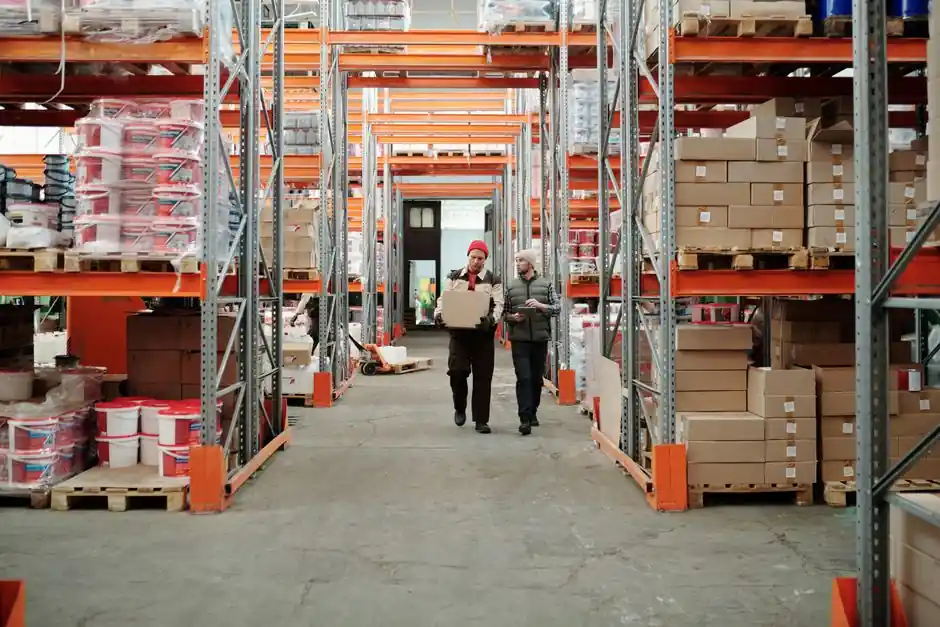
An order picker is a man-up or mast-style powered industrial truck that lifts the operator (and sometimes the load) to retrieve individual items, cases, or broken-case eaches from rack faces, and the three classes, low-level, medium-level, and high-level, are defined almost entirely by the lift height and aisle width they are designed for, not by the SKU type they handle [S4][S5].
Operator-up platforms are documented to reach up to 40 ft (about 12.2 m) and carry payload in the low-to-medium range, roughly up to 2,500 lb (about 1,134 kg) at the platform [S4]. By contrast, the typical low-level order picker (LLOP) is a stand-on or step-on truck whose platform sits at a fixed low height, usually under about 1 m, and whose job is to move fast between pick faces on the warehouse floor [S3][S7].
Height Bands and What Actually Defines Each Class
The three classes are not defined by a single IEC or ISO number, but a consistent engineering pattern shows up across OEM catalogs: low-level work ends where the operator can no longer reach the top of the load on foot or by standing on the platform; medium-level work begins once a lift mast is required; high-level work is reserved for racks tall enough that the operator must ride up with the load [S1][S2][S3].
Concretely, low-level picking is described in warehouse-engineering literature as the operator working on foot or, at most, riding on the highest part of the body of a self-propelled pallet truck, with the goods positioned to be reached without any platform lift [S3]. Medium-to-high level picker ranges from OEMs like Toyota are designed specifically for narrow-aisle operation, with mast heights that allow the truck to reach full picking speed without losing stability [S2]. Cat Lift Truck's published medium/high-level NOM10P and NOH12PH series sit at 1.0-1.2 tonne capacity, with the truck class reserved for taller racking configurations [S1].
Payload, Capacity, and Operator-Up vs Mast-Style
Within the picker family, there is a second axis that often matters more than the height label: operator-up vs mast-style. Operator-up pickers lift the operator to the same elevation as the inventory and are commonly used for loose case or each picking, with platform capacities topping out around 2,500 lb (about 1,134 kg) per QMH's 2023 equipment guide, last reviewed July 2026 [S4]. Mast-style pickers keep the operator on the floor and lift only the forks or platform, so they can carry heavier unit loads but require the operator to work at a distance from the pick face [S4].
Low-level OEM offerings reflect the lighter-duty end: Cat's NO12-25N2(F)(X)(P)(FP) second- and low-level order picker line spans 1.2-2.5 tonnes, while the NOL10P is a 1.0-tonne dedicated low-level unit [S1]. For mini-pickers used in very small-footprint operations, Cat publishes the MNO038Q2 at 0.4 tonnes [S1]. Those numbers are useful as a sanity check: if your pick face is consistently over 200 kg per pick at low level, a mid-range 1.2-2.5 t LLOP or a mast-style unit is the correct starting point, not a 0.4 t mini.
When a Low-Level Order Picker Is the Right Answer
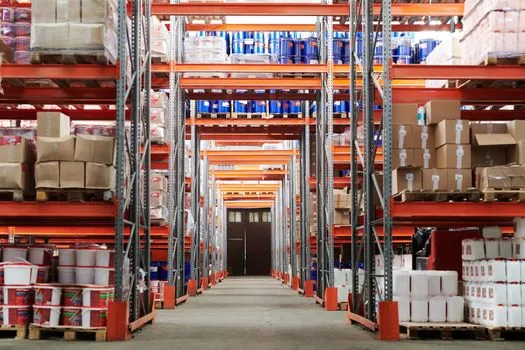
Low-level order picking fits warehouses where most picks happen on the lowest rack level, or where the SKU profile is dominated by fast-moving, broken-case, and each picking that benefits from a fast, step-on/step-off platform rather than a lift cycle [S3][S5][S7]. Mecalux's warehouse engineering manual explicitly bounds this category to goods the operator can reach on foot or by riding a self-propelled pallet truck, with no machine lift required [S3].
Typical deployments documented by integrators include retail distribution centers, grocery warehouses, e-commerce fulfillment operations, and consumer goods facilities where fast-moving inventory sits at the lowest rack level and the pick frequency is high enough that walking distance dominates cycle time [S5]. Total Warehouse's 2021 buyer guidance, still consistent with the 2026 Alt G material handling review, recommends low-level units when the warehouse layout stores bulk products higher up and reserves the lowest rack levels for pick products [S6]. An LLOP in this layout reduces walk distance and removes the mast-lift cycle from the critical path, which is the main productivity lever in this class.
When a Medium- or High-Level Order Picker Earns Its Cost
Move up to medium- and high-level pickers once the rack face requires the operator to be lifted, or once storage density forces you to put inventory above the second rack level. Toyota's medium-to-high level picker line is engineered for narrow-aisle layouts, with stability characteristics that let the truck travel at full speed while elevated [S2]. Cat positions the same class as the highest-productivity option in their warehouse-equipment range, citing lifting capability and operator ergonomics as the key benefits [S1].
High-level pickers are specifically called out for warehouses that prioritize cubic storage density: when storage density is the priority, when inventory sits multiple rack levels above the floor, when the facility has no room to expand the building footprint, and when the operator needs to be elevated with the load handling controls to access greater heights safely [S5]. Operator-up platforms in this class are documented at up to 40 ft (about 12.2 m) of platform height, with the operator tied off and harnessed per OSHA-style operator-up practice [S4]. The narrow-aisle (VNA) sub-class adds wire- or rail-guided steering to shrink aisle width and recover floor space, at the cost of more rigid racking and guided-aisle infrastructure [S5].
Decision Matrix: LLOP vs Medium-Level vs High-Level / VNA
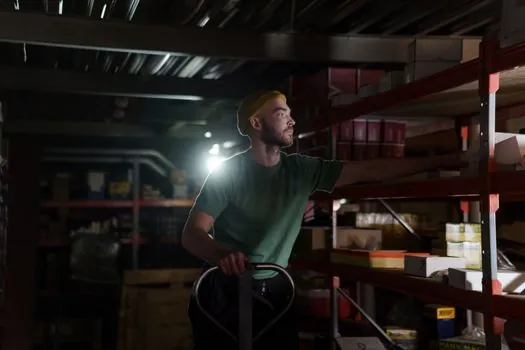
A criteria-based comparison reads cleanly when the decision variables are rack height, aisle width, payload per pick, and the dominant pick type (each/case vs full pallet layer) [S3][S4][S5][S6]:
<b>Pick height.</b> LLOP: ground to roughly 1 m platform, no machine lift needed [S3]. Medium-level: 2.5-6 m typical mast range, operator lifted to the load [S2][S4]. High-level / VNA: up to about 12 m platform height, with operator-up variants documented at 40 ft / 12.2 m [S4].
<b>Aisle width and guidance.</b> LLOP runs in standard counterbalance or straddle aisles with no guidance. Medium-level pickers are designed for narrow-aisle operation without rails [S2]. High-level VNA pickers require wire- or rail-guided steering and a flat, dedicated aisle floor to hit the tightest aisle envelopes [S5].
<b>Payload.</b> LLOP family: 0.4 t mini up to 2.5 t heavy LLOP per Cat's published NO12-25N2 line [S1]. Medium/high-level operator-up: typically up to 2,500 lb (1,134 kg) at the platform per the QMH guide [S4]. Mast-style: higher unit-load capacity because the load, not the operator, is what's lifted [S4].
<b>Best-fit pick type.</b> LLOP: eaches and broken cases, fast-moving SKUs at the lowest rack level [S3][S5][S7]. Medium-level: case picking into the second to sixth rack level, narrow-aisle retail and 3PL operations [S2]. High-level: high-density storage where cubic utilization matters more than cycle time per pick [S5].
Use Cases That Map Cleanly to Each Class
Three canonical deployments show up repeatedly across OEM and integrator material. First, retail and grocery DC with pick products on the lowest shelves and bulk stock above: an LLOP is the workhorse, the operator steps on and off at every pick face, and the highest-cost line item is the number of picks per operator hour, not the lift cycle [S3][S5][S6]. Second, e-commerce and 3PL fulfillment with mid-height case-pick faces and a moderate number of SKUs per order: a medium-level picker in a narrow aisle gives a good balance of reach and travel speed without the infrastructure cost of a full VNA system [S2]. Third, parts distribution and high-SKU warehouses where the building footprint is fixed and storage density is the binding constraint: a high-level operator-up picker, often VNA-guided, pushes pick faces to 10-12 m while keeping the operator on the same level as the inventory [S4][S5].
This is also the deployment pattern in Tawi's 2024 comparison of LLOP products, which describes LLOPs as the standard for warehouses that store pick products on lower shelves and bulk products on higher ones, the same split that defines an LLOP's working envelope [S7].
Limits, Failure Modes, and Operator-Safety Constraints
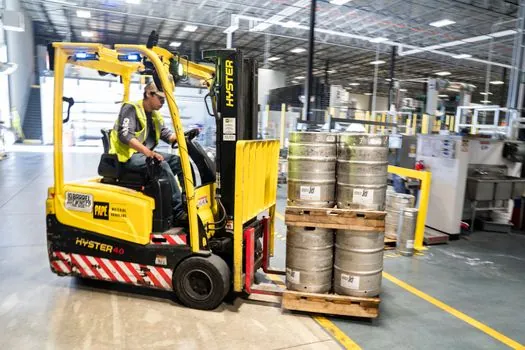
Order pickers are not a universal replacement for other classes of lift truck, and QMH's 2023 equipment guide, still in force as of its July 2026 review, is explicit: these machines are not ideal for unit-load picking, for long horizontal transport, or for right-angle stacking of full pallets [S4]. Trying to use an operator-up picker as a long-distance transporter adds travel cycles and burns tires and batteries without a productivity gain. Trying to use it for right-angle stacking of full pallets is a stability and racking-damage risk.
Operator-up work above 1.8-2 m generally requires a harness and documented operator training; the exact threshold is set by local safety regulation rather than by a single equipment standard, but the operational practice is consistent across the OEM and integrator sources [S4]. On the low-level side, the main failure mode is operator fatigue and stepping accidents when the LLOP is pushed beyond its design envelope, for example, used as a tow tractor for long trailer drags, or operated in aisles too narrow for its turning radius [S8]. EP Equipment's 2019 LLOP operating guide, republished in 2026, is explicit that the LLOP is "efficient, easy, and cheap to operate, especially for high speed order picking and transporting heavy loads through long distances," but that statement applies within the truck's rated payload and aisle class, not outside it [S8].
Selection Checklist and Sourcing Notes
For a structured spec-out, the short list reads: confirm the maximum pick-face height in your rack; measure the tightest aisle you can run without changing the building; define the 95th-percentile payload per pick, not the average; decide whether you need operator-up or mast-style based on whether the operator must be at the same elevation as the inventory; and only then compare specific OEM models within the correct class [S4][S5]. Cat's published LLOP line tops out at 2.5 t for the NO12-25N2 and sits at 1.0 t for the NOL10P, so a 3 t pick at low level rules out that family entirely and pushes you toward a mast-style or reach truck [S1]. Toyota's medium-to-high level range is the right reference point for narrow-aisle mid-height case picking [S2]. For taller, denser storage, an operator-up high-level picker with platform height up to 12.2 m is the documented ceiling in the public QMH guide, last reviewed July 2026 [S4].
Trackable signals to watch over the next planning cycle: OEM-published mast-height extensions on the medium-level line, particularly anything pushing past the current 6 m band, and any integrator-published updates to OSHA-style harness thresholds for operator-up platforms above 3 m. For a deeper dive into the equipment taxonomy itself, the order picker encyclopedia entry is the right reference; for a view on how picker throughput compares against tugger-train and AMR-based transport in the same warehouse, the AMR ROI vs forklift and tugger trains 2026 decision matrix pairs naturally with this comparison.
For component-level specifications, see high voltage tester, and medium voltage vfd.