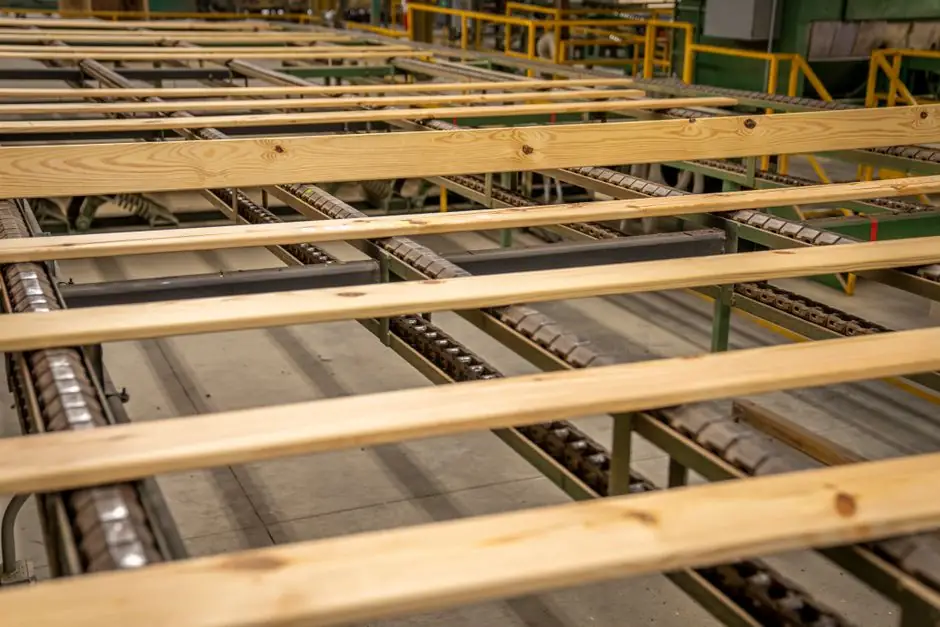
A gravity-sloped manual overhead conveyor is a hand-pushed monorail or enclosed-track system where the track itself is inclined and trolleys coast downhill under their own weight, with no drive chain in the free-flowing sections [S3][S5].
Typical rated load per trolley carrier sits in the 100 kg to 2,000 kg range (with systems rated up to roughly 5 tons / 4,410 lbs at the upper end), and the running speed on the gravity legs is generally held to 1–30 m/min when partially powered sections are added [S4][S5]. Common chain pitch options cover 150, 200, 250, 300, and 350 mm (6"–14"), with horizontal curve radii of 600, 700, 1000, 1200, and 1500 mm at 90°, 45°, 30°, and 15° [S5].
Slope Angle and Velocity Targets
Gravity conveyor slope commonly starts at a 5° minimum floor and is raised from there until loads overcome static friction but stay below unsafe terminal speed [S2]. On manual overhead tracks the same physics applies: the trolley's wheel bearings and the track surface friction set the breakaway force, and a heavier load (for example, a 1,000 kg paint rack) builds momentum quickly once moving, so heavier trolleys actually want a shallower grade than light garment hooks [S2][S5].
Skatewheel-style bearings and small trolley wheels need less slope than full roller conveyor lanes because wheel bearing losses are lower; the same logic carries over to overhead trolley wheels, which is why vendors publish grade recommendations per trolley series rather than per track [S2].
Track Section, Trolley, and Attachment Options
Manual overhead conveyor tracks are offered in I-beam, square tube, tubular, and enclosed C-rail (aluminum or steel) profiles, with bolted track connections to ease layout changes [S5]. Carrier models in the 150/200/250/300/350/400 family cover typical capacities from 5 kg hooks up to roughly 2,000 lbs per trolley, with the 4,410 lb figure representing the heavy-duty ceiling for the overall system rather than a single carrier [S4][S5].
Common chain-model identifiers for the trolleys include UH-5075, WF-350, WF-400, XF400, QXT150, QXT200, QXT250, and QXT300, and H/U/Y hanger attachments are the standard load interface for paint racks, garment hangers, and assembly carriers [S5]. Vertical curve options are tighter (30°/15° at 1000–2500 mm radius) than horizontal curves, which is why gravity-slope sections are usually routed on the straights and any level transitions happen at workstations [S5].
Where Gravity-Assisted Overhead Fits vs Powered Conveyor
Low-volume or "high-mix" production with relatively low value per load is where gravity-assisted manual overhead returns a better ROI than full automation: a paint line running 30–50 racks per shift does not justify a continuous power-and-free chain, but does justify an inclined monorail with brake posts at each station [S3].
Conversely, lines that require consistent cycle time, accumulation under power, or synchronized entry into ovens and wash booths usually upgrade at least the transfer segments with power chain conveyor or pneumatic pushers, keeping the gravity-slope legs for storage buffers between processes [S4][S5]. For heavier or longer-span lifts, a bridge crane section is sometimes integrated with the overhead track rather than stretching a single gravity run [S5].
Loading Capacity, Materials, and Environment
Standard capacities for manual overhead systems are 100 kg, 200 kg, 300 kg, 500 kg, 1,000 kg, 2,000 kg, and 5-ton ratings, and these map onto track profiles in the 21–27,000 series [S4][S5]. Track and trolley materials are typically zinc-plated mild steel for general paint and assembly lines, with 304/316 stainless offered for wash-down, food, and chemical environments [S4].
For higher-temperature zones such as batch cure ovens, the same manual track concept is used but the gravity-slope section is kept outside the oven envelope, and the trolleys are pushed or pulled through the heated zone on level track to keep the grade-driven speed predictable [S5]. Surface treatment and powder coating lines are the dominant application set, with finishing, assembly, and garment handling as secondary uses [S4][S5].
Layout, Curves, and Storage Buffers
Horizontal curve options at 90°, 45°, 30°, and 15° with 600/700/1000/1200/1500 mm radii let gravity runs wrap around columns and island workstations without resorting to transfer tables, and the 780–1000 mm horizontal-curve figure shown in some catalogs is the bearing-house clearance, not the centerline radius [S5]. Vertical curves are limited to 500, 600, and 800 mm rise at 30°/15° for the same reason: steeper climbs stall trolleys on the up-slope and accelerate them on the down-slope beyond the 30 m/min comfort limit [S5].
Trolley storage lanes between stations act as the gravity system's "accumulation zone": extra trolleys are parked on a short level or slightly up-slope spur so the downstream station can pull a loaded carrier without waiting for a chain indexer [S3][S5]. For ergonomic loading, drop sections lower the carrier to operator height, which is a common reason to keep the gravity-slope main line above head height and only drop at the workstations [S5].
Selection Criteria: Manual Overhead vs Alternatives
For a specifier choosing between (a) gravity-sloped manual overhead, (b) powered chain overhead, and (c) floor gravity roller conveyor, the four decision criteria are load mass, cycle-time consistency, span geometry, and capital cost per workstation [S1][S3][S5]. Gravity-sloped manual overhead wins on capital cost and floor-space clearance for loads up to 4,410 lbs in low-volume paint, finishing, and assembly lines; powered chain overhead wins where cycle time must be locked; and floor gravity roller conveyor lanes win for carton and tote flow at the same level, not for hanging loads [S1][S3][S4].
Within overhead conveyors specifically, the same criteria comparison holds for overhead conveyor enclosed-track versus I-beam: enclosed C-rail aluminum gives lighter trolleys and shallower gravity grades, I-beam steel gives higher capacity and easier field modification but heavier trolleys that want gentler slopes [S4][S5].
Standards, Maintenance, and Sourcing References

Manual overhead conveyors fall under general material-handling machinery practice rather than a single product-specific standard, so the design reference points are vendor catalogs (Webb-Stiles, PACLINE, Niko, Yuanda) and the dimensional tables in their literature libraries [S6][S7]. Maintenance load is described as minimal, with lubrication intervals set by the trolley wheel and track interface rather than by a chain drive, because gravity sections have no chain [S4][S5].
For parallel-spec reference, the same enclosed-track trolley hardware is shared with manual pallet jack wheels and bearings in lower-capacity ratings, and the overhead bridge crane form factor is the natural escalation path when spans exceed what a single inclined monorail can gravity-feed in one shot [S4][S5]. Buyers should request the vendor's full dimensional and lubrication sheet, confirm chain model and pitch against the trolley wheels being supplied, and verify whether the proposed gravity run can be partially motorized later without replacing the track [S7].
Trackable next signal: any 2026 vendor update that publishes a measured slope-vs-load chart for UH-5075 or QXT series trolleys would materially change how steep a gravity leg an integrator can safely specify for paint-line duty.
Background reading: Low-Level vs Medium-Level vs High-Level Order Picker: Spec-Based Selection.