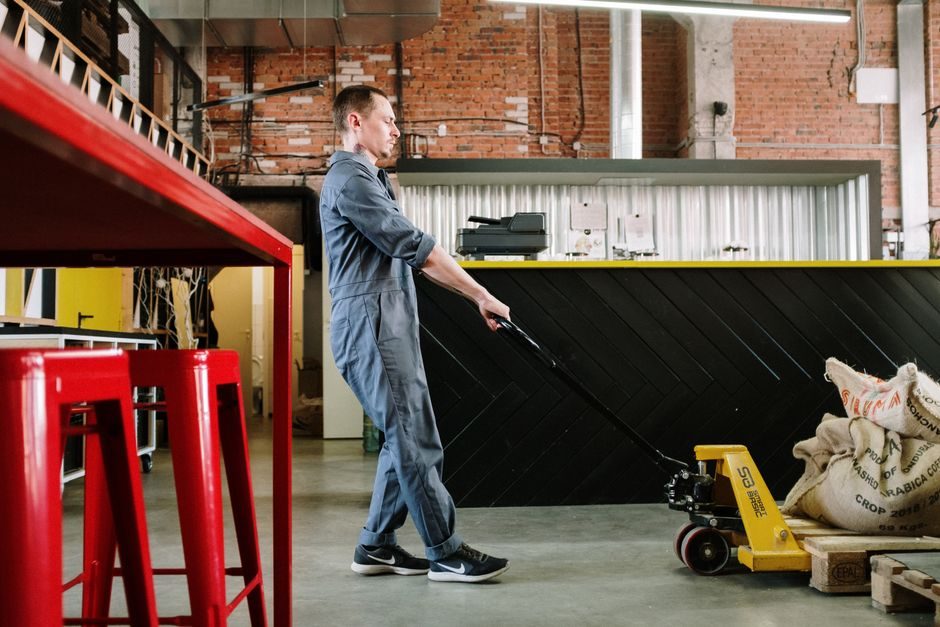
Manual pallet jack selection in 2026-06 is dominated by a 5,500 lb (≈2,495 kg) load class on 48×27 in forks with 3 in × 7.3 in max-lowered profile, the spec cluster most US distributors stock across Crown PTH, Dayton 493X19, Big Joe P33, and generic 48×27 in rebuilds [S4][S5][S6].
Buyers still walk the same five gates process engineers walked a decade ago — capacity, fork size, lowered height, lift stroke, and steer-wheel compound — but the failure modes have shifted toward polyurethane 95A wheel chipping on rough concrete and 200-series hydraulic cylinder seal blow-by after roughly 18–24 months of multi-shift duty [S2][S3].
Gate 1 — Rated Capacity, Fork Length and Fork Width
Most US-spec hand pallet trucks in active distribution are stamped at 5,500 lb (≈2,495 kg) and ship with 48 in long × 27 in wide forks, the GMA-style footprint that matches the dominant 40×48 in four-way block pallet found across grocery, 3PL, and light-industrial receiving docks [S5][S6]. Stepping down to 4,400 lb (≈1,996 kg) units is common for retail back-room and food-service applications, while 6,600 lb (≈2,994 kg) and 7,700 lb (≈3,493 kg) heavy-duty variants exist for steel coil and bagged-goods handling, typically with 48 in forks and 27 in or 33 in wide stance.
Fork length must be matched to the deepest pallet stringer the operation sees — 48 in covers standard GMA block, 60 in forks are specified for double-deep or automotive dunnage, and 72 in units are specials. Fork width (outside-to-outside) is the second decision: 27 in suits 40×48 in pallets, while 20.5 in narrow-gauge models are required for closed-flank European CHEP/EPAL pallets inside the same 800×1200 mm footprint class. A model code such as Crown PTH 50/55-series and Big Joe P33 5,500 lb designation collapses capacity, fork length, and fork width into a single SKU string, and reading that string is the fastest way to disqualify wrong units before RFQ [S1][S4].
Gate 2 — Lowered Height, Lift Stroke and Pump Geometry
The standard lowered fork height in 2026 distribution is 3 in (≈76 mm) for 5,500 lb / 48×27 in models, with 7.3 in (≈185 mm) maximum lift stroke giving a fully raised top-of-fork height near 10.3 in — enough to clear the bottom deck of a standard GMA block pallet and load a typical conveyor at receiving [S6]. Skid-low-profile applications (carton flow, dock plate loading) drop the minimum fork height to 2 in or even 1.6 in, but those units lose the 5,500 lb rating and typically fall back to 3,300–4,400 lb.
Pump geometry is a hidden cost lever. Standard 2-stage pumps lift 5,500 lb through full stroke in roughly 12–14 handle pumps, while the newer 1-stage or 3-stage options trade handle effort for stroke count. Tiller length, spring-back, and handle-arc-to-roller-distance determine whether a 5 ft 2 in operator can squeeze a full pallet into a 96 in aisle — a tighter turning envelope than any pallet stacker would require, which is why the manual jack persists at the back of the rack where stackers cannot follow.
Gate 3 — Steer Wheels, Load Wheels and Floor Compatibility
Wheel and roller selection is the most underestimated gate in 2026. The dominant spec is a polyurethane 95A durometer load wheel on a cast-iron or polymer hub, sold in the aftermarket as a direct-fit kit — Big Joe P33 with Durarun 95A poly load wheels lists near $74.40/ea at 2-pack and $82.67/ea single-unit at eBay distribution channels, which is also the price band at which most fleet operators will rebuild rather than replace the truck [S3]. Nylon (white) steer wheels are specified on smooth warehouse floors and noisy areas; polyurethane steer wheels (red/grey) are the all-rounder; rubber and cast iron are reserved for outdoor, contaminated, or rough-cast concrete floors.
Load-wheel diameter — 2.5 in, 3 in, or 3.3 in — determines how easily a loaded truck rolls over expansion joints and dock-plate edges. Larger-diameter load wheels reduce rolling resistance on rough floors but raise the minimum fork height by 0.3–0.5 in, which can disqualify a jack for low-clearance skids. Entry/exit rollers (tapered cones at the fork tip) determine whether the jack can be inserted into a damaged pallet without bending the roller pin — a real failure mode in recycled-pallet operations. Fleet managers running 30+ trucks on mixed floors should standardize on 3 in poly load + 7 in poly steer and accept the 3 in minimum fork as the design point.
Gate 4 — Hydraulic Circuit, Seals and Serviceability
Manual pallet jack hydraulics are dominated by a single-stage vertical plunger pump feeding a one-piece welded cylinder, with a release valve at the base of the handle. The chronic failure point is the polyurethane U-cup seal on the plunger — when it bypasses, the handle self-pumps back down under load. Rebuild kits including wiper seal, U-cup, O-ring, backup ring, and split retaining ring are stocked by dedicated parts suppliers, and the 30–45 minute teardown is a known shop-bench task [S2].
Serviceability — not initial price — separates the long-value tier from the disposable tier. Crown's PTH positioning explicitly claims "exceptional long-term value," "serviceability," and "durability" over a 10+ year service life, and the platform is designed around field-replaceable seals, hardened axles, and greaseable pivot points [S1]. Cheap import trucks (typically sub-$400 new) ship with non-serviceable welded cylinders and are designed to be scrapped at first seal failure, often inside 18 months. The total-cost math is straightforward: a $739.99 Dayton 493X19-class 5,500 lb manual jack [S5] rebuilt twice over a 10-year life costs less than three disposable imports scrapped in the same window.
Gate 5 — Handle, Tiller and Operator Ergonomors
Tiller geometry determines shift-long injury exposure. The standard 3-function handle (lift / lower / neutral) is now augmented on premium lines with a soft-return spring, an ergonomically wrapped rubber grip, and a hand-position gauge that limits wrist deviation. Handle pivot geometry — specifically the handle-arm-to-fork-tip ratio — sets the effort required to break a loaded pallet free from floor friction; a poor ratio is why some 5,500 lb units feel heavier than competing 6,600 lb trucks. [S1]
Operator-side gates that lock the spec: (1) minimum fork height matched to lowest receiving surface, (2) handle height comfortable for the 5th-percentile female operator (≈64 in standing elbow height), (3) steer-wheel tread compound matched to floor finish, (4) documented service-kit availability within 48 h, and (5) a verifiable ISO 9001 or factory QA certificate. A truck that fails any one of these gates is the wrong truck, regardless of nameplate capacity.
Manual vs Powered Pallet Truck: When the Manual Jack is Still Correct
The 5,500 lb manual jack remains the right answer when (a) throughput is below roughly 30 pallet moves per shift per operator, (b) trip distance is under 50 ft, (c) aisles are below 96 in, and (d) the operator is trained and the floor is smooth. The decision flips to an electric pallet truck — class I walkie or class III walkie-rider — when any of those thresholds is crossed, which mirrors the same gate logic in the 2026 electric pallet truck buying guide for capacity, battery, and drive class. [S2]
For vertical lift beyond 7.3 in, the manual pallet jack cannot do the job and a pallet stacker takes over — walkie stackers to 10–15 ft, rider stackers beyond that. The manual jack's role then narrows to ground-level spotting at the rack face, where its 360° turn radius and zero-battery architecture still beat every powered alternative on cost-per-move.
Sourcing, Total Cost and 2026-06 Distributor Snapshot
Channel pricing as of 2026-06 in the US market: new 5,500 lb / 48×27 in manual pallet trucks list from roughly $400 (import) to $750+ (Dayton 493X19, Crown PTH) at industrial distributors, with used units of the same class selling around $300–$500 depending on seal condition [S5][S6]. Aftermarket load-wheel kits for the Big Joe P33 class cluster at $74.40–$82.67/ea [S3]. OEM parts channels through dedicated specialists such as Pallet Jackson carry full seal kits, handle springs, steer axles, and tapered load rollers for the Crown, Big Joe, Dayton, and Raymond truck families [S2].
The selection criteria that actually move the spec sheet — capacity, fork size, lowered/lift height, wheel compound, and pump serviceability — are unchanged from prior years, but the 2026-06 buy-side shift is toward rebuildable platforms with stocked seal kits, not lowest first-cost imports. Buyers who lock those five gates before RFQ avoid the three most common field failures: bent steer axles from undersized wheels, seal blow-by from non-serviceable cylinders, and fork-tip damage from missing entry rollers on recycled pallets [S1][S2][S3].