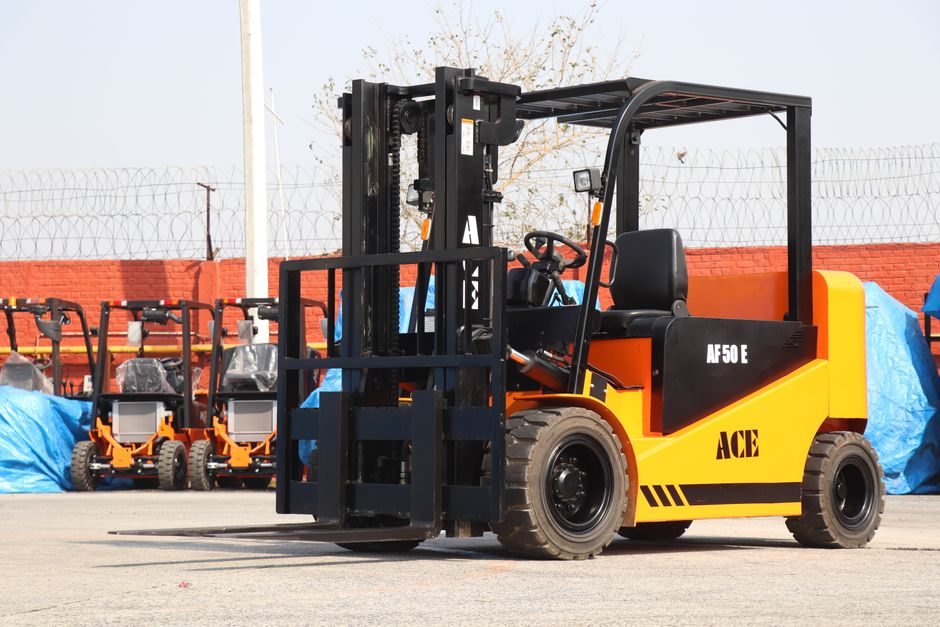
Jiangsu- and Anhui-based manufacturers dominate the export pallet-stacker market in mid-2026, with Nanjing Liftor Machinery listing industrial units at US$780-1,280 per piece on Made-in-China, while full-electric 1.5-2 tonne reach-stacker models from Maanshan Jieling International Trade price at US$2,500-5,500 per piece on the same portal [S2][S10].
Manual and semi-electric hand stackers hold the entry tier — NIULI Machinery in Guangdong markets the CTY-A manual hand pallet stacker, the CTD semi-electric stacker and the CTQD full-electric stacker as a three-model family on its product page [S3]. Battery-powered telescopic mini-reach forklifts at 1,500-2,000 kg capacity with 1,600-3,500 mm lift height are also listed as 2026 product offerings, indicating that mid-range electric stackers have moved into the mainstream catalogue tier rather than remaining specialty SKUs [S9].
Maker Clusters and Provincial Concentration
Changzhou Yi-Lift Material Handling Equipment (Wujin District, Changzhou, Jiangsu) identifies as a dedicated stacker manufacturer with lift tables and pallet truck lines, and lists a General Manager contact (Mr. Jerry Yang) on its Made-in-China storefront — a structural sign of mid-tier MHE OEM depth in the Yangtze delta [S6]. Maanshan Jieling International Trade (Maanshan, Anhui) supplies the full-electric 1.5-2 t reach stacker at US$1,900-4,500 wholesale, broadening the geographic spread beyond the Suzhou-Wuxi-Changzhou axis typical of Chinese MHE exporters [S10].
Nanjing Liftor Machinery Co., Ltd., operating as a Diamond Member and Audited Supplier with Secured Trading status on Made-in-China, lists industrial pallet stackers starting at US$780 per piece with a one-piece MOQ — a price floor that effectively defines the budget import segment for buyers sourcing FOB China [S2]. The 2,000+ manufacturer count on the Made-in-China pallet category (with 6,000+ products and a sub-segment that includes 87-plant-area plastic-pallet makers) shows how saturated the broader pallet-handling supplier pool has become, with stacker-only specialists operating inside that wider funnel [S8].
Price Band Tiers Across Drive Type
Across the 2026 sourcing pages, the price stratification by drive type is consistent: manual hand stackers such as the CTY-A sit at the bottom of the catalogue, semi-electric CTD-type models occupy a mid-band, and 1.5-2 t full-electric reach stackers span US$1,900-5,500 depending on mast configuration and battery spec [S3][S10]. A 1,000 kg hot-selling mini electric hydraulic hand stacker with remote-control lifting lists at US$1,900-4,500 per unit on the same platform, confirming that the US$2,000-4,500 band has become the default for full-electric 1 t-class stackers [S5].
The Shanghai-made reinforced fully-welded steel chassis with a 1.0 t rating and 3 m lift, paired with a high-efficiency cast-pump jack carrying a one-year manufacturer's limited warranty, is offered alongside heavy-duty iron steer wheels on a Made-in-China category page — a spec combination that maps directly onto the manual pallet jack / manual stacker crossover segment [S1]. For comparison, the cross-border Alibaba supplier pool for "pallet stackers" includes water-well drill rig and rock drill vendors that match the keyword, an artefact of the marketplace's search index rather than a sign of vertical specialisation [S4].
Spec Levers Buyers Actually Use
Three specs drive the price gap in this segment: capacity (1.0 t vs 1.5 t vs 2.0 t), lift height (1,600 mm entry vs 3,500 mm for telescopic masts), and drive type (manual / semi-electric / full-electric). The 1,500-2,000 kg class with 1,600-3,500 mm battery-powered telescopic lifting is now treated as a standard product family rather than a custom build [S9]. Reinforced fully-welded steel chassis construction is described as "durable yet light" by Shanghai MHE exporters, with cast-pump jacks backed by a one-year limited warranty — a baseline specification Chinese OEMs use to differentiate from cut-and-weld low-cost competitors [S1].
For buyers comparing 2026 sourcing options, the pallet stacker sizing logic flows directly from those three levers: load class, lift envelope, and power source. The electric pallet truck supplier map shares the same Jiangsu/Anhui cluster pattern, which means buyers running combined MHE RFQs can usually consolidate onto one or two vendor rosters. The pallet rack and pallet ecosystems also anchor on the same Yangtze-delta and Pearl River delta manufacturing belts, so freight consolidation is feasible for mixed-load MHE + racking shipments.
Quality Signals and Supplier Vetting
Made-in-China's audit-tier vendors (Diamond Member, Audited Supplier, Secured Trading) cluster around the Nanjing/Changzhou/Maanshan corridor, with ISO 9001:2015 certification explicitly listed on at least one Maanshan-based exporter's profile [S2][S10]. Response time of three hours or less is advertised by plastic-pallet vendors on the same platform — a service benchmark that has migrated to MHE category storefronts as a competitive lever [S8]. For buyers who need third-party verification rather than self-declared OEM claims, the Audited Supplier filter on Made-in-China is the practical shortcut; Alibaba's "Verified Supplier" pool remains noisier because keyword matches pull in unrelated categories like drill rig exporters [S4].
Total Revenue bands disclosed on Alibaba supplier pages (US$2.5-5 million for one pallet-fork-frame factory, US$5 million-plus for a wheel-loader/self-loading-concrete-mixer supplier) show that even adjacent MHE-adjacent factories operate at modest mid-tier scale, not the gigafactory tier — which means order lead times for full-electric stackers typically run 30-45 days FOB rather than the 7-day fulfilment some B2B platform banners imply [S7].
Who Should (and Should Not) Source From This Pool

Buyers running 1.0-2.0 t stacker fleets for warehousing, light manufacturing, or stacker crane feed positions are well served by the Jiangsu/Anhui cluster at the US$780-5,500 band. Operations needing ATEX/IECEx-rated explosion-proof stackers for chemical or paint lines, or cleanroom/ESD-rated units for semiconductor back-end, sit outside the standard Made-in-China catalogue tier and should expect custom-engineered SKUs with longer lead times and higher unit costs — a sourcing profile that overlaps with the semiconductor cleanroom stacker selection logic. The AS/RS sizing and selection workflow is the natural upstream step for any buyer evaluating walkie stackers against automated crane-based storage. [S1]
Trackable signals for the next sourcing cycle: new ISO 9001:2015 audit disclosures on Changzhou/Maanshan storefronts, any shift in the US$1,900-4,500 1 t electric band as lithium battery pricing moves, and whether Nanjing Liftor-type Diamond Members expand their MOQ from one piece to higher minimums as raw-material costs reset in Q3 2026.