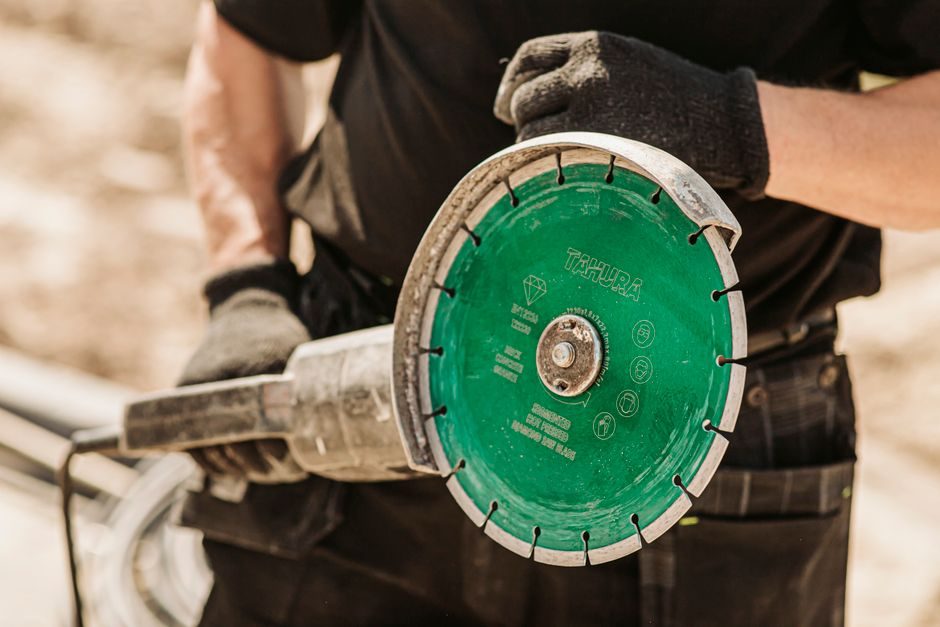
A marble cutter is the handheld or table-mounted power tool used to score, trim, and section natural stone in masonry fit-out — typically a 110-125 mm hand-held angle-grinder-format machine for trim cuts and a 350-450 mm bridge/rail saw for slab sizing.
For masonry trades — bathroom walls, kitchen tops, entrance halls, fireplace surrounds, external cladding — the selection logic is driven by stone type (marble, granite, limestone, engineered stone, porcelain), cut length per shift, and finish tolerance, not by brand loyalty. This spec map walks through the decision tree process engineers and stonemasons actually use on site [S1][S2].
Hand-Held vs Bridge Saw: Which Format Fits the Masonry Job?
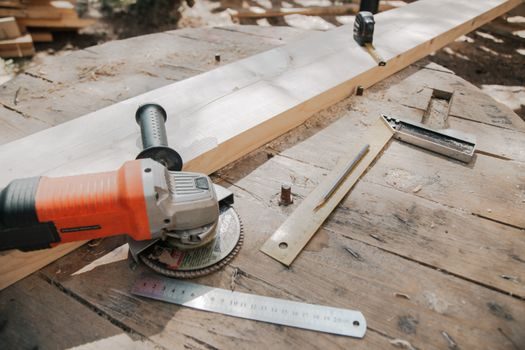
Hand-held marble cutters in the 110-125 mm / 1400 W class are the workhorse for vertical and overhead masonry cuts — chase walls, around sockets, mitres on window reveals, and trimming slabs on site before final placement [S3].
For horizontal slab sizing in a workshop or factory setting, a bridge saw (single- or 5-axis CNC) with a 350-450 mm diamond blade is the standard; it gives straight, repeatable cuts within ±1 mm tolerance over 3 m lengths and pairs with a CNC water-jet for curved cutouts [S1]. On small residential bathroom refits the hand-held tool handles 80% of cuts; on hotel-cladding or commercial kitchen projects the bridge saw does the sizing and the hand-held tool handles the final trim [S1][S2].
Blade Diameter, Motor Power, and RPM: The Hard Numbers
110-125 mm hand-held marble cutters typically run 11,000-13,000 rpm no-load with 1200-1400 W motors, and accept 20 mm or 22.23 mm bore diamond continuous-rim or turbo-rim blades [S3].
Bridge saws use 350-450 mm diamond blades at 2000-2800 rpm, driven by 15-22 kW spindle motors, with table travel typically 3.0-3.5 m in X and 2.0 m in Y. The 5-axis CNC variants add a rotational C-axis and 0-90° tilt A-axis for mitre and compound cuts on cladding panels [S2]. Choosing below 1100 W for a 125 mm blade on granite is a false economy — the blade stalls, the cut wanders, and segment life drops by a third on a typical 20 mm granite slab.
Wet Cutting, Dust, and On-Site Safety
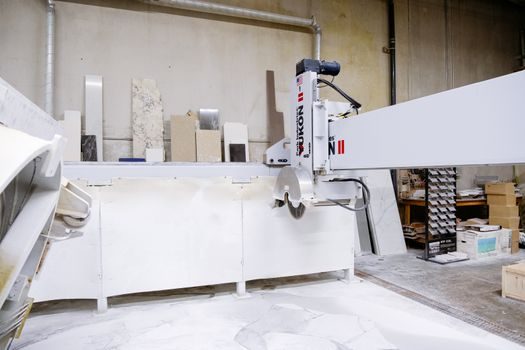
Wet cutting with a regulated water feed is the default for marble and limestone — it suppresses respirable crystalline silica dust, cools the diamond segment, and extends blade life by roughly 50% versus dry cutting on the same material [S1].
Dry cutting is reserved for quick trim cuts where a water feed is impractical (overhead, external facade at height) and only with a continuous-rim blade rated for dry use, plus an M-class or H-class dust extractor coupled to the tool. On engineered stone and porcelain, which have low porosity, wet cutting is essentially mandatory to avoid segment glazing. Always specify an RCD (residual current device) on the supply when wet cutting indoors — a 30 mA RCD trips before a lethal earth fault develops on a wet floor [S1].
Material Matching: Marble, Granite, Limestone, and Engineered Stone
Marble (Mohs 3-4) and limestone (Mohs 2-3) cut cleanly with a standard continuous-rim diamond blade and modest feed pressure; granite (Mohs 6-7) needs a turbo-rim or segmented blade and 30-40% slower feed to keep segment temperature down [S1].
Engineered stone and porcelain are abrasive and dense — a dedicated hard-material blade with a softer metal bond is specified, otherwise the segment polishes over and stops cutting. For a single-machine shop that cuts all four, the practical answer is one hand-held cutter with two blades (one continuous-rim for marble/limestone, one turbo-rim for granite) plus a bridge saw with a hard-material blade for engineered stone tops. The marble cutter selection for demolition: 110-125mm 1400W spec map is a useful parallel read when the same tool is being specified for chop-saw duty on masonry walls rather than trim.
Comparison: Hand-Held 125 mm vs Bridge Saw 400 mm vs 5-Axis CNC
For masonry fit-out the three formats compare as follows on the criteria that actually drive the purchase decision: cut depth (single pass), tolerance, productivity, and capital cost.
A 125 mm hand-held cutter delivers roughly 30-35 mm depth of cut, ±2 mm tolerance over 1 m, and 8-12 linear metres per hour on 20 mm marble — at a capital cost under $300 for the tool and blade. A 400 mm bridge saw delivers 130-150 mm depth, ±1 mm over 3 m, and 15-25 linear metres per hour — capital cost runs $15,000-40,000 depending on CNC fit. A 5-axis CNC bridge saw adds mitre and curved cut capability, 0-360° rotation, 0-90° tilt, and 20-40 linear metres per hour on programmed cuts — capital cost $50,000-120,000 [S2]. For a residential masonry contractor doing 2-3 bathrooms a month, the hand-held tool is the rational spec; for a commercial stone fabricator doing hotel cladding, the bridge saw or 5-axis CNC pays back inside 12 months on labour alone.
Failure Modes and Limits You Should Plan Around
The three failure modes process engineers see on stone-cutter fleets are: blade segment loss (overheating from dry cutting or wrong blade for material), motor brush wear (running the tool at stall for more than a few seconds), and bearing failure (water ingress through a degraded seal on wet-cut machines) [S3].
Hand-held cutters are not a substitute for a bridge saw on long straight cuts — operator fatigue and the natural drift of a hand-guided blade produce wavy joints that show up under raking light on a polished marble wall. Conversely, a bridge saw cannot reach a chase cut in an existing masonry wall without dismantling the surround, which is why every masonry team keeps at least one hand-held marble cutter on the van at all times [S1][S3].
Standards, Sourcing, and What to Verify Before Purchase

For European supply, hand-held marble cutters should carry a CE mark under the Machinery Directive and, for site use, comply with the EN 60745 series for hand-held motor-operated electric tools; dust extraction should meet EN 60335-2-69 Class M for silica-bearing stone [S1].
For OEM/ODM sourcing of stone cutting machinery, Chinese manufacturing hubs (Fujian, Shandong) list 5-axis CNC bridge saws alongside the standard marble cutter ranges, with bridge saws being the dominant product category on factory listings [S2]. For trim-cut tools the JD8409-class 110-125 mm machines remain the volume sellers, with negotiable MOQ and typical motor powers in the 1200-1400 W band [S3]. On the procurement side, the practical checklist is: confirm blade bore size (20 mm vs 22.23 mm), verify no-load RPM matches the blade rating, check the spindle lock fits a standard wrench, and confirm the carbon brush cap is user-serviceable without tool disassembly.
Next signal to track: BS 8500 updates on silica dust exposure limits and the Machinery Regulation (EU) 2023/1230 transition from the old Machinery Directive — both will tighten on-site dust extraction requirements and force spec changes on dry-cut marble cutters over the next 24 months. For a broader industrial site spec context beyond stone cutting, the dry-mix mortar selection for industrial facilities: 2026 spec map covers the bedding mortar that the cutter is trimming against.
The underlying component specifications are covered under plasma cutter, and rebar cutter.