
A handheld 115 mm marble cutter spinning at 14,000 RPM no-load delivers 34 mm max depth per pass — the typical spec for trimming asphalt patches and scoring concrete curbs in spot road repair [S6]. For full-width pavement cutting on road maintenance, the tool class shifts toward walk-behind concrete saws and dedicated road cutters, not handheld marble saws.
Road maintenance under U.S. Forest Service T-800 series permits centers on ditch cleaning (T-802), surface blading (T-803), dust abatement (T-806), roadway vegetation (T-807), and waterbars (T-809) — activities dominated by motor graders, dust palliatives, and shoulder work rather than slab cutting [S1]. Where a cutter is genuinely required — joint resealing, patch cutting, concrete culvert headwall trimming — the spec map below applies. For a broader tool reference see the marble cutter encyclopedia entry.
When a Marble Cutter Fits the Road-Maintenance Scope
Handheld electric marble cutters (115-180 mm blade class) are specified for three road-adjacent tasks: trimming the edges of asphalt patches to a clean vertical face before tack-coat and infill, scoring concrete curbs and gutters for partial-depth removal, and cutting opening windows in concrete manhole rings and culvert headwalls during drainage-structure repair [S1][S5].
Typical spec envelope for this duty: 1200-1500 W input, 220-240 V / 50-60 Hz, 2.5 kg bare-tool weight, 115-180 mm diamond blade, 34-60 mm max cutting depth per pass, no-load speed 12,000-14,000 RPM [S6][S9]. Continuous-feed water is the default dust-control method on road sites; IP67 sealed motor housings and stainless-steel-race sealed bearings are the differentiating build feature for wet-cut road work [S7].
When It Does NOT Fit — Route to the Right Machine Class
For full-lane asphalt or concrete cutting deeper than ~60 mm, a walk-behind road cutter or self-propelled floor saw with 350-500 mm diamond blade is the correct class — handheld marble saws physically cannot reach the depth in one pass and the operator cannot control a 400 mm blade safely at hand-arm power levels [S2][S6].
Routine blading, reshaping of the traveled way crown, inslope/outslope correction, and dust-palliative application on aggregate-surfaced roads are not cutting tasks at all — these are motor-grader and water-truck operations governed by T-803 Surface Blading and T-806 Dust Abatement, and no spec of marble cutter will substitute [S1][S2]. Long-reach vegetation work along roadsides is a brush-mower or excavator-mower task, not a cutter task. If the maintenance item is "ditch cleaning" or "waterbar rebuild," the answer is an excavator or grader, not a diamond saw.
Selection Criteria — Side-by-Side Comparison
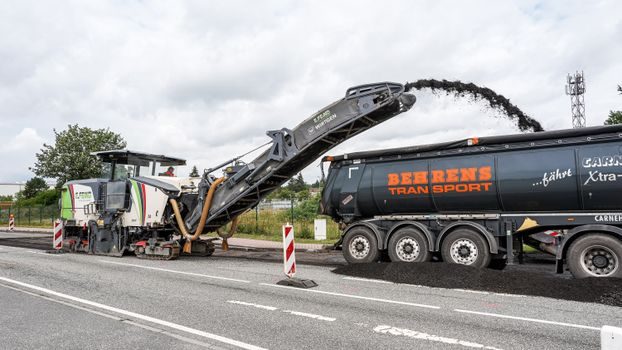
Across the duty envelope a road maintenance buyer faces four decision axes, lined up against three machine classes: [S1]
1) Cutting depth per pass: 115 mm handheld = 34 mm, 180 mm handheld ≈ 60 mm, 350-500 mm walk-behind road saw = 120-195 mm [S6][S9]. 2) Power source: 1500 W corded 220-240 V mains for handheld, 9-25 HP gasoline or 7-15 kW diesel for walk-behind — corded handheld is the only practical class for indoor or confined-trench work where exhaust is unacceptable. 3) Dust / water management: IP67 wet-cut rating plus continuous water feed is mandatory for handheld on road concrete; dry-cut handheld is restricted to short asphalt trim work with vacuum extraction. 4) Mobility: handheld at 2.5 kg is a one-person carry-on; walk-behind road saws are 80-200 kg and need a tail vehicle or trailer [S7][S6].
The spec-to-task map narrows quickly: spot patch trimming inside a 60 mm lift → 115 mm handheld; culvert headwall windowing up to 60 mm → 180 mm handheld; full-depth asphalt or concrete slab cutting on a lane closure → walk-behind road saw, not a marble cutter. For a deeper dive on concrete-side use, see Choosing a Marble Cutter for Concrete Cutting Work.
Blade, RPM, and Power Specs That Drive the Decision
No-load speed below 12,000 RPM is a reject threshold for road concrete — the diamond segment clears less material per revolution and the blade walks off the cut line, leaving a tapered patch edge that fails the tack-coat bond [S5]. The 14,000 RPM figure on the Ronix 3411 spec card is a typical mid-market data point; the 1500 W input at 220-240 V delivers the torque margin needed to hold RPM under load when the blade enters aggregate [S6].
The Ideal MCH180 7-inch (180 mm) unit ships as a 1520 W corded saw with diamond blade, positioned at the upper end of the handheld class for road patch and culvert trim [S9]. The 180 mm format gives roughly 60 mm depth — close to a typical asphalt patch lift in a single pass on thin overlays. For a related power-tool spec walkthrough, see Aluminum Alloy Selection for Construction: 2026 Spec Map.
Failure Modes, Acceptance Criteria, and When to Replace
Symptom: blade glazing (polished segments, slow cut, blue discoloration). Root cause: insufficient feed pressure or wrong blade for material — typically a continuous-rim blade run on hard aggregate. Action: dress the segment with a dressing stone, switch to a segmented or turbo blade, or replace if segment wear exceeds 1.5 mm above the steel core. Acceptance: cut time returns to rated mm/min for the material. [S7]
Symptom: wandering cut, tapered edge, chip-out on the exit side. Root cause: low no-load RPM, side load on the blade, or warped flange. Action: verify no-load ≥ 12,000 RPM, replace outer flange if runout exceeds 0.1 mm, reduce lateral pressure. Acceptance: cut face is square within 2 mm over 60 mm depth [S5][S6]. Symptom: water ingress, switch failure, bearing seizure. Root cause: IP rating below site requirement, or seal damage from dry-running after water-feed failure. Action: replace the tool if the motor housing is not IP67-rated for wet-cut road work; on IP67 units, replace the input seal and re-test. Acceptance: 5-minute no-load run with water feed shows no leakage past the seal [S7].
Replace, do not repair, when armature continuity fails, when the carbon-brush holder is heat-discolored, or when the gearbox housing shows cracking around the spindle bearing seat — these are out-of-tolerance for a 2.5 kg handheld class where rebuild cost approaches new-tool cost. Escalate to a walk-behind road saw class when the required depth exceeds 60 mm, the run length exceeds ~3 m per cut, or the work is in a live traffic lane requiring a vacuum-extracted, walk-behind enclosure for operator silica exposure control.
Sourcing, Standards, and Where the Catalog Fits
Spec sheets for road-suitable handheld marble cutters consistently publish the same envelope — 1500 W class, 115-180 mm blade, 34-60 mm depth, 14,000 RPM no-load, 2.5 kg, IP-rated wet-cut variants — across OEM catalogs and OEM/ODM factory listings [S6][S7][S9]. The factory-direct ODM channel (for example the granite marble cutter OEM/ODM manufacturers index on Made-in-China) lists 5-axis cutting machines, bridge saws, and stone profiling machines alongside handheld units, but the road-maintenance buyer should stay on the handheld 115-180 mm tier rather than the stationary stone-fab tier [S3].
No single ISO or EN standard governs the marble cutter as a product class for road work; the relevant rules are operator-side: employer dust-control duties under national silica and vibration regulations, water-feed or vacuum-extraction on concrete cutting, and the road authority's lane-closure and flagger spec on the permit (e.g. USFS T-800 series defines the maintenance activity, not the tool) [S1][S2]. Verify the cut spec against the project engineer's patch detail (lift thickness, vertical-face tolerance) before selecting a 115 mm vs 180 mm handheld, and route any cut deeper than 60 mm to a walk-behind road saw. Track two signals on the 2026-08-03 sourcing cycle: IP67 wet-cut handheld stock at 1500 W / 180 mm tier, and walk-behind 350-500 mm diesel road-saw availability for the next full-depth pavement cut cycle.
The underlying component specifications are covered under plasma cutter.