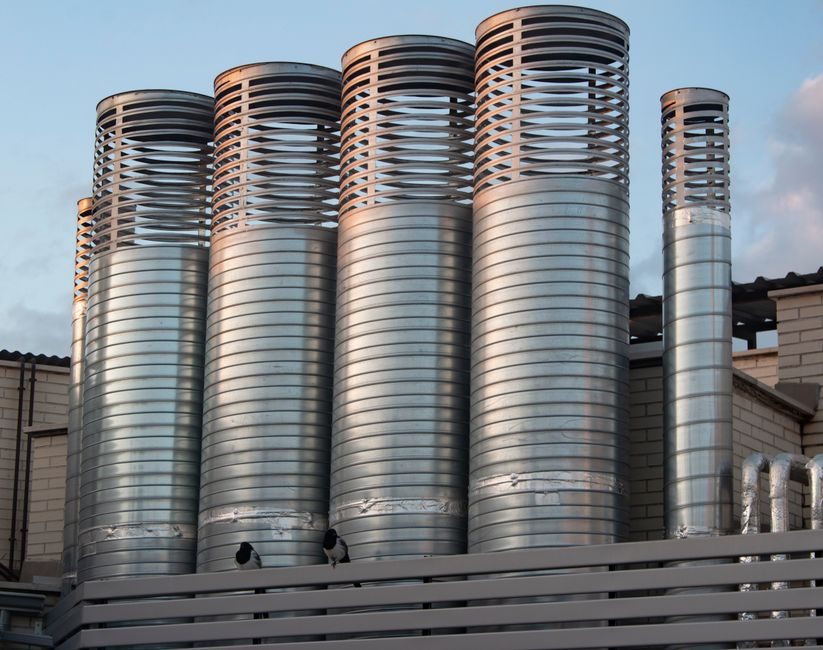
Construction-grade aluminum alloy choice in 2026 still pivots on the 6xxx series (Al-Mg-Si) for extruded profiles and the 5xxx/3xxx series (Al-Mg, Al-Mn) for sheet and cladding, because each family sits inside a different extrusion-speed, weldability, and strength window [S8].
Specifying engineers should treat alloy selection as a four-axis decision — strength requirement, exposure class, joining method, and surface finish — rather than a one-line material call-out, since a wrong grade on a coastal façade or a fire-rated curtain wall produces failures that do not show until the second or third service year [S4].
Where 6063, 6061, and 5xxx Sit in a Construction Bill of Materials
The 6063 alloy dominates architectural extrusion because its hot-deformation behaviour allows die-outflow speeds roughly in the 10–60 m/min band on modern presses, against tighter 2–5 m/min ceilings typical for higher-allyed 2xxx and 7xxx grades [S8]. That speed window is the reason window, door, and curtain-wall profiles default to 6063-T5/T6 rather than to 6061, even though 6061 can carry higher service loads [S4].
For load-bearing elements — façade brackets, scaffold components, formwork beams, structural ladder rails — 6061-T6 is the usual upgrade, with typical tensile strength in the 290–310 MPa range and yield above 240 MPa, well above 6063-T5 at roughly 145 MPa yield [S4]. When the section is welded rather than mechanically fastened, the 5xxx series (5083, 5086, 5754) becomes the default sheet and plate choice because Al-Mg solidifies without the hot-short cracking that hits the heat-affected zone of 6xxx extrusions [S3].
Welding, Corrosion, and Fire Behaviour by Family
Friction-stir welding trials on aluminum alloys show tool rotation rate and active cooling directly govern grain size in the stir zone, which in turn controls HAZ softening on 6xxx extrusions — the practical lesson is that 6061-T6 joints need either FSW or a re-heat-treatment step after fusion welding to recover the T6 temper [S1]. For marine-grade assemblies, ANSI/AWS D3.7-2004 remains the cited guide for aluminum hull welding, covering filler selection, joint preparation, and distortion control for 5xxx and 6xxx base metals [S5].
Corrosion behaviour tracks the alloying element: 5xxx grades in marine atmospheres outperform 6xxx grades because Mg stays in solid solution, whereas the Mg2Si precipitates that give 6xxx its strength can sensitise and promote intergranular attack in aggressive chloride exposure [S3]. On façades above 30 m elevation in coastal zones, specifying 6063 with a PVDF or anodised finish is common practice; the underlying alloy is rarely changed because the surface system, not the bulk alloy, is the corrosion barrier [S4].
Fire performance is set less by alloy and more by system design: aluminum melts at approximately 660 °C and loses meaningful strength above 200–250 °C, so fire-rated assemblies rely on gypsum, mineral wool, or intumescent layers around the aluminum window and door frames rather than on a special alloy.
Selection Criteria Comparison: 6063 vs 6061 vs 5xxx vs 1xxx

On the four decision axes that drive a construction spec, the families line up as follows. (1) Strength: 6061-T6 (≈290 MPa UTS) > 5xxx-H116 (≈275–305 MPa) > 6063-T6 (≈215 MPa) > 1100-O (≈90 MPa) [S4]. (2) Extrudability / die-outflow speed: 6063 (10–60 m/min) > 6061 (≈3–10 m/min) > 5xxx (not extrudable in complex profiles) > 1xxx [S8]. (3) Weldability by fusion methods: 5xxx (excellent) > 6061/6063 (good, with HAZ softening) > 1xxx (excellent, low strength) > 2xxx/7xxx (poor, hot-cracking) [S5]. (4) Coastal corrosion without surface treatment: 5xxx > 6xxx > 1xxx; 2xxx and 7xxx are the worst performers in chloride atmospheres [S3].
For most curtain-wall, aluminum window and door, and decorative-trim applications, the 6063 vs 6061 question collapses to a strength-versus-speed trade: if the die can be run above ~15 m/min and the calculated section modulus clears the wind load, 6063-T5/T6 wins on cost per kilogram; if the section is a thick-walled mullion or a sun-shade blade above 3 m, 6061-T6 is the safer call [S4].
Castings, Formwork, and Non-Extruded Construction Items
Where the product is a casting rather than an extrusion — access covers, hardware, scaffolding couplers, decorative end caps — Al-Si alloys such as A5, AK7, AMg10, and VAL10 are the working set, and the riser-insulation choice for the foundry is governed by the Pilling–Bedworth ratio of the alloying elements to keep diatomite-based unshaped insulation from breaking down into the melt [S3]. AMg10 (≈10% Mg) sits at the high end of the 5xxx cast spectrum and is specified where impact toughness after T6 heat treatment is required.
For concrete formwork and shoring, aluminum ladder rails, and modular scaffolding, 6061-T6 tube and sheet remain the dominant choice, and Chinese OEM/ODM lines routinely quote 0.5–20 mm wall-thickness aluminium construction profile at 1,000–1,400 USD per ton FOB for 6xxx grades [S7]. Heatsink-style aluminium tubes used as structural members — increasingly common in light-frame architecture — quote at 650–750 USD per ton at the same source, indicating the cost spread between commodity and engineered 6xxx extrusions is narrow enough to be overridden by section complexity and tolerance, not alloy family [S7].
What This Means for Spec Writing and Sourcing
Two practical rules keep a 2026 construction spec defensible. First, name the temper, not just the alloy: "6063-T5" and "6063-T6" carry different strength, elongation, and surface-hardness values and are not interchangeable on a curtain-wall line. Second, separate the alloy call-out from the surface call-out — a coastal 6063-T5 mullion with a 25 µm anodised layer will outlast an inland 6061-T6 mullion with no finish, and the spec should read that way on paper [S4].
For non-structural cladding skins, aluminum veneer panel products typically use 3003 or 3004 (3xxx) or 5005 (5xxx) sheet because paint adhesion and roll-forming behaviour are the controlling properties, not tensile strength. Where architectural panels are recycled-content, a 1xxx or 3xxx base will hit a higher post-consumer recycled fraction than 6xxx, which is one reason aluminum alloy sourcing in 2026 is starting to show 3xxx sheet specified for visible façade panels on green-rated projects.
Trackable signals for the next planning cycle: friction-stir welding line throughput for 6xxx extrusions, the push of higher-strength 6082-T6 into Asian and EU curtain-wall catalogues, and the share of 5xxx plate replacing 6xxx plate in coastal infrastructure — each of these will be the first place a 2027 spec refresh shows a material change. For an aerospace cross-reference, see the related 2xxx/7xxx selection map; for a marine cross-reference, see the stainless-steel grade map.
This topic is covered further in Screw Conveyor Selection for Air Cargo: Spec Map.