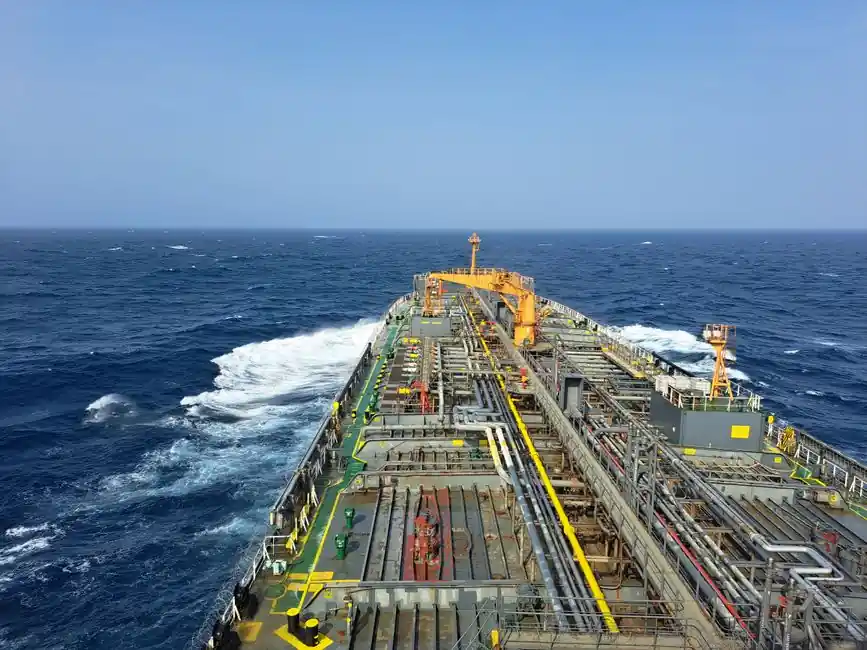
Marine diaphragm valves isolate process media from the bonnet and actuator, providing tight shutoff with no stem packing leakage in freshwater, ballast, bilge, chemical-dosing, and cooling services [S2][S3].
The weir-type, also known as saddle-type, diaphragm valve is the most widely used type, so the body pattern should be selected according to the application and other valve requirements.
Body Pattern Determines Flow and Sealing Performance
Weir-type diaphragm valves use a ridge-shaped weir and have a short stroke.
The detailed trade-off is covered in Weir vs Straight-Through Diaphragm Valve: Body Pattern Decision Guide.
Match the Valve to the Marine System
Their wetted separation reduces stem leakage risk, which matters with hazardous, corrosive, or sterile media, while elastomer construction also suits slurries and particulate-bearing fluids [S2][S3].
That makes them a practical option for fire-main isolation where positive closure and limited actuator travel are priorities. The fire-main system still requires separate verification of pressure class, end connection, certification, and compatibility with the specified fire-water chemistry.
Do not select a diaphragm valve solely because it is corrosion resistant. A seawater-exposed body, bonnet, stem, fasteners, and handwheel can create a galvanic pair even when the diaphragm itself is suitable. Marine service must be assessed for chloride pitting, crevice corrosion, vibration, shock loading, limited maintenance access, and restricted installation space [S5].
Compare the Main Options by Decision Criteria
Specify the Wetted Materials Before the Actuator
Material selection must be based on fluid composition, concentration, temperature, pressure, and cycle life rather than on a generic seawater label. A PTFE diaphragm, for example, requires attention to deformation under differential pressure and should not be treated as a universal elastomer replacement.
Body materials are selected for corrosion and mechanical loading. The Saunders range includes A-type, WFB-type, and KB-type diaphragm valves, with sections covering body and diaphragm materials, reinforced diaphragms, dimensions, weights, standards, valve ratings, and flow coefficients. For marine specification, request the exact body material, trim set, diaphragm reinforcement, and fastener grade rather than accepting a generic corrosion-resistant description.
A diaphragm valve may be actuated by a manual handwheel, pneumatic actuator, or electric actuator.
Pressure, Temperature, and Life Are One Selection Problem
Flow capacity should be checked using the manufacturer's Cv or Kv data and the valve model, diaphragm, and end connection. The Saunders brochure contains sections on Cv and Kv flow coefficients for A-type valves, Cv and Kv flow coefficients for KB valves, and large valve sizes DN400, DN450, and DN500. Use the exact size and configuration, not a generic DN-to-Cv conversion, especially where fouling, slurry, or throttling changes the valve coefficient.
Cycle life depends on diaphragm compound, reinforcement, stroke, closing pressure, and service medium. Reinforced diaphragms are used to extend life in abrasive or corrosive applications [S4]. Specify expected starts per hour, daily cycles, total operating years, and whether the valve is expected to modulate or remain a tight on/off device.
Marine Construction, Connections, and Approval
Marine valves must tolerate continuous vibration, shock loads, limited space, and restricted maintenance access [S5]. End connections may be screwed, flanged, or welded [S4]. Flanged valves need the specified facing, gasket, bolt material, and flange standard; welded valves need compatible weld procedures and corrosion allowance; screwed marine connections need an assigned pressure rating and thread sealing method.
Approval requirements depend on the vessel, service, and governing authority rather than on the generic word marine. Classification-society approval may be required, with DNV and BV identified as examples of marine certification routes [S5]. A fire-main valve may also need the project-specific fire-safety approval, while PED and CE marking are separate product regimes shown in the Saunders documentation [S4]. Do not treat CE marking as evidence of ship classification approval.
Marine construction should also address galvanic isolation of dissimilar metals, bonnet sealing, actuator positioning, manual override, and accessibility of diaphragm replacement parts [S5]. The diaphragm valve construction separates the bonnet from the process medium, but exposed bonnet, stem, handwheel, and fasteners still require a defined environmental class.
Limits and Failure Modes to Control
The most important design limit is the mismatch between the diaphragm compound and the service. Swelling, embrittlement, chemical attack, or excessive permeability can shorten life even when the body material is satisfactory [S2]. PTFE is highly chemical-resistant, but its mechanical behavior and deformation under pressure must be checked against the valve geometry and operating condition.
A second limit is pressure loss. The raised weir in a weir valve and the corner in an angle valve both create resistance relative to a straight-through path [S3]. A third limit is actuator capability: straight-through valves require a longer closing travel, and throttling service requires enough actuator travel and positioning resolution for stable control [S3].
Marine vibration can loosen components if the installation arrangement does not restrain the actuator and piping [S5]. A fourth practical failure mode is inaccessible maintenance. A compact valve that cannot be opened without removing adjacent equipment should not be accepted for a duty with scheduled diaphragm inspection.
Build the Marine Purchase Specification
A complete marine diaphragm valve schedule should state valve tag, service fluid, design and working pressure, design temperature, nominal size, body and diaphragm material, body pattern, flow direction, end connection, actuator type, fail action, control characteristics, Cv or Kv, diaphragm cycle rating, approved coating, dimensional envelope, vibration requirement, and required ship or fire-system approval [S1][S2][S4].
Shortlist a weir type for throttling or tight shutoff, a straight-through type for minimum pressure drop, an angle type for a required 90-degree turn, and a full-bore globe pattern for high-load capacity where its greater complexity is justified [S3]. For actuator sizing and marine system integration, compare pneumatic, electric, and manual operation against available power, fail-safe behavior, maintenance access, and control accuracy [S2].
The final selection gate is straightforward: verify the exact valve model against the required Cv or Kv, working pressure, temperature, diaphragm compound, corrosion class, end connection, and certification. Track the selected model's flow coefficient and diaphragm replacement interval in the vessel maintenance system, with the manufacturer model and material grade recorded against the valve tag [S4].