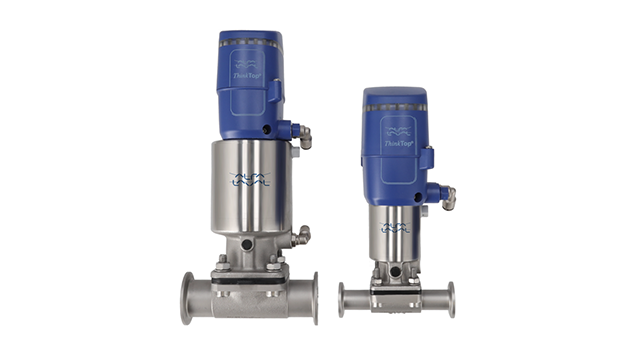
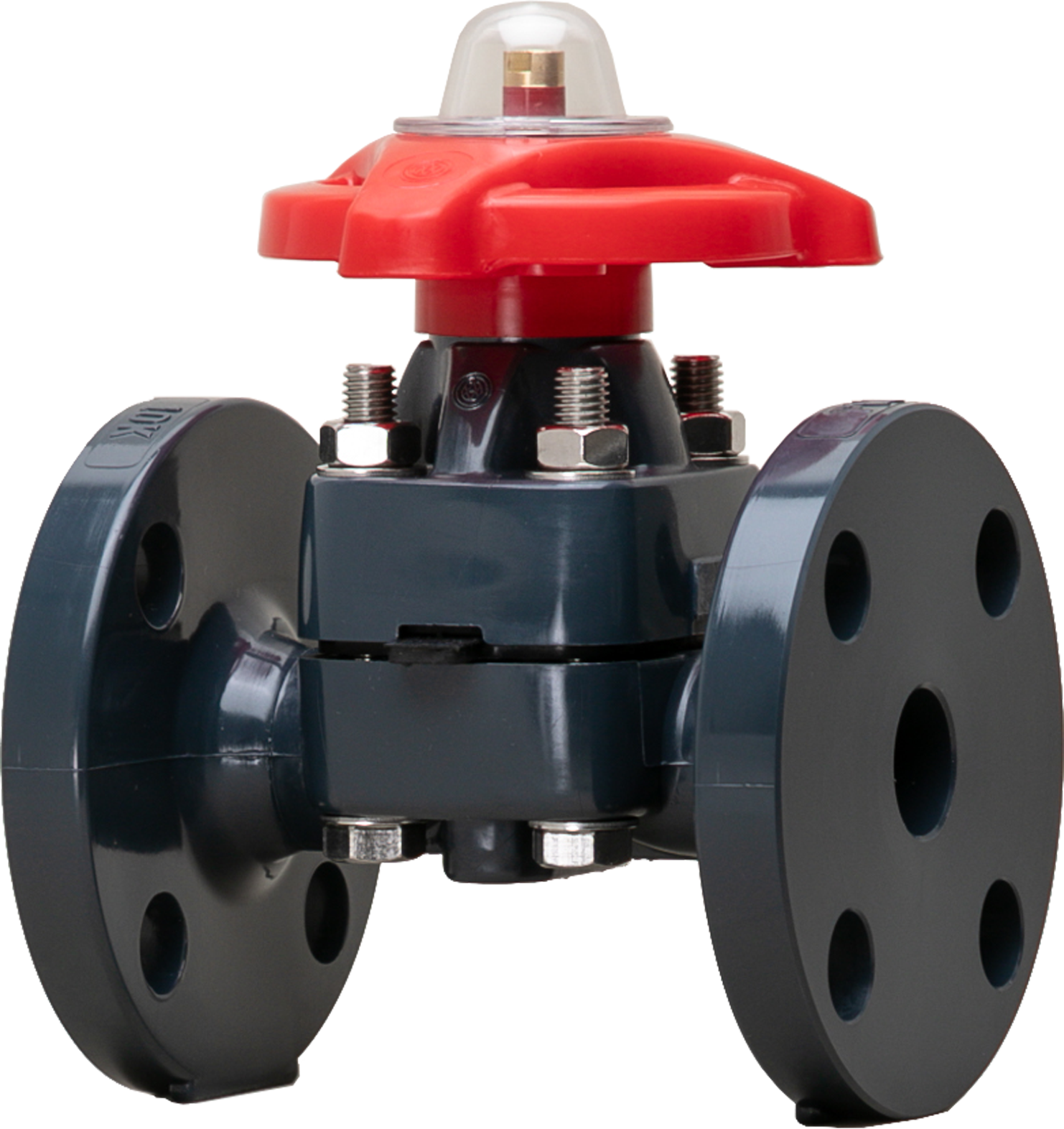
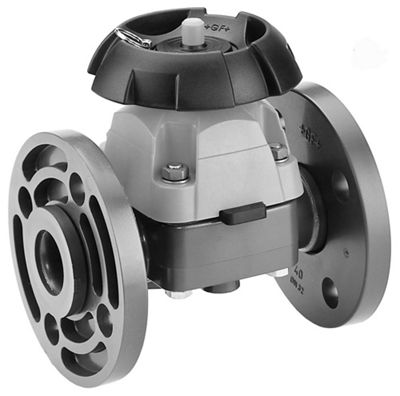
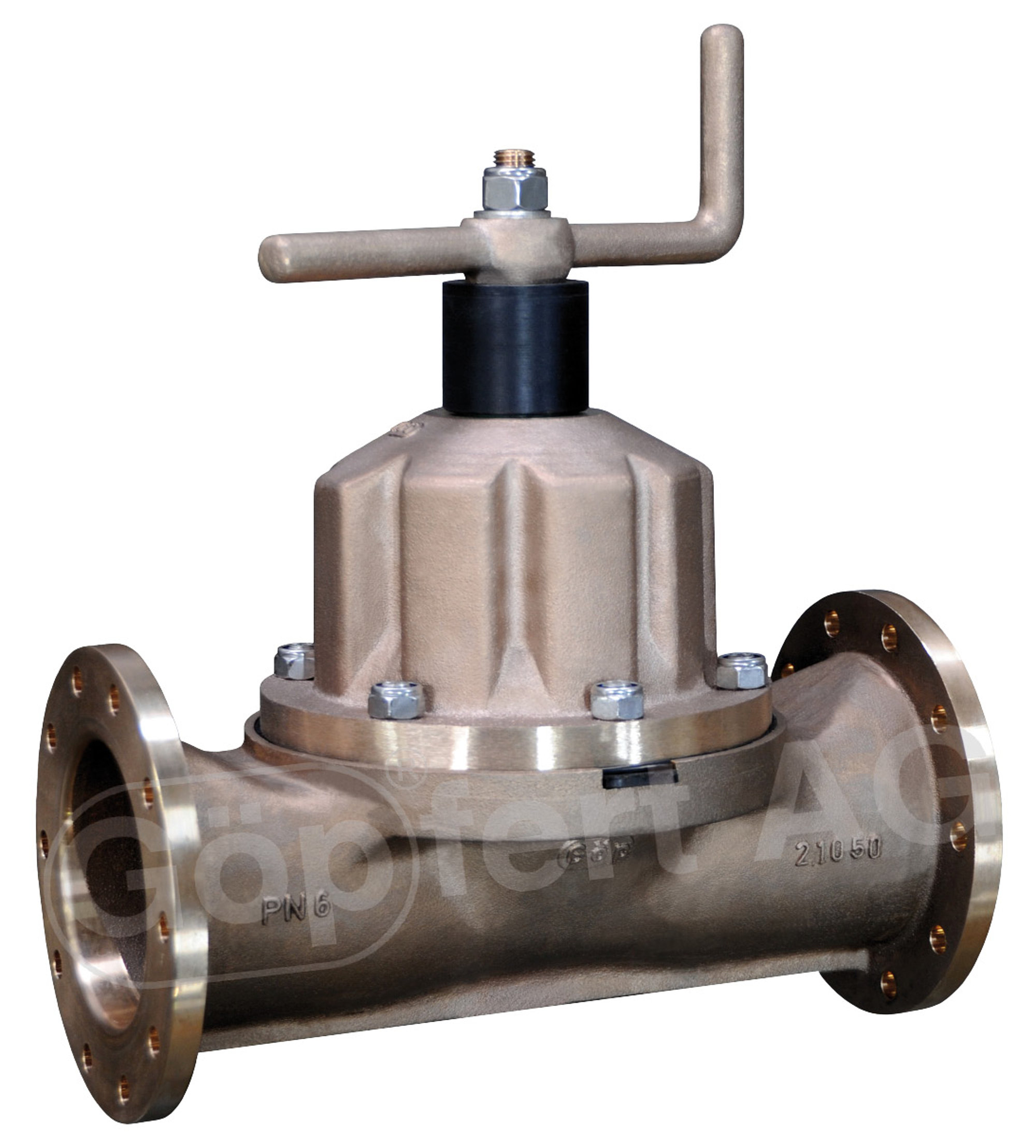
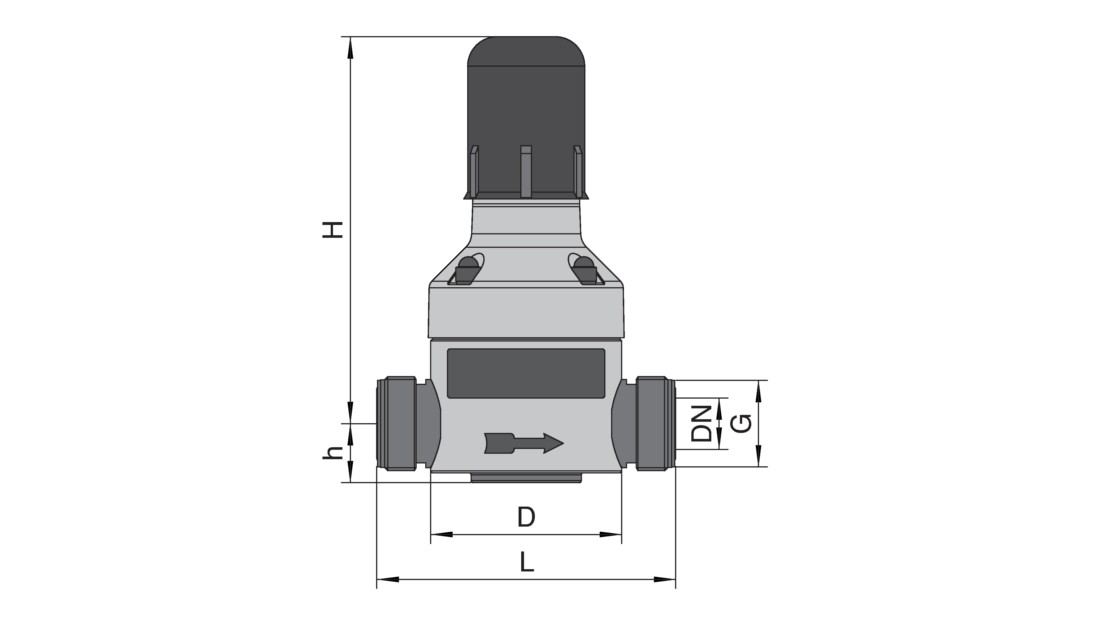
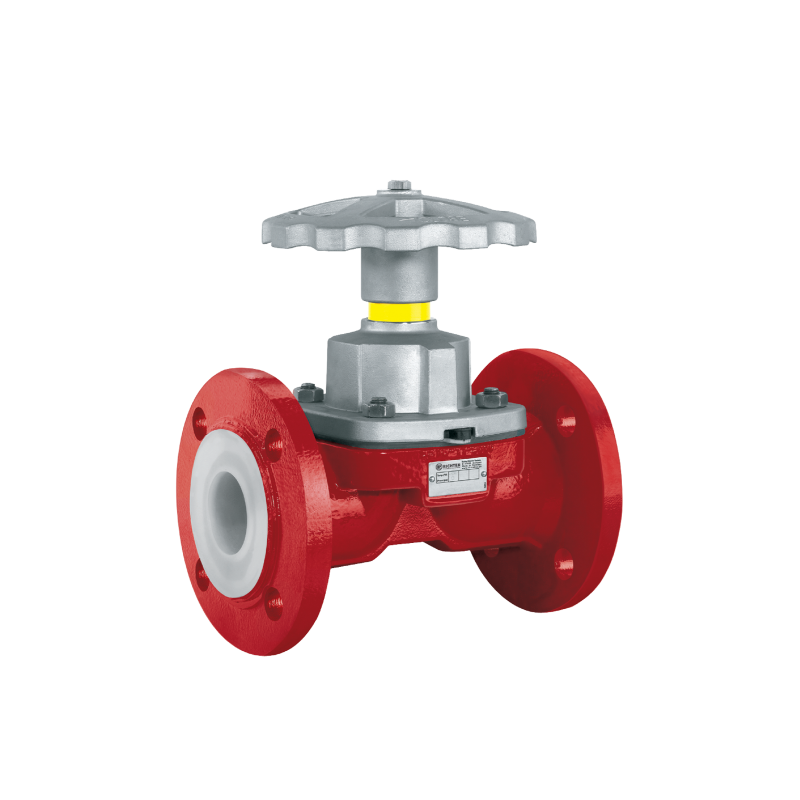
A diaphragm valve controls flow by pressing a flexible diaphragm down onto a weir or onto the floor of the valve body, sealing the flow path while keeping the stem, bonnet, and actuator completely isolated from the process fluid. That single design choice, separating the moving metal from the wetted volume, is why the diaphragm valve became the default isolation and control valve for sanitary, ultrapure, corrosive, and abrasive duty across the pharmaceutical, biotech, food, water-treatment, mining, and semiconductor industries.
Because the only wear part is an inexpensive replaceable diaphragm, and because there is no packing gland to leak, the valve trades high-pressure capability for cleanliness, low fugitive emissions, and easy maintenance. This guide decodes the two body styles, the diaphragm and body materials, the governing standards, the spec sheet, and the selection sequence a procurement or design engineer needs before issuing an RFQ.
Photo: SISTO Armaturen S.A., CC BY-SA 3.0 de, via Wikimedia Commons
This guide is aimed at industrial purchasing engineers and design engineers. It covers 6 chapters from working principle and valve types, through diaphragm and body materials, governing standards, and spec-sheet decoding, to the selection decision, with 7 selection FAQs and manufacturer comparisons. All parameters reference MSS SP-88, EN 13397, ASME B16.34, BS 5156, ISO 5208, and the 3-A and EHEDG sanitary schemes.
Chapter 1 / 06
What is a Diaphragm Valve
A diaphragm valve is a linear-motion valve that opens and closes flow by flexing a thin elastomeric or fluoropolymer membrane, the diaphragm, against a seating surface inside the body. The actuator, whether a handwheel, a pneumatic actuator, or an electric one, pushes a metal plate called the compressor onto the back of the diaphragm. The diaphragm itself forms both the closure member and the seal, so the fluid contacts only the body bore and the wetted face of the diaphragm. The stem, the bonnet internals, the spring, and the actuator never touch the process. This is the defining feature that separates a diaphragm valve from a gate, globe, ball, or butterfly valve, where the stem passes through a packed gland into the flow.
Functionally the valve has four core parts. The body is the wetted casting or molding, usually ductile iron, 316L stainless steel, or a plastic such as PVC or solid PFA, and it carries either a raised weir or a flat floor. The diaphragm is the flexible membrane, clamped at its rim between the body and the bonnet, made from EPDM, PTFE or TFM, NBR, FKM, butyl, or natural rubber. The bonnet houses the stem nut and a travel stop that is factory set so the compressor cannot over-stroke and crush the diaphragm. The compressor is the shaped plate that transfers actuator thrust evenly into the membrane and must match the weir crown profile closely so the seal is bubble-tight across the full seat line.
The diaphragm valve is one of the oldest engineered valves still in mainstream use. The weir-body principle was patented in the 1920s by the South African engineer P. K. Saunders, originally to stop sand and grit jamming the valves in gold-mine dewatering lines, and the Saunders name remains a generic term for the weir style to this day. The straight-through pinch-and-flex variant followed for slurry duty. Through the second half of the twentieth century the design migrated from mining and water into the pharmaceutical and food industries, where its packing-free, dead-leg-free geometry made it the natural choice for hygienic process lines, and more recently into semiconductor ultrapure-water and wet-chemical systems built entirely from PFA.
The trade-off the valve makes is explicit. By using a flexible membrane instead of a rigid metal closure, it gains a leak-tight stem, a clean drainable bore, full chemical isolation of the working parts, and a low-cost replaceable wear element. In exchange it gives up high-pressure and high-temperature capability, because the diaphragm sets the envelope: typical ratings reach only PN 10 to PN 16 or ASME Class 150, and continuous temperature tops out near 130 degrees Celsius for EPDM and 175 degrees Celsius for PTFE-faced membranes. A diaphragm valve is therefore a moderate-duty specialist, not a general-purpose pipeline valve, and selecting one is fundamentally an exercise in matching a clean or aggressive process to the right membrane and body chemistry.
Four engineering attributes determine whether a given diaphragm valve fits a service: the body style (weir or straight-through), the diaphragm material and its temperature and chemical limits, the body material or lining, and the pressure-temperature rating at the actual operating point. These four together also drive the total cost of ownership, because the diaphragm is a consumable that must be replaced on a maintenance schedule, and the labor and downtime to change it dominate lifecycle cost far more than the initial purchase price.
Chapter 2 / 06
Weir vs Straight-Through Types
Diaphragm valves divide into two body geometries, and choosing the wrong one is the most common and most expensive selection mistake. The weir type carries a raised dam cast across the flow path; the straight-through type has a flat, unobstructed floor. The difference is not cosmetic: it sets the diaphragm flex, the throttling capability, the ability to pass solids, and the achievable diaphragm life. The table below summarizes the engineering split between the two.
Attribute
Weir type (Saunders)
Straight-through (full bore)
Body floor
Raised weir, 25 to 40% of bore height
Flat, unobstructed bore
Diaphragm travel
Short
Full bore depth
Best media
Clean liquids, gases, sanitary
Slurries, fibers, viscous, abrasive
Throttling
Good, mid-travel band
Limited, isolation duty
Diaphragm life
Longer
Shorter (deeper flex)
Self-draining
Only when installed at slope
Yes, fully drains
Weir type valves, often still called Saunders-pattern valves, place a raised saddle across the bore at roughly 25 to 40 percent of the bore height. The diaphragm only has to drop a short distance onto the weir crown to seal, which keeps membrane flex low, lets the maker fit thicker and more chemically robust PTFE faces, and extends diaphragm life. The short, controlled flex also gives a fine, repeatable seat contact line, so the weir type is the better throttling valve and the standard choice for clean liquids, gases, and all sanitary and high-purity duty. Its weakness is drainage: the weir traps a small pool of liquid unless the valve is mounted at the manufacturer-specified self-draining angle, and the dam itself obstructs anything chunky or fibrous.
Straight-through valves, also called full-bore or full-port, remove the weir entirely. The bore is smooth and flat, and the diaphragm must flex all the way down to the floor to close. Because there is no dam, the valve passes slurries, suspended solids, fibers, and viscous media without trapping them, drains completely, and handles bidirectional flow. This makes it the workhorse for mining tailings, wastewater sludge, pulp stock, and adhesive or paste-like products. The price is diaphragm life: the membrane flexes through its full depth on every cycle, so fatigue accumulates faster, and the deeper geometry makes it a poorer throttling valve, generally reserved for on/off isolation.
A practical decision rule follows directly. If the fluid is clean, needs modulation, or runs in a hygienic line, specify weir. If the fluid carries solids, fibers, or high viscosity, or if complete drainage is mandatory, specify straight-through and accept a shorter diaphragm change interval. For abrasive slurry that is also pressure-limited, the straight-through body is frequently rubber-lined to protect the casting, and the diaphragm is upgraded to a tougher natural-rubber or butyl grade. Never specify a weir valve for slurry to gain diaphragm life: the trapped solids on the weir will pinhole the membrane far faster than the saved flex would have worn it.
Chapter 3 / 06
Diaphragm Materials Decoded
The diaphragm is the heart of the valve, the wear part, and the single component that sets both the chemical compatibility and the temperature envelope. It must be flexible enough to seal and refold for tens of thousands of cycles, yet chemically inert to the process. No single elastomer covers every service, so material choice is the core of diaphragm valve selection. The table below lists the mainstream diaphragm materials with their published continuous-temperature limits and their best-fit media.
Material
Temperature range
Best-fit media
Watch out for
EPDM
-20 to 130 °C
Water, dilute acids/alkalis, steam, CIP/SIP
Oils, hydrocarbons, fats
PTFE / TFM (EPDM-backed)
-20 to 175 °C
Aggressive acids, solvents, high purity
Lower flex, lower cycle life
NBR (nitrile)
-30 to 100 °C
Oils, fuels, greases
Ozone, ketones, strong acids
FKM (Viton)
-20 to 150 °C
Hot oils, fuels, oxidizers
Steam, hot water, amines
Butyl (IIR)
-20 to 120 °C
Acids, low gas permeation, steam
Mineral oils, hydrocarbons
Natural rubber
-40 to 70 °C
Abrasive slurry, mild chemicals
Oils, ozone, oxidizers, heat
EPDM (ethylene propylene diene monomer) is the default diaphragm for water, dilute acids and alkalis, alcohols, and steam, and it is the standard choice for sanitary clean-in-place and steam-in-place cycles because it tolerates repeated saturated steam to roughly 130 degrees Celsius continuous. It is FDA-listable and inexpensive. Its blind spot is hydrocarbons: EPDM swells badly in oils, fats, and fuels, so any greasy or oily service rules it out immediately. For most water, pharmaceutical, and food lines, EPDM is correct until proven otherwise.
PTFE and its modified grade TFM are the universal-chemical answer. Because solid PTFE is too stiff to flex reliably on its own, the diaphragm is built as a two-piece part: a thin PTFE or TFM face that contacts the media, backed by an EPDM cushion that provides the spring and refold. This composite resists nearly all chemicals, including concentrated acids and solvents that destroy elastomers, and serves high-purity and aggressive duty to about 175 degrees Celsius. The trade is mechanical: the PTFE face flexes less, is more prone to cold-flow and creep, and gives a shorter cycle life, typically in the 25,000 to 50,000 range against the 25,000 to 100,000 of a pure-EPDM diaphragm. PTFE-faced diaphragms also demand careful, torque-limited closing to avoid cracking the face.
NBR, FKM, butyl, and natural rubber fill the specialty gaps. NBR (nitrile) is the oil-and-fuel elastomer, used wherever hydrocarbons would swell EPDM, but it has poor ozone and weathering resistance. FKM (Viton) extends oil and oxidizer service to about 150 degrees Celsius and resists many aggressive media, but it is poor in steam and hot water, so it is rarely used in sanitary SIP lines. Butyl offers very low gas permeation and good acid resistance and tolerates steam, making it a niche choice for acid and gas-tight duty. Natural rubber is the abrasion champion for mining and slurry service, where its resilience shrugs off particle impact, but it has no heat, oil, or oxidizer tolerance. In every case the controlling document is the manufacturer chemical-resistance chart for the exact concentration, temperature, and sterilization frequency, because generic compatibility tables hide concentration and temperature cliffs.
Chapter 4 / 06
Body Materials, Linings and Standards
While the diaphragm sets the wetted-media chemistry on the seat side, the body and its lining carry the pressure, define the rest of the wetted surface, and set the corrosion and abrasion resistance of the bore. Body selection runs from bare metal castings for water service, through lined castings for corrosive and abrasive chemistry, to solid plastics for ultrapure and highly corrosive duty. The most common body and lining materials are listed below with their typical service.
Bare metal bodies cover the two extremes of cost and cleanliness. Ductile iron and cast iron are the economical choice for clean and dirty water, wastewater, and general industrial duty, but they corrode and are unsuitable for acids or chlorides. Forged or cast 316L stainless steel is the hygienic standard for pharmaceutical, biotech, and food lines, where the wetted surface is electropolished to a roughness of Ra 0.4 micrometers or finer, the geometry is made self-draining, and the whole valve is certified for clean-in-place and steam-in-place service. GEMU 673 and similar sanitary valves are built from forged 316L specifically for this duty.
Lined bodies let a cheap iron casting carry an aggressive or abrasive fluid. Rubber and hard-rubber linings protect the casting from slurry abrasion in mining, dredging, and tailings service. PFA and PTFE linings give near-universal chemical resistance for concentrated acids, solvents, wet chlorine, and chloride brines, and are common on weir-type chemical valves. Glass-lined bodies serve concentrated acid and ultra-clean duty but are brittle and intolerant of thermal shock and impact. For the most aggressive ultrapure semiconductor chemistry, the valve is built entirely from solid virgin PFA, body and diaphragm alike, eliminating any metallic contamination, at the cost of a lower pressure and temperature rating.
On the standards side, several documents govern design, dimensions, and testing. MSS SP-88 (Diaphragm Valves) is the primary North American standard for design, materials, and testing. In Europe, EN 13397 specifies metallic diaphragm valves up to PN 16, and BS 5156 covers cast-iron and ductile-iron bodies. Pressure-temperature ratings and flanged dimensions follow ASME B16.34 and ASME B16.10/B16.5, or EN 1092 for PN flanges, while shell and seat testing follows ISO 5208, EN 12266-1, or API 598. Sanitary and high-purity valves additionally carry 3-A Sanitary Standards, EHEDG certification, FDA-listed elastomers, and USP Class VI compliance. Diaphragm valves are generally not fire-safe rated, because their elastomeric seal cannot meet a fire-test standard, so fire-critical isolation uses metal-seated valves instead.
Chapter 5 / 06
Key Specification Parameters
A diaphragm valve datasheet looks short next to a control-valve sheet, but a handful of parameters carry all the selection weight: nominal size, pressure rating, temperature rating, flow coefficient, end connection, actuation, and diaphragm and body material. Each is explained below so the numbers on the spec sheet map to a real engineering decision.
Nominal size runs from about DN 8 (1/4 inch) up to roughly DN 300 (12 inch), with the sanitary GEMU 673 plastic-handwheel series covering DN 15 to DN 65 (1/2 to 2-1/2 inch) and larger industrial weir and straight-through bodies reaching 8 to 12 inch. Size sets the flow capacity and, indirectly, the pressure rating, because the larger the diaphragm, the lower the pressure it can hold. Always size on flow, not on the existing line size, because diaphragm valves are frequently installed a size down to keep the operating point in the controllable mid-travel band.
Pressure rating is moderate by valve standards. Typical ratings are PN 10 or PN 16 (10 to 16 bar) and ASME Class 150, with small bores rated near 10 bar (about 150 psi) and the largest bores derated to only a few bar. The rating is also a coupled pressure-temperature curve: the full pressure is available only at low temperature, and both the pressure and the maximum temperature fall as size increases. Read the rating at the actual operating temperature, not at ambient.
Temperature rating is set by the diaphragm, not the body, and is the parameter most often gotten wrong. EPDM diaphragms are good to about 130 degrees Celsius continuous, PTFE-faced to about 175 degrees Celsius, FKM to about 150 degrees Celsius, and natural rubber only to about 70 degrees Celsius. A 316L body that could metallurgically take 400 degrees Celsius is still capped at the membrane limit. For steam-sterilization duty, confirm the diaphragm is rated for repeated saturated steam at the SIP temperature and that the cycle count is realistic.
Flow coefficient is the sizing number. Cv is defined as the gpm of 60 degree Fahrenheit water passing the fully open valve at 1 psi pressure drop, and the metric Kv is the equivalent in cubic meters per hour at 1 bar drop. Weir-type Cv runs from roughly 4 on a small bore to over 1,200 on a large bore. The flow characteristic is non-linear and quick-opening: a weir valve passes only about 15 percent of full Cv at 25 percent open and about 45 percent at 50 percent open, so usable modulation lives in the 40 to 75 percent open band. Below about 40 percent open the diaphragm flutters and wears, which is why diaphragm valves are poor low-flow throttlers.
End connection and actuation close out the sheet. Common ends are flanged (DN flange to EN 1092 or ASME Class 150), threaded (BSP or NPT), butt-weld, and hygienic clamp such as Tri-Clamp for sanitary lines. Actuation is one of three:
Manual handwheel: a plastic or metal wheel driving the stem nut against a factory travel stop. Standard for isolation and infrequent operation.
Pneumatic actuator: piston or diaphragm actuator, air-to-open or air-to-close, with a fail-safe spring. A 2 inch sanitary valve typically needs 60 to 80 psi air against 150 psi line. Used for automated and remote duty.
Electric actuator: motor-driven, for slow modulation or where no air is available. Add a positioner for any true throttling service.
One spec that hides in the fine print is the diaphragm cycle life: roughly 25,000 to 100,000 cycles for EPDM and 25,000 to 50,000 for PTFE-faced types, falling sharply under frequent steam cycling or severe throttling. Treat the diaphragm as a scheduled consumable and confirm spare-diaphragm part numbers and availability at the time of valve purchase.
Chapter 6 / 06
Selection Decision Factors
To turn the preceding five chapters into a specific model and a clean RFQ, work through the decision sequence below in order. Most selection failures come not from one wrong answer but from deciding a downstream parameter before the upstream one is fixed, for example choosing a size before settling the body style. These eight steps double as a fixed RFQ template.
Body style first: decide weir or straight-through from the media. Clean, modulating, or sanitary goes weir; slurry, fiber, viscous, or must-fully-drain goes straight-through. This decision constrains everything after it.
Diaphragm material: match the elastomer to media chemistry and temperature using Chapter 3. Default EPDM for water and sanitary, PTFE/TFM for aggressive chemistry, NBR for oils, natural rubber for abrasive slurry. Verify against the maker chemical-resistance chart at the real concentration and temperature.
Body and lining material: choose per Chapter 4. Iron for water, 316L electropolished for hygienic, rubber-lined for slurry, PFA or glass lined for corrosives, solid PFA for ultrapure semiconductor.
Size and flow coefficient: size on Cv or Kv, not on line size, so the design flow sits in the 40 to 75 percent open band. Drop one nominal size if the operating point would otherwise sit near full open.
Pressure and temperature point: read the coupled rating curve at the actual operating temperature. Confirm PN 10 / PN 16 / Class 150 is adequate and that the diaphragm temperature limit, not the body, is respected.
End connection and ingress: flanged (EN 1092 / ASME 150), threaded, butt-weld, or hygienic clamp. Specify housing ingress protection for automated valves in washdown or outdoor locations.
Actuation and control: handwheel for isolation; pneumatic air-to-open or air-to-close with fail-safe spring for automation; electric where no air exists. Add a positioner for any modulating duty, and define fail position explicitly.
Certifications and total cost of ownership: specify MSS SP-88 or EN 13397 design, plus 3-A, EHEDG, FDA, or USP Class VI for sanitary, and ISO 5208 / API 598 test class. Then cost the diaphragm replacement interval and labor over the valve life, which usually dominates the purchase price.
One dimension that is routinely underweighted at purchase is serviceability: the diaphragm is a consumable, so local availability of the correct spare diaphragm part number, the ease of changing it in place, and the integrity of the factory travel-stop setting determine real lifetime cost more than the valve sticker price. GEMU, Crane Saunders, ITT Pure-Flo, Burkert, Alfa Laval, ASAHI/AV, and Richter all maintain spare-diaphragm catalogs and regional stock, and replacement-diaphragm suppliers cross-reference the major brands, so confirm the spare-part path before committing to a series. A correctly specified diaphragm valve that cannot get a same-week diaphragm replacement is a worse outcome than a slightly less ideal valve that can.
FAQ
What is the difference between a weir-type and a straight-through diaphragm valve?
A weir-type valve has a raised dam (the weir) cast across the flow path, roughly 25 to 40 percent of the bore height, so the diaphragm only has to travel a short distance to seal against the crown. This minimizes diaphragm flex, allows thicker PTFE faces, and gives precise bubble-tight throttling, which is why it dominates clean and sanitary service. A straight-through (full-bore) valve has a flat-bottomed body with no weir, so the diaphragm must flex all the way down to the floor to close. The unobstructed bore passes slurries, fibers, and viscous media without trapping solids, but the deeper flex shortens diaphragm life. Choose weir for clean liquids and modulation, straight-through for slurries and abrasive suspensions.
What standards apply to diaphragm valves?
MSS SP-88 (Diaphragm Valves) is the primary North American design, material, and testing standard. In Europe, EN 13397 covers metallic diaphragm valves up to PN 16, and BS 5156 covers cast-iron and ductile-iron bodies. Pressure-temperature ratings and end-to-end dimensions follow ASME B16.34 and ASME B16.10/B16.5 for flanged designs, or EN 1092 for PN flanges. Shell and seat testing follows API 598, ISO 5208, or EN 12266-1. Sanitary and high-purity valves additionally carry 3-A Sanitary Standards, EHEDG certification, FDA-listed elastomers, and USP Class VI compliance. Fire-safe service is rare for diaphragm valves because elastomers are not fire-rated.
How do I choose the diaphragm material?
Match the diaphragm elastomer to the media chemistry and temperature first, then to mechanical duty. EPDM handles water, dilute acids, alkalis, and steam to about 130 degrees Celsius continuous and is the default for water and sanitary CIP/SIP. PTFE or TFM-faced diaphragms (backed by EPDM) resist almost all chemicals to roughly 175 degrees Celsius and suit aggressive acids, solvents, and high-purity duty, but flex less and have lower cycle life. NBR (nitrile) suits oils and fuels, FKM (Viton) suits hot oils and oxidizers to about 150 degrees Celsius, butyl suits abrasion and low gas permeation, and natural rubber suits abrasive slurries. Always cross-check the manufacturer chemical-resistance chart for the exact concentration, temperature, and steam-sterilization frequency.
What is the maximum pressure and temperature a diaphragm valve can handle?
Diaphragm valves are moderate-duty isolation and control valves. Typical pressure ratings run to PN 10 or PN 16 (10 to 16 bar) and ASME Class 150, with small bores rated near 10 bar (about 150 psi) and the largest bores derated to a few bar. Maximum continuous temperature is set by the diaphragm, not the body: about 130 degrees Celsius for EPDM and 175 degrees Celsius for PTFE-faced diaphragms. Both ratings fall as size grows and as the two limits combine: full pressure is only available at low temperature. They are not suited to high-pressure pipelines, superheated steam above the elastomer limit, or cryogenic service, where ball, gate, or globe valves are used instead.
Why are diaphragm valves preferred for sanitary and high-purity applications?
The diaphragm physically separates the process fluid from the stem, bonnet, and actuator, so there is no packing, no stem leakage path, and no metal-to-metal seat to shed particles. A weir body with an electropolished 316L wetted surface (Ra 0.4 micrometers or better) and a self-draining install angle leaves almost no dead leg where product can stagnate. The whole assembly is steam-sterilizable (SIP) and clean-in-place (CIP) compatible, autoclavable in benchtop sizes, and certifiable to 3-A and EHEDG. For semiconductor ultrapure water and aggressive chemistries, solid PFA bodies and diaphragms add zero metallic contamination. These properties make the valve standard in pharmaceutical, biotech, food, and electronics process lines.
How is a diaphragm valve sized for flow and throttling?
Size on flow coefficient Cv (or Kv in metric), defined as the gpm of 60 degree Fahrenheit water that passes at 1 psi pressure drop. Weir-type Cv values range from roughly 4 on a small bore to over 1,200 on a large bore. The flow characteristic is non-linear and resembles a quick-opening curve at high lift: a weir valve passes only about 15 percent of full Cv at 25 percent open and about 45 percent at 50 percent open, so effective modulation lives in the 40 to 75 percent open band. Below about 40 percent open the diaphragm flutters against the weir, accelerating wear, so do not specify a diaphragm valve for tight low-flow control. For true throttling use a positioner and size so the design flow sits mid-travel.
Which manufacturers make industrial and sanitary diaphragm valves?
For sanitary and high-purity duty, GEMU (673 series), Crane Saunders, ITT Pure-Flo, Burkert, and Alfa Laval are the mainstream brands, all offering forged 316L bodies, EHEDG-certified sealing, and PTFE or EPDM diaphragms. For industrial water, mining slurry, and lined chemical service, Crane Saunders, GEMU (675 series), ASAHI/AV, and Richter supply rubber-lined, PFA-lined, and glass-lined bodies in cast and ductile iron. For PFA-lined and solid-PFA semiconductor and corrosive duty, Entegris, Asahi, and specialized fluoropolymer makers dominate. Verify body lining, diaphragm grade, certification, and spare-diaphragm availability against the specific series datasheet, because the same brand spans very different pressure-temperature envelopes.
Diaphragm Valve Manufacturers
Source-backed product routes. Open a company dossier for procurement scope and cited evidence.
RICHTER documents MV/MVP as PFA-lined diaphragm-valve variants with modified PTFE diaphragms.
Published product fact
RICHTER MV/MVP PFA-lined diaphragm valves in manual and remote-actuated variants.
Published product fact
RICHTER MNK Heavy Duty PFA/PTFE-lined centrifugal magnetic-drive pump configurations, including frame-mounted and close-coupled designs with permanent-magnet coupling.