
Capital-equipment measuring instruments ranging from radon meters to 3D profile scanners are facing extended lead times through 2026, driven by upstream sensor and detector shortages documented in recent distributor listings [S5][S2].
For procurement engineers, the practical question is which classes of instruments have real alternates on the shelf, and which are still single-sourced; the 2026 sourcing map for these devices is laid out below, drawing on current OEM and distributor inventory pages [S1][S3][S5].
Where the shortage is concentrated in 2026
DSHD-216 environmental radon meters, with a soil-radon range of 300-300000 Bq/m³, a radon exhalation range around 10.000 Bq/(m²·s), and a 90% relative humidity upper limit, are now being offered through an explicit excess-stock channel at kitairu.net, indicating that new-build lead times have stretched enough to push buyers toward surplus inventory [S5]. The listing specifies operating temperature up to +40°C, a 11-minute soil-radon cycle, and a 30-minute radon exhalation cycle, all of which match the original spec sheet, so the alternate path is technically a like-for-like unit rather than a downgraded replacement [S5].
Distance measuring instruments (DMIs) from Microdynamics, including the DOT-Z1 Pro, DOT-Z1 Standard, and DOT-Z1 Basic (the latter two without GPS), remain listed as in-stock products with a 24-year company history and thousands of units shipped, suggesting this sub-segment is currently less constrained than environmental radon instrumentation [S3]. The DOT-Z1 line offers GPS and USB variants, a useful fallback when higher-end EDM or laser units are back-ordered, particularly for surveying, mapping, and route-planning jobs where sub-second accuracy is not required [S3].
Three- and four-week delivery versus six-month back-orders
Wide-area 3D profile-measuring instruments from KEYENCE, used for non-contact roughness and curvature measurements at millimetre to tens-of-micron resolution, complete a typical scan of a few square millimetres in about 4 seconds using a white-LED striped-pattern projection, and these are still being sold through normal OEM channels as of 2026-03-12 [S2]. The contrast with the DSHD-216 is informative: the KEYENCE non-contact profiler is positioned at a higher unit cost and lower volume, and its supply chain has held up better than the radon-meter segment, which depends on a narrower set of scintillation-cell vendors [S2][S5].
For context, India's Atlantic Sales and Service, a 40-year distributor of industrial test and measuring instruments and instrument cooling fans, lists active inventory of EBM-papst AC axial and centrifugal fans with model codes such as D2E160-AH02-15, G2E 160-AY47-01, G2E 133-DN77-01, R2E220-AA40-05, and R2K 150-AC, illustrating that electromechanical accessories (which sit adjacent to many measurement rigs) have continuous stock in 2025-04 [S1]. When a measuring instrument is back-ordered, the cooling fan that lives inside its enclosure is rarely the bottleneck, so the constraint is concentrated in the sensor and detector layers, not the cabinet-level peripherals [S1].
Decision criteria: which classes are short, which are not
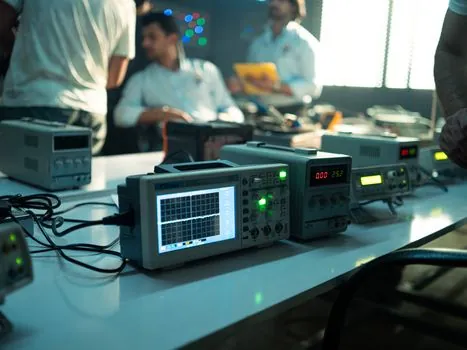
For buyers running a 2026 risk assessment, the practical sorting criterion is detector type. Environmental radon and low-level radiation meters depend on scintillation cells and photomultiplier tubes, both single-source commodities; DMIs and 3D optical profilers use CMOS or CCD image sensors that have multiple Tier-1 alternates (Sony, ON Semi, ams OSRAM), so the optical sub-segment carries lower supply risk [S3][S2][S5]. CO₂ measuring instruments from Testo use non-dispersive infrared (NDIR) sensors with a broader second-source market, which is why CO₂ analyser listings remain on standard OEM channels rather than excess-stock channels [S6].
A second criterion is calibration regime. The Microdynamics DOT-Z1 line is a surveying-grade DMI used for distance, route planning, and material estimation; the DSHD-216 is a regulatory radon instrument tied to environmental permits; the KEYENCE 3D profiler is a QA instrument tied to PPAP and Cpk reporting [S3][S5][S2]. When a regulatory or PPAP-tied instrument is short, the cost of switching suppliers is high, because re-calibration, re-correlation, and customer PPAP resubmission can run 8-16 weeks on their own, which is exactly the gap that excess-stock channels aim to close [S5].
Frameworks for quantifying the supply-side risk
The 2014 paper "Measuring external oil supply risk: A modified diversification index with country risk and potential oil exports" (Yang, Li, Sun, Chen, Energy Vol. 68, 930-938) remains a published reference point for supply-risk modelling, using a portfolio-style diversification index that weights source-country political risk against potential export volumes [S4]. The framework is energy-specific but the underlying logic (single-source share, supplier-country concentration, and Herfindahl-style index) applies directly to capital-equipment measuring instruments, where a single detector vendor can swing a multi-million-dollar product line [S4].
For optical DMI and 3D profiler components the index would drop into the safer zone, which matches the observed difference between the DSHD-216 excess-stock listings and the still-in-stock KEYENCE and Microdynamics lines [S5][S2][S3].
Concrete fallbacks for 2026 procurement
Where the primary vendor is back-ordered, three fallback paths are open in 2026: (1) excess-stock and re-certified units from kitairu.net for radon and asphalt-testing instruments, with explicit surplus-inventory pricing [S5]; (2) standard-channel DMI alternates such as the DOT-Z1 Basic (no GPS) when survey-grade GPS is not contractually required, allowing a faster 4-6 week delivery versus the GPS-equipped Pro variant [S3]; (3) NDIR CO₂ analysers such as the Testo CO₂ measuring instrument range, which remain on OEM channels with inline or separate probes for indoor-air quality and HVAC commissioning [S6].
For 3D surface metrology, the KEYENCE wide-area non-contact profiler remains the primary reference, but for lower-volume jobs a stylus-type instrument (tens of microns, slower cycle) is a proven substitute and is generally available on shorter lead times than the white-LED striped-pattern units [S2]. For instrument-cooling subsystems used in measurement racks, EBM-papst AC and DC fans (D2E160, G2E 160, R2E220, R2K 150) are continuously stocked through 40-year distributors such as Atlantic Sales, so this layer of the bill of materials is not the 2026 chokepoint [S1].
Limitations and failure modes of the fallback path
Excess-stock and used-instrument channels carry their own risks: calibration certificates may be older than the buyer's quality system allows, firmware versions may be pre-revision, and warranty terms typically shift from 12-24 months to 30-90 days, so each surplus buy needs a documented incoming-inspection step including a known-source check-gas run on the DSHD-216 and a verifiable probe-trace on the Testo CO₂ analyser [S5][S6]. For DMIs, the trade-off is clear: dropping GPS on a DOT-Z1 Basic removes geotagging but does not affect distance accuracy, so the swap is generally safe for material-estimation and route-planning jobs but not for cadastral surveying [S3].
Optical profilers have a sharper failure mode. The KEYENCE wide-area 3D unit relies on a structured white-LED pattern calibrated to a specific camera baseline; any third-party substitute must match the baseline within roughly 1-2% to keep the micron-level roughness reading traceable, so the fallback here is a stylus-type profiler rather than another non-contact unit [S2]. Across all paths, the 2026 playbook is to qualify two independent sources for any detector-class instrument before the shortage window closes.
For broader context on 2026 industrial supply patterns, see the measuring instrument sourcing map and the color-mark sensor spec gate map, both of which line up with the detector-versus-optics split documented here. Engineers weighing measurement-instrument cabinets against enclosure thermal limits will also find the electric motor demand 2026-2030 sizing piece useful for the cooling-fan sizing around instruments such as the DSHD-216 and DOT-Z1 Pro.
The underlying component specifications are covered under lighting equipment and electric lamps, contour measuring machine, and vision measuring machine.