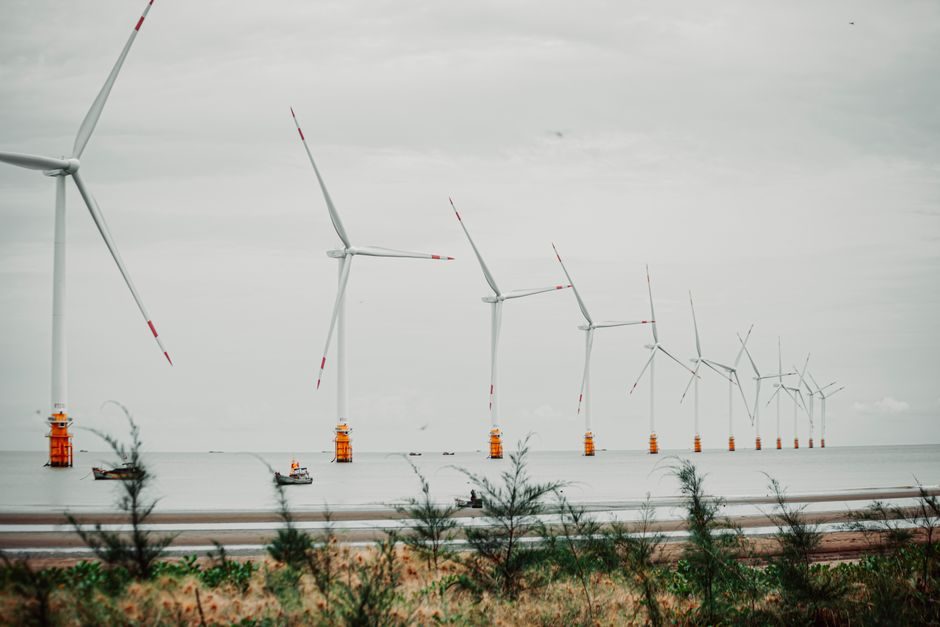
Offshore wind foundations sit at the hinge of the European energy build-out: OWFA reports 25 GW of installed offshore wind capacity, a 44 m average water depth, 52 km average distance to shore, and a 2,000 t maximum monopile weight already on the market [S2].
Meeting the European Commission's 60 GW-by-2030 and 300 GW-by-2050 targets requires a sustained 9.5 GW/year installation cadence, which directly dictates the tonnage of plate steel, the fleet of heavy-lift crane vessels, and the kilometres of dynamic array cable that fabricators and yards must deliver each year [S2].
Upstream: Plate Steel, Flanges, and Forged Transition Pieces
Monopile-grade steel demand scales with turbine size: foundation mass on current offshore turbines reaches 2,000 t per unit at diameters up to 10 m, with monopiles embedded up to 30 m into the seabed [S2]. Upstream suppliers must therefore hold EN 10025 S355 / S420 plate stock in thicknesses above 100 mm, plus forged flange rings capable of accepting grouted or bolted transition-piece connections on units now in the 10 m diameter class [S2].
The OWFA coalition explicitly states its objective of ensuring "a level playing field to ensure sustainable manufacturing of offshore wind foundations" and of having foundation suppliers "take the lead in setting standards and defining certification processes" [S2]. That mandate puts the burden of qualification testing on upstream mills and forgers, who must weld-deposition qualify procedure specifications against the project-specific fatigue spectra that 15+ MW turbines generate over 25-year design lives [S2].
Foundation Typology: Monopile vs Jacket vs Suction Anchor
OWFA members manufacture "different types of foundations such as monopiles and jackets, as well as transition pieces linking them to the wind tower," with monopile-plus-transition-piece systems dominating the 15–60 m water-depth band that covers the average 44 m European site [S2]. Monopiles are "connected to the wind tower through a transition piece and made up of a steel cylinder buried up to 30 meters under the seabed" [S2].
For deeper water and floating-tender work, suction anchors and mudmat subsea foundation systems offer an alternative anchoring and mooring solution that avoids pile-driving noise and the associated underwater ecology monitoring overhead that the Seaward practice notes as a recurring project cost on European sites [S5][S1]. The four-way comparison below lines the main options against the criteria a spec engineer actually weighs: (1) suitable water depth, (2) per-unit steel mass, (3) seabed preparation, and (4) installation noise footprint.
Monopile + transition piece: 15–60 m water depth, up to 2,000 t steel per unit, pile-driven 30 m into seabed, high underwater noise requiring GWO/OPITO-certified monitoring crew [S2][S1]. Jacket (lattice): typically 40–80+ m water depth, distributed steel mass across 3–4 pin piles, pile-driven at each leg, moderate per-leg noise. Suction anchor: variable depth including floating turbine moorings, low per-unit steel mass, hydrostatically installed (no pile-driving), minimal seabed noise [S5]. Gravity base / mudmat: shallow water, mass-concrete or ballast-filled steel shell, seabed-prepared rather than driven, very low installation noise [S5].
Downstream: Vessels, Cranes, Cable Lay and O&M
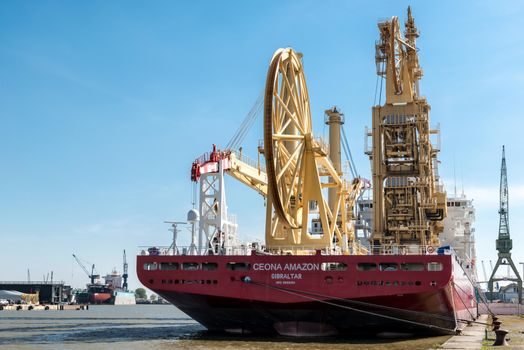
Foundation installation downstream is dominated by heavy-lift jack-up vessels; Cadeler has signed a firm contract to transport and install 60 offshore wind turbines off Scotland for Siemens Gamesa, and the wider fleet of "Heavy Lift Crane" units is reported ready to work across the North Sea, Baltic and Atlantic queues [S3]. For yard handling of monopile and transition-piece loads in the 2,000 t class, the lifting envelope intersects with the crawler crane envelope mapped in the 2026 spec guide, since many coastal marshalling yards move 1,500–2,500 t foundation components with land-based crawlers before vessel pickup.
Subsea array and export cable lay is the second downstream pillar, with each 1 GW project requiring roughly 200–400 km of 66 kV–220 kV cable and the supporting pressure-rated subsea junction housings and sensor pods that monitor hydrostatic pressure at water depths to 60 m. Dogger Bank's transmission-technology milestone is the most-cited recent downstream signal because it directly de-risks the 66 kV–132 kV array cable architecture that future 15 MW+ foundations will feed [S3].
Installation, Monitoring and the Underwater Ecology Overhead
Every pile-driving campaign in European waters triggers a mandatory underwater-ecology monitoring programme, typically scoped by GWO Basic Safety- and OPITO BOSIET-certified personnel running simultaneous noise-measurement and marine-fauna observation per project permits [S1]. The Seaward practice, run by an ex-Damen R&D lead engineer with a TU Delft mechanical background, frames this as a standalone project workstream with its own cost-effectiveness / scientific-quality balance rather than a sub-task of the foundation install [S1].
Adaptive-autonomy underwater inspection vehicles, such as the system deployed at Nordsee One, are the practical answer to the monitoring cost question: they reduce the surface-vessel day-rate burn that a conventional dive-class ROV would otherwise impose on every foundation in a 60–80 unit wind farm [S3]. With the Saint-Nazaire farm sized to supply 400,000 Loire-Atlantique households, the recurring inspection budget across a 25-year design life is the largest single downstream line item after initial install [S3].
Capacity, Cost and the Workforce Multiplier
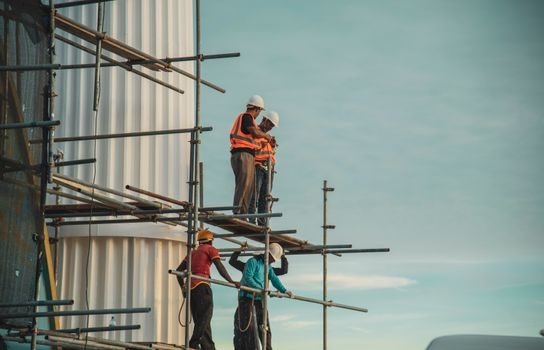
OWFA's published numbers translate directly into upstream and downstream capacity: Europe added 2.4 GW of offshore capacity during 2020, while 4.5 GW/year is required to hit 2030 and 9.5 GW/year to hit 2050 — a 4× scaling factor that has to land in steel mill order books, foundation fabrication halls, and vessel-fleet capacity simultaneously [S2]. Employment in the sector is set to expand from 77,000 to 200,000 by 2030, with the largest single labour pool concentrated in the foundation manufacturing yards that OWFA members operate [S2].
The 42% UK, 31% Germany, 10% Netherlands, 9% Belgium and 7% Denmark share of the European installed base also defines where downstream O&M ports, cable factories, and jack-up vessel hubs will physically cluster [S2]. For spec engineers sourcing industrial valves and flow meters into the cooling, ballast, and turbine-hydraulic systems of a 15 MW foundation, that geographic concentration matters because it determines lead time and total landed cost on every procurement order.
Trackable Signals for the Next Reporting Window
Three verifiable signals will tell you whether the upstream–downstream foundation chain is on track in the next 6 months: (1) a signed Siemens Gamesa–Doosan Enerbility strategic MoU on offshore wind supply, already announced but not yet converted into firm manufacturing tonnage [S3]; (2) the next Saitec pre-commercial pilot installation on the Costa Brava, which would mark the first commercial-scale concrete-pontoon foundation outside the existing monopile / jacket pair [S3]; (3) any update to the Ridgeway inspection contract on its first French offshore wind farm, which will signal European O&M market access for non-French service providers [S3].