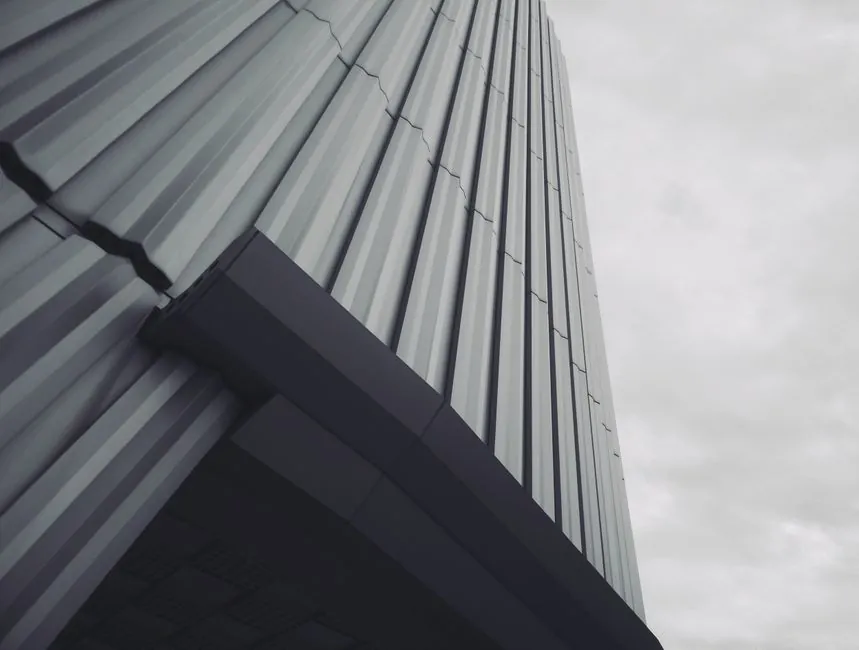
For plants, warehouses, and process buildings, metal curtain wall panels are specified by material grade, panel function, fabrication method, and the corrosion/wind duty of the site, with single-layer aluminium sheet the most widely used decorative infill.
Stick-built and unitized are the two fabrication categories, and metal panels sit alongside glass, stone, and terracotta as the principal opaque infills used to conceal slab edges and between-floor services.
Where Metal Panels Fit in an Industrial Curtain Wall
Curtain wall systems are exterior envelopes hung from the floor slabs, designed to carry self-weight and transfer horizontal wind loads without taking building dead loads [S4]. The envelope’s primary job is resisting air and water infiltration and providing a thermal barrier between inside and out, while accommodating thermal movement, building sway, and inter-floor drift at the stack joint [S4].
Inside that envelope, glass is the most common infill, but other cladding materials include metal panels, natural stone, and terracotta [S4]. Because curtain wall systems typically span floor slabs, opaque cladding is required to hide the slab edge, fire-safing, and any between-floor mechanical services; the metal element doing that job is called a spandrel panel [S4]. For industrial buildings, this is the same function that spandrel panels perform in office towers, except the corrosion, impact, and wash-down duties are usually heavier.
Material Options: Aluminium vs Steel vs Composites
Single-layer aluminium sheet metal curtain wall is a commonly used decorative panel material, widely used, with current national standards governing its application [S9]. The advantage is a low weight-to-area ratio, easy forming, and good corrosion behaviour with an anodized or PVDF finish. Aluminium alloys typically used in architectural cladding are in the 3xxx (e.g. 3003, 3105) and 5xxx (e.g. 5005, 5052) series.
Galvanized and Galvalume steel coil substrates dominate where impact resistance and lower material cost are the priorities. Coatings are referenced by weight class: G60, G90 for hot-dip galvanized (zinc) and AZ50 / AZ55 for Galvalume (aluminium-zinc alloy). Galvalume is widely specified for industrial envelopes because the aluminium-zinc cut edge behaves better than straight zinc in many atmospheric-corrosion environments. Insulated metal panels (IMP) sandwich metal facers to a foamed-in-place PIR or PUR core, typically 50–200 mm thick, which is the typical wall build-up when the building also needs a continuous thermal envelope. For product reference data, see metal material and the broader metal curtain wall panel category page.
Stick-Built vs Unitized: Decision Criteria
Classified by method of fabrication and installation, curtain walls fall into stick-built and unitized categories, both used as interior or exterior systems with infills of glass, stone, fabric, louvres, panels, vents, and windows [S5]. Stick-built systems ship individual mullions and infills to site, where the frame is assembled piece by piece, making them the natural choice for small to mid-sized projects and for sites where factory-bought modules are not economical [S5].
Unitized systems are prefabricated interlocking modules delivered as full panels, installed sequentially around each floor from bottom to top, and designed to accommodate thermal expansion and contraction through factory-controlled dry-gasketed stack joints [S5]. The trade-off is field labour versus factory QC. A simple comparison for industrial-facility specifiers:
1. Project size: stick-built is preferred for small to mid-sized industrial buildings; unitized pays back on larger footprints where factory quality control offsets higher unit cost [S5].
2. Site access: stick-built needs on-site space for material storage and assembly; unitized only needs crane time and a lay-down yard for finished modules, which is critical on tight industrial sites where space can ultimately be limited [S5].
3. Tolerance and movement: unitized modules are developed to accommodate thermal expansion and contraction and inter-floor movement through engineered stack joints; stick-built detailing is more dependent on the building structure’s tolerance and on-site craftsmanship [S4][S5].
4. Lead time: unitized pushes more time to the factory and reduces on-site time; stick-built extends the on-site schedule and the dependency on skilled installers.
Selection Criteria by Plant Environment
Selecting the right metal wall covering involves balancing factors like design flexibility, aesthetics, concealed fastening options, and the duty imposed by the building’s environment [S6]. For an industrial facility, the criterion that usually decides the spec is not aesthetics but exposure class and impact.
1. Atmosphere / corrosion: facilities near chemical stacks, coastal sites, or wash-down areas need aluminium or aluminium-zinc-coated steel with a PVDF topcoat rather than SMP or polyester; a Galvalume AZ50 substrate is widely used as a baseline.
2. Wind and impact: open industrial sites see higher wind pressure coefficients on wall corners and roof edges; specify panel thickness, rib geometry, and fastener pull-out values accordingly.
3. Thermal: IMP with a PIR core is preferred where the building is conditioned; single-skin metal panels are paired with a separate steel-stud and mineral-wool or mineral-fibre cavity for projects where the wall can be field-assembled.
4. Fire: opaque spandrel areas often have a fire-safing requirement at the slab edge; the metal panel and its back-up must not compromise that rating.
For the broader wall-system context and how metal panels interact with vision glass and opaque spandrel areas, see glass curtain wall and door window curtain wall.
Fabrication, Finishes, and Fastening
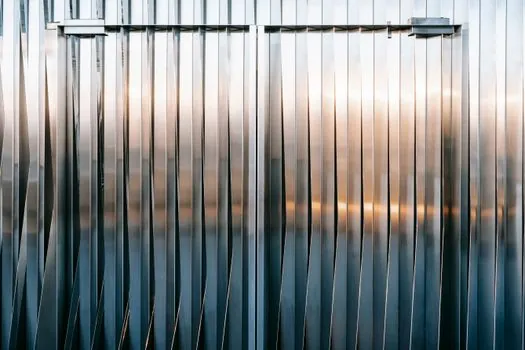
Metal wall panels are produced in a variety of profiles and finishes that combine visual effects with cost-effective installation [S1]. Profiles are commonly grouped into three families: exposed-fastener (through-fastened ribbed panels, common on warehouses), concealed-fastener (snap-lock or hook-lock, common on commercial envelopes), and composite / cassette (flat panels with a stiffener, common on architectural façades).
Finish systems are typically referenced by resin and top-coat: polyester (PE), silicone-modified polyester (SMP), polyvinylidene fluoride (PVDF, often 70% Kynar 500 or Hylar 500), and anodized for bare aluminium. PVDF is the standard for industrial envelopes with long colour-fastness and chalk-and-fade warranties. Where the same envelope needs to tie into a metal roof, the wall panel and roof panel are usually specified from the same product family for finish and weathertightness continuity [S7].
Common Failure Modes and How to Avoid Them
The most common field failures on industrial metal-panel envelopes are not the panels themselves but the stack joint, the perimeter, and the fasteners. The stack joint provides continuity of air and water resistance, accommodates environmental and building movements, and permits an efficient modular installation; its design is so critical that it is often described as the single most important performance detail of the curtain wall [S4].
Galvanic corrosion at the panel-to-mullion interface is the second classic failure, and it is driven by pairing dissimilar metals (for example, bare steel fasteners in contact with aluminium) without a proper isolation washer or gasket. Cut-edge corrosion on galvanized or Galvalume panels must be considered in the panel layout because the cut edge of a coil-coated panel no longer has the original metallic coating on the face. Oil canning (visible waviness on flat panel areas) is a thermal-movement and panel-flatness issue that is controlled by panel gauge, stiffener geometry, and the fixity pattern; it is not a coating failure. On agricultural, civic, educational, and industrial sites, a large selection of metal wall panels is offered precisely because each duty requires a different combination of substrate, coating, and profile [S2].
For comparison with other building-envelope and process-equipment decisions, see Metal Curtain Wall Panel Selection for Commercial Buildings and Suspended Working Platform Selection for Tunnel Construction.
Standards, Sourcing, and Specifications
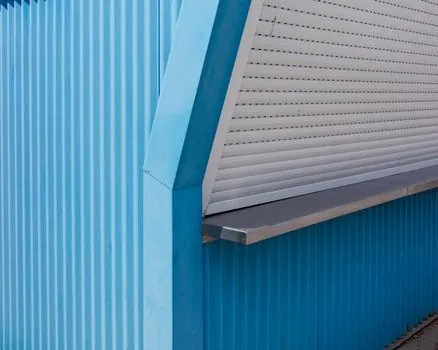
Specification-grade metal wall panels carry product data sheets, finish warranties (typically 20–40 years for PVDF topcoats), and weathertightness ratings that are referenced against standardized test methods. Anchor design and attachment are project-specific and must consider slab-edge geometry, embed depth, and adjustability; the anchoring method is highly efficient, provides adjustability, and can be positioned on the face, top, bottom, or recessed in any of these positions [S4].
Sourcing pattern: large industrial users typically split the envelope into the metal-roof-and-wall scope (single supplier for finish and weathertightness continuity [S7]) and the glazed-curtain-wall scope (a custom curtainwall contractor [S4]). Where the metal panel is a decorative infill, the panel sub-supplier works to the same stack-joint geometry as the vision-glass units.
Who Metal Curtain Wall Panels Are For, and Who Should Look Elsewhere
Metal curtain wall panels are the right infill for industrial facilities that need opaque spandrel areas, decorative facades, or full metal envelopes with high impact resistance and predictable weathertightness. They are not the right choice where the project is a simple warehouse that can be served by a through-fastened metal wall on a rack system, where the budget cannot support a custom curtain wall, or where the building is a non-conditioned industrial shed that does not need the curtain wall stack-joint detail. [S4]
For projects where the dominant need is internal subdivision rather than external envelope, a different product family applies: industrial curtain walls, warehouse curtain walls, insulated industrial warehouse curtains, and dock door screens are examples of interior vinyl and coated-fabric systems used for facility separation, dust control, and wash-down areas [S3]. These are an unrelated product category and should not be confused with exterior architectural curtain wall.
Trackable signals for the next sourcing cycle: published product data sheets for PVDF topcoat systems from the same suppliers referenced above, and updates to the national standards governing single-layer aluminium sheet metal curtain wall [S9]. For related raw-material context, see metal powder.