
Metal curtain wall panels for educational facilities are typically specified from five material families: aluminum plate, aluminum composite (ACM/MCM), stainless steel, copper, and zinc, with galvanized steel coil (often 0.22 gauge, ~0.76 mm) used where a custom-painted school identity is required [S4][S6]. The envelope is normally organized as a hybrid system: vision glass and spandrel glass in the curtain wall for transparency, with metal panels integrated as glazed-in infills or as a separate rainscreen plane for opaque spandrel and feature zones [S1][S5].
For schools, the design brief usually stacks four performance demands: impact resistance at ground-floor and corridor conditions, long finish life (PVDF/Kynar 30-year warranties are common on architectural plate), airtight acoustic separation for classrooms, and a custom color palette tied to district branding [S1][S7]. The selection problem is therefore not "which metal" but which metal-on-system-geometry combination survives student traffic, the local climate, and a 30- to 40-year replacement horizon.
Material Families and Where Each Fits a School
Aluminum plate (typically 3 mm to 6 mm) and ACM (4 mm to 6 mm composite with two aluminum skins bonded to a mineral or FR core) are the default metal curtain wall infills for school projects because they accept high-end metallic paint and anodized finishes and weigh roughly 1.5 lb/ft² to 3.0 lb/ft² depending on the gauge chosen [S4]. Stainless steel (2B, No. 4, or bead-blasted) is specified at high-abuse zones such as entry vestibules, stair towers, and cafeteria kitchens, where the 24-gauge to 18-gauge range handles impact better than painted aluminum but adds roughly 1.8 to 4.0 times the dead load [S4]. Copper and zinc are reserved for signature schools where the developing patina is part of the architectural brief, and they are typically run as standing-seam or flat-lock cladding rather than glazed-in infills [S4].
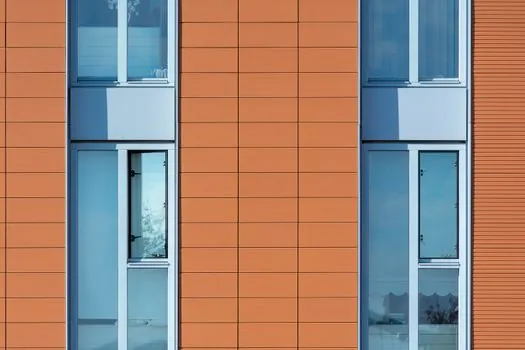
For a typical North American K-12 envelope, custom-painted 0.22-gauge (about 0.76 mm) galvanized steel coil has been used as protruding window-bay cladding in three custom red tones, demonstrating the gauge is thin enough to brake-form into tight reveals yet rigid enough to read as a flat panel from the curb [S6]. Where the school wants a metal-on-glass unitized wall, the CPGIP-style glazed-in plate panel is sized to drop into the standard glazing pocket of the curtain wall system, available in single-sided (one finished face) or double-sided (finished both faces for visible returns) configurations [S1]. This pocket-fit approach keeps a single mullion grid across the whole facade, which most school districts want for visual unity [S1][S3].
System Options: Glazed-In, Wet-Joint, and Rainscreen
Three attachment systems compete for school curtain wall metal panels, and the choice drives both appearance and long-term service. Glazed-in metal panels (CPGIP-style) are designed as a direct "replacement for glass" within the same aluminum mullion grid, with panel thickness machined to fit the glazing pocket and the option of structural silicone or wet-glazed stops [S1]. Wet-joint plate panels (CPWJ-style) seal the panel joints with sealant rather than leaving an open pressure-equalized gap, which simplifies water management on low-rise schools but reduces the ability to dry out a leak [S1]. Rainscreen plate panels (CPRS-style) hang on a drained-and-ventilated substructure behind the glazing plane, and that pressure-equalized cavity is the most forgiving choice for schools in coastal or mixed-humid climate zones [S1].
The unitized curtain wall trend in schools is to mix infill materials inside one prefabricated module: vision glass, spandrel glass, and a metal plate panel can all share the same mullion geometry, which simplifies procurement and gives the school a single source for the weather barrier [S4]. DAMS and similar North American panel shops offer this trio (rainscreen, wet-joint, glazed-in) as parallel product lines because each one implies a different sub-frame, joint profile, and tolerance stack-up, and the wrong pairing with the glazing supplier is the most common cause of field rework [S1]. For a 2-story elementary school with punched windows, a stick-built stick system with stick-assembled metal panels is usually cheaper than full unitization; for a 3- to 4-story middle or high school on a tight schedule, unitized modules with pre-glazed metal infills tend to win on schedule and quality control [S3].
Performance Targets Driven by School Use
Classroom acoustics drive the metal panel spec toward higher-mass infills and continuous thermal breaks at the framing. Standard curtain wall framing relies on polyamide or poured-and-debridged thermal breaks to drop the U-value and condensation risk at the perimeter, and metal infill panels inherit that break when they sit inside the same mullion [S3]. For schools, design teams typically target a STC rating in the 35 to 45 range at the wall and an OITC of 28 to 35 at the perimeter, which a 3 mm to 4 mm aluminum plate over a mineral-fiber backpan can deliver without going to a thicker composite [S3].
Energy and air-water performance come down to the curtain wall, not the panel itself, but the metal infill has to cooperate with the gaskets and seals. A modern curtain wall has to deliver weather protection (wind, rain, dust, UV), thermal efficiency that reduces HVAC load, and acoustic insulation against street noise, with natural daylight from the vision glass zones [S3]. For the metal infill specifically, the weak point is the joint: glazed-in panels are sized to the glazing pocket, then the same EPDM gaskets and structural silicone that seal the glass also seal the metal, which is why panel tolerance has to be held to roughly ±0.5 mm to ±1.0 mm on the perimeter to keep the gasket line continuous [S1][S3]. Finish warranties up to 30 years on PVDF-coated architectural plate are the industry baseline for K-12 work, and CENTRIA-style metal wall and roof panel systems are commonly specified on educational facilities for that reason [S7].
Comparison: Metal Panel Options for a School Project
Lining the five common metal families up against the criteria that drive a school spec, the trade-offs fall out clearly: [S6]
1. Aluminum plate (3-6 mm): lightweight (~1.5-3.0 lb/ft²), accepts PVDF/metallic paint, 30-year finish warranty, easy to source, moderate impact resistance. Best for general glazed-in infills and feature panels on a typical K-12 facade [S1][S4].
2. ACM/MCM (4-6 mm composite): very flat, wide color range, lighter than solid plate, but the core must be specified as FR (fire-retardant) to meet IBC tall-school and high-rise school requirements. Best for fast unitized projects and large flat surfaces [S4].
3. Stainless steel (24-18 gauge, 2B/No. 4 finish): high impact and abuse resistance, no painted finish to chalk or fade, but heavier and 2 to 4 times the cost of painted aluminum. Best for vestibules, stair towers, and kitchen-adjacent walls [S4].
4. Copper and zinc (typically 0.7-1.0 mm): signature appearance, natural weathering/patina, long service life (60+ years documented), but requires a different attachment (standing seam or flat-lock, not a glazing pocket) and skilled installers. Best for signature schools with a civic-identity brief [S4].
5. Custom-painted galvanized steel coil (commonly 0.22 gauge, ~0.76 mm): cheap, can be brake-formed to match school brand colors, good for protruding window bays and accent bands where the metal reads as trim rather than as a curtain wall infill. Best for cost-driven accent cladding, not for primary curtain wall zones [S6].
Failure Modes and Constraints Specific to Schools
The two failure modes that drive school panel replacement are impact damage at ground-floor level and finish failure on south/west elevations with no shading. Painted aluminum and ACM chalk and fade in roughly 10 to 15 years on UV-exposed walls if a low-grade polyester coating is used in place of PVDF, which is why specifying PVDF or FEVE is treated as a hard floor on most K-12 work rather than a preference [S7]. At ground level, the fix is usually stainless steel wainscot or a heavier 18-gauge stainless plate behind the curtain wall at the kick zone, not a thicker paint system, and a panel spec that treats the first 8 ft as a separate abuse-resistant zone typically pays back in avoided patching [S4][S6].
For new schools in wildfire or severe-storm zones, a metal infill in the same curtain wall pocket as the glass is actually an advantage: there is no combustible ACM core exposed at the spandrel, and the metal plate itself does not contribute to fire spread the way a polyethene-core ACM panel can. The flip side is that an anodized aluminum finish, while durable, cannot be re-coated in the field the way a PVDF finish can, so if the school district expects to repaint in year 20, a PVDF system is the safer pick [S1][S7]. Thermal bridging is the other constraint: a metal panel that interrupts the curtain wall's polyamide thermal break creates a local cold line that will sweat and stain the interior finish, so glazed-in plate panels are usually limited to non-thermally-broken locations or specified with a thermal isolator at the perimeter [S3].
Specification and Procurement Map
For a typical school specification, the panel section needs to lock down: material (aluminum plate, ACM, stainless, copper, or zinc), thickness in mm (3-6 mm is the common plate range), system type (glazed-in CPGIP, wet-joint CPWJ, or rainscreen CPRS), finish (PVDF Kynar 500 or FEVE, 30-year warranty), core (FR for ACM), gauge (24-18 for stainless, 0.22 in steel coil for accent trim), and the standards the panel shop will fabricate to [S1][S4][S7]. The associated metal curtain wall panel encyclopedia entry is a good cross-check on the system-versus-finish matrix, while the glass curtain wall page documents the mullion geometry the panels have to fit into. Where the school is doing a hybrid envelope with curtain wall plus a separate rainscreen field, the metal material reference covers alloy selection, and for perforated accent panels the metal powder entry is relevant for the coating spec. For larger school projects that need a comparison to other envelope strategies, the curtain wall overview pages (also accessible via door-window-curtain-wall for unitized interfaces) are the right reading order.
A practical spec note: where the panel shares a unitized module with glass, the panel shop and the glazing shop have to be coordinated before the mock-up, because the metal-to-glass color match, the gasket compression set, and the panel tolerance stack into the same water test. A single pre-construction mock-up that includes both a vision-glass sample and a glazed-in metal plate, both pulled from the production jigs, will catch the bulk of the field problems before they hit the school [S1][S3]. For schools on a tight schedule that need a hybrid envelope, the unitized-with-prefab approach where vision glass and opaque metal panels share a single module has become the default on towers and is now migrating down to 3- to 4-story schools [S5].
Where the Spec Is Heading in 2026
Two trackable signals are worth watching for the next school-design cycle. First, district-level specifications are increasingly requiring FR-core ACM (or a non-combustible plate alternative) at any spandrel zone above the second story, which is pushing some lower-tier ACM products out of the school market and tilting the spec back toward solid aluminum plate [S4]. Second, hybrid envelopes that mix vision glass, spandrel glass, and glazed-in metal plate in a single unitized module are being specified on more 3- to 4-story schools as a way to lock in factory quality control and reduce field labor, mirroring the trend that already runs on most new towers [S4][S5]. A third signal is the slow migration from PVDF to FEVE on high-UV southern and western school elevations, because FEVE retains gloss and color in the 20- to 30-year window without the chalking that PVDF shows in those exposures [S7].
Related analysis: Filling Scale Selection for Port Logistics: SOLAS, Throughput, and Hardware Map.