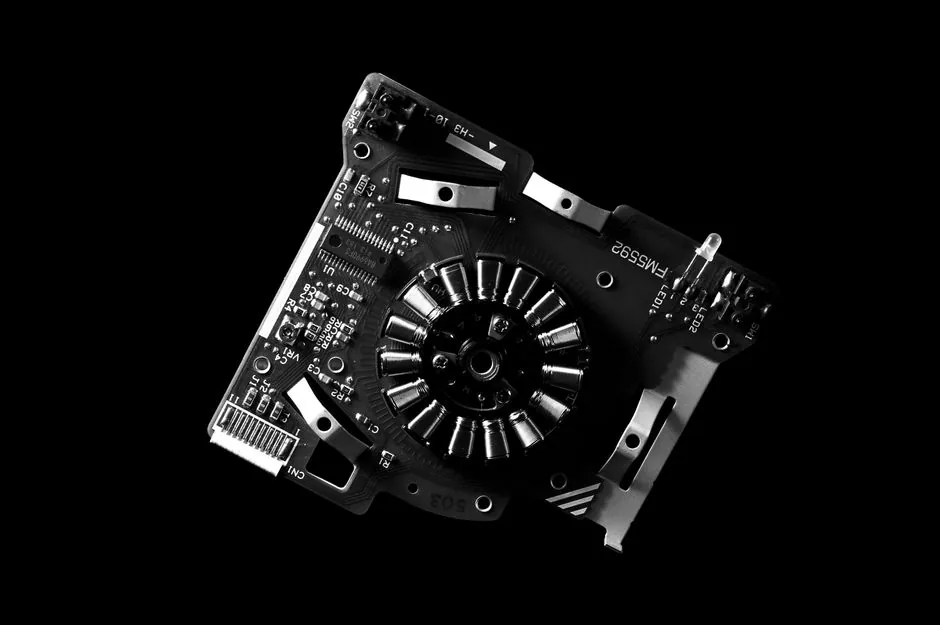
Electronics-grade metal powders divide into functional families by job: silver, copper, and nickel for conductive pastes and printed circuits [S1]; tungsten carbide, copper-tungsten, and silver-tungsten composites for switching contacts that see arcing [S1]; aluminum oxide and aluminum nitride as thermal fillers [S1]; and lithium and cobalt for battery electrodes [S1].
Production route is the first spec gate, not the last. Atomization, mechanical milling, and chemical reduction each produce different morphology, purity, and cost profiles; a powder qualified for one forming process will frequently fail in another, so selection must start with the forming step, not the alloy name. The 1950s first use of metal powders in electronics was as conductive fillers in rudimentary circuits, and the field has since spread into PCBs, contacts, EMI shielding, and battery electrodes [S4].
Alloy-to-Function Map: What Each Powder Actually Does in a Device
Silver and copper powders are the dominant choices for conductive pastes used in printed electronics and photovoltaic cells because of their high bulk conductivity and stable oxide behavior in screen-printing inks [S1][S2]. For high-performance electrical contacts in switches, tungsten carbide, copper-tungsten, and silver-tungsten composites are specified, since tungsten resists arc erosion while the copper or silver phase keeps contact resistance low [S1].
Thermal management is a separate alloy family, not a thinner version of a conductor. Aluminum oxide and aluminum nitride are filled into thermal interface materials to lift heat-transfer rates in packaged ICs and power modules [S1]. For electromagnetic and radio-frequency shielding, nickel and copper powders are applied as coatings and plating layers; nickel is favored where controlled magnetic permeability is required, copper where maximum bulk conductivity at minimum thickness is the goal [S1].
Battery electrodes draw on lithium and cobalt metal powders for their high specific energy, and the broader functional powder set used across electronics spans silver, copper, nickel, cobalt, zinc, and gold-based compositions [S3]. Copper specifically is singled out across the literature for the combination of electrical conductivity, thermal conductivity, and corrosion resistance that makes it a default in contacts, filters, and heat exchangers [S2][S5].
Particle Size, Morphology, and the Three Production Routes
Electronics-grade powders typically run from a few micrometers to several hundred micrometers, and particle size distribution directly controls screen-printing resolution, sinter density, and packing in conductive inks [S2]. Atomization, the dominant industrial route, uses high-pressure gas or liquid jets to break a molten stream into droplets that solidify as spherical or near-spherical particles, which is the morphology that flows cleanly in additive and powder-metallurgy equipment [S2].
Mechanical milling grinds bulk metal in ball mills or attritors and is the practical choice for hard, brittle materials and for mechanical alloying, but it introduces milling-media contamination and work-hardens particles, so it is rarely used where oxide cleanliness or ductility matters [S2]. Chemical reduction of metal oxides or salts with hydrogen or carbon monoxide delivers ultra-fine, high-purity powders and is the route of choice for reactive metals that do not behave well in a molten bath, at the cost of slower throughput [S2].
For powder metallurgy components outside the strict electronics-paste world, iron and steel powders remain the cost-effective default for structural parts such as gears, bushings, and bearings, while stainless-steel grades are used where corrosion resistance is the leading requirement [S5][S8]. The decision between metal powder families and a bulk metal material starts here: powder metallurgy trades the cost of machining for the design freedom of near-net shapes, but only if the powder grade is matched to the forming route.
Selection Criteria: How to Match Powder to Process and End-Use

The criteria order is fixed by the physics of forming, not by preference. Start with end-use demands, since high-temperature, corrosive, or weight-sensitive environments rule out entire alloy families before particle specs are considered [S5]. Compatibility with the chosen manufacturing process is the second gate: a powder that screens well may not sinter well, and a powder that sinters well may clog an injection-molding barrel [S6].
Powder characteristics to specify in order are particle size distribution, particle morphology (spherical, irregular, or flake), chemical purity, and apparent density, with each parameter traceable to a production route [S5][S6]. For aluminum powders specifically, the combination of low density, high strength-to-weight, and thermal conductivity makes them a cornerstone for metal 3D printing of lightweight, high-strength electronic and structural components [S7].
Comparative spec ranges for the main powder families used in electronics, as drawn from the surveyed sources, line up roughly as: silver and copper offer the highest electrical and thermal conductivity but oxidize without inert handling; tungsten carbide and Cu-W trade conductivity for arc resistance and density; aluminum and its alloys sit in the middle for conductivity with the lowest weight penalty; iron and stainless-steel powders are the structural baseline where conductivity is not required [S1][S2][S5][S8]. A common pitfall is to treat powder metallurgy as a near-net-shape substitute for cement-bonded or cast parts without re-qualifying the part for the porosity and grain-flow limits of the sintered state [S8].
Recent Direction: Self-Healing Powders and Sustainable Feedstocks
Research is actively pursuing metal powders with self-healing properties to extend device longevity and reliability, particularly for high-performance electronics exposed to thermal cycling and mechanical stress [S4]. The same review notes that modern manufacturing routes such as gas atomization, electrochemical deposition, and mechanical alloying now produce particles from micron-scale down to nanoscale, with controlled morphology and composition, opening room for tunable conductivity-to-weight ratios and compatibility with flexible or stretchable substrates [S4].
Sustainability has moved from a side note to a stated objective, with efforts targeting lower-energy powder production routes, recycled feedstocks, and the reduction of rare or toxic elements, plus bio-compatible powders for wearable and implantable electronics [S4]. The integration paths that are now visible combine metal powders with polymers for tailored electrical-mechanical composites, and with ceramics for thermal-management parts in high-performance computing, both of which depend on powder-grade selection rather than bulk substitution [S4].
Limits, Failure Modes, and What the Data Will Not Tell You
Two failure modes dominate electronics-powder selection. First, oxide formation on copper and silver powders degrades sinter bonds and contact resistance, so storage and handling in inert atmosphere are part of the spec, not a footnote. Second, impurities introduced during mechanical milling can shift resistivity and sintering kinetics enough to scrap a lot, which is why high-purity chemical reduction is preferred for reactive metals even at lower throughput [S2].
For thermal management, aluminum oxide and aluminum nitride are fillers, not conductors, and their dielectric behavior must be considered when a part also carries signal currents [S1]. For battery electrodes, lithium and cobalt powders carry the usual handling constraints of reactive and toxic metals, and any cross-reference to a structural powder grade should be treated as a different material class, not a similar one [S1]. The fact that a single powder family appears in multiple application lists does not mean the same grade, size cut, or purity will work across them.
Sourcing, Standards, and What to Verify Before Order
Standards to pin at the spec stage include particle size distribution methods (sieve and laser diffraction), apparent density and flow rate per the relevant ISO/ASTM metallurgical-powder standards, and chemical purity by ICP or XRF traceable to a published test method. Where parts end up in regulated environments, RoHS and REACH compliance for restricted elements is a separate gate from powder performance, and should be confirmed by certificate rather than by supplier statement alone. [S2]
For sourcing, the choice between atomized, milled, and chemically reduced powder should be justified by the forming route, not by availability: gas-atomized spherical powder for additive manufacturing and powder-bed fusion, water-atomized or milled irregular powder for press-and-sinter structural parts, and chemically reduced ultra-fine powder for paste and ink applications where surface area dominates [S2]. Cross-check incoming lots against a retained reference sample before release, and lock the production route and atomization gas in the purchase specification, since two "spherical copper powders" from different routes will not perform identically in the same printer or paste.
One trackable signal over the next 12 months: whether self-healing powder research moves from journal papers to commercial powder grades with documented recovery behavior under thermal cycling [S4]. A second: how quickly recycled-content powder feeds clear the same purity and morphology bars as virgin atomized powder in electronics-paste and AM applications, since the sustainability push and the performance push are now pointing at the same supply chain [S4]. For a complementary view on choosing equipment that handles these powders, the spec map for cold chamber die casting machine selection for electronics housings and the broader optical glass selection for electronics piece both address the same downstream tolerance and process-control questions that drive powder-grade decisions upstream.