
For aluminum and magnesium electronics housings, a cold chamber die casting machine is the default architecture whenever shot weight crosses the ~90 g threshold that marks the upper limit of typical hot chamber work, because the molten aluminum ladling step keeps the gooseneck and plunger out of continuous contact with alloy above roughly 660 °C [S1][S3]. Selection in practice is alloy-driven, not process-driven: specify the alloy grade (commonly A380, ADC12, or AZ91D for magnesium), define the housing envelope and projected area, then match clamping tonnage, shot weight, and cycle time to that envelope [S3].
High-end cold chamber machines are routinely built in clamping-force bands from roughly 180 t up to 900 t for general electronics and automotive work, with the largest industrial builds reaching 1,000–9,000 t for structural parts [S2]. For an electronics housing that typically maps to mid-range tonnage, the practical question is not "which brand" first, it is "what cycle rate, what shot weight, and what porosity budget" the part and the downstream inspection plan can absorb [S3].
Why Cold Chamber, Not Hot Chamber, for Electronics Housings
Hot chamber die casting runs roughly 400–900 cycles per hour because the molten zinc or magnesium stays inside an integrated furnace plumbed to the gooseneck, but the gooseneck, plunger, and nozzle are continuously immersed in the melt, so the architecture is only viable for alloys that do not aggressively attack steel at process temperature [S5]. Cold chamber die casting instead melts the alloy in a separate furnace and ladles a discrete shot into the shot sleeve before each injection, so the injection hardware sees only one slug of metal per cycle, not a continuous bath, which is what unlocks aluminum, magnesium, brass, and copper work [S4][S5].
The trade is throughput: cold chamber typically runs 50–90 cycles per hour versus 400–900 for hot chamber, because the ladling step and the longer pour-and-inject window add several seconds per cycle [S5]. For an electronics housing with wall sections in the 1.5–3.0 mm band, that hit is acceptable because the per-shot value (housing price, machining savings, surface finish) is high, and the slower cycle buys denser fill, less porosity, and longer die life under thermal cycling [S3][S4]. Buyers comparing routes should put cycle rate on a per-shift-output basis, not a per-second basis, before declaring cold chamber "too slow" [S3].
Alloy and Material Selection for Housing Applications
Aluminum is the most-used metal in the cold chamber process, and the standard die-casting grades A380, ADC12, and similar Al-Si-Cu families are the default picks for housings, heat sinks, covers, mounting frames, and structural shells where low mass and thermal conductivity matter [S1][S3]. Magnesium alloys such as AZ91D are a common second choice when the housing is weight-critical (laptops, drones, handheld electronics) and the part can be designed around magnesium's lower modulus and tighter corrosion-control needs [S2][S3].
Brass and copper are also cold-chamber-compatible but appear less often in mainstream consumer electronics housings, because the higher melt temperature and shorter die life at those temperatures push total cost up versus aluminum at the same geometry [S5]. When the housing is a structural part, fastener boss, or RF shield that doubles as a heat spreader, the right starting point is aluminum A380 or ADC12; if the housing is primarily cosmetic and lightweight, magnesium via cold chamber or thixomolding is the route to evaluate [S1][S2].
Machine Specs That Drive the Buy Decision

Five machine parameters dominate selection: clamping force, shot weight, platen size, injection pressure, and die-height stroke. Clamping force must overcome the projected area of the housing at the planned injection pressure, with a 1.2–1.5× safety factor for aluminum to contain flash on the parting line [S2][S3]. Shot weight is the next hard gate: cold chamber machines are commonly specified for parts above ~90 g of cast weight, and the machine's rated shot weight should sit roughly 1.3–1.5× above the part's net weight to keep the injection sleeve fill ratio inside the 30–50% band that minimizes air entrainment [S1][S2].
Platen size and tie-bar clearance define the maximum housing envelope; a 1600 × 1600 mm platen is typical for mid-range machines, and the part plus runner plus overflows must fit within roughly 70% of tie-bar spacing to leave room for ejection and robotics. Injection pressure on modern cold chamber cells is commonly in the 70–120 MPa band for aluminum housings, with intensification (the boost at end of fill) a separate spec that affects flash and porosity [S2]. For electronics housings, surface-finish spec (typically Ra 1.6–3.2 µm as-cast on visible faces) and the leak-tightness or EMI-shielding requirement are usually more binding than the headline tonnage number, so write those into the RFQ before tooling talks begin [S3].
Defect, Porosity, and Process Window Trade-offs
Cold chamber die casting's main quality risks are porosity, shrinkage, cold shuts, and thermal distortion, all of which the buyer should expect to see addressed in the supplier's first-article inspection report [S3][S4]. Porosity is governed by injection speed profile (slow fill, fast intensification), melt temperature (typically 660–720 °C for aluminum A380), and die temperature (180–250 °C on the cavity face), and the buyer's spec should call out the maximum acceptable void size on X-ray, usually under 1 mm and below 5% area fraction on critical faces [S3].
Shrinkage and cold shuts are usually a function of the gating/runner design and the cooling line layout, so RFQ packages should include the CAD model and the critical wall-thickness map, not just the 3D file [S4]. Vacuum-assist cold chamber, where the shot sleeve and cavity are evacuated before injection, is the documented route to drop porosity on thin-wall electronics housings below the as-cast leak-tightness threshold, and the buyer should flag vacuum as a feature on the vacuum die casting machine spec when the housing must pass a pressure-decay or helium-leak test [S3][S4].
Process Control, Energy, and Throughput Economics
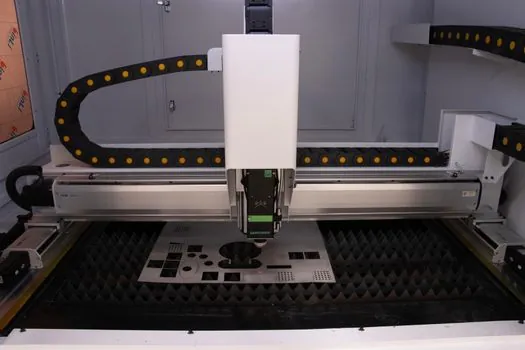
Modern servo-driven hydraulic cold chamber cells are markedly more energy-efficient than legacy proportional-valve machines, with closed-loop pressure and velocity control cutting both kWh per shot and scrap rate on critical parts [S2]. Real-time process monitoring of shot position, intensification pressure, and die-temperature zones is now standard on mid-range and up, and that data feeds both SPC charts at the press and downstream traceability records that the electronics OEM almost always requires for housing shipments [S2][S3].
What to Write Into the RFQ, and What to Verify at First Article
The cleanest cold chamber RFQ for an electronics housing fixes, up front, alloy grade, projected area and net part weight, critical wall thickness, as-cast surface-finish spec, leak-tightness or shielding requirement, annual volume, and target piece-price band; without these, suppliers default to generic tonnage-based quotes that almost always miss the actual constraint [S3]. The next gate is first-article inspection evidence: CMM dimensional report, X-ray or CT scan for porosity on critical faces, leak test or conductivity test, and a tensile or hardness coupon from the same shot, all of which are routine asks in serious housing programs [S3][S4].
For buyers also evaluating other casting routes, the same alloy-and-envelope logic applies to aluminum die casting machine cells and to gravity die casting machine cells used for lower-volume or thicker-walled housing variants, and the cold-chamber decision should be made against those two alongside any die casting machine shortlist on equal RFQ terms. For shops that already CNC-mill or finish metal housings, the practical next signal to watch is the spread of vacuum-assist and real-time shot-monitoring options on mid-range cold chamber quotes, because those two features are doing the most to drop scrap rates on electronics-housing programs through 2026. Related capacity planning on the finishing side is covered in Sand Blasting Machine TCO: Cost Drivers, Air Cost, and Media Selection, and tool-side decisions for housing dies sit alongside the logic in Mold Base Selection for Energy Equipment: Material, Plate Stack-Up, and Size Logic.