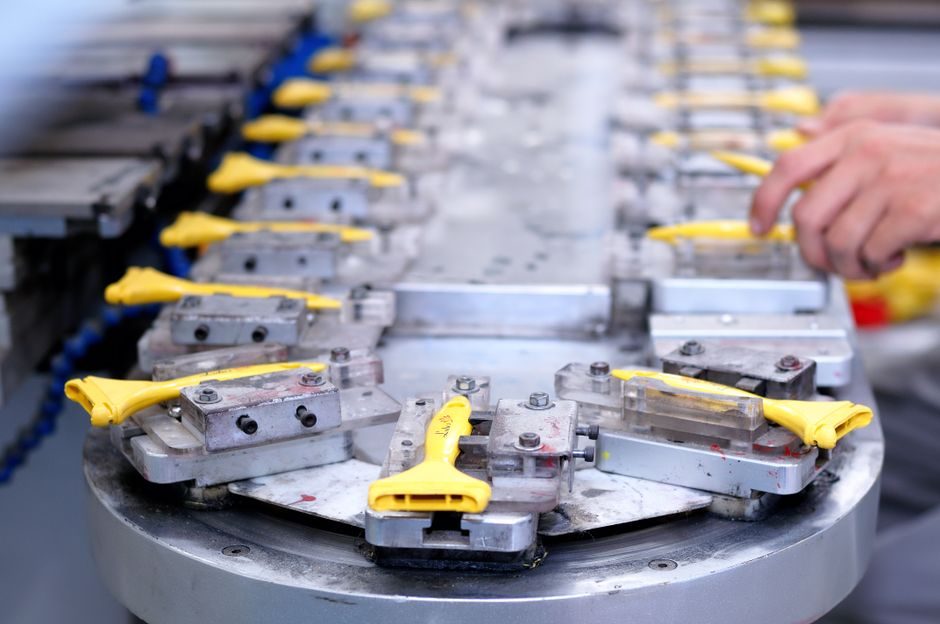
Progressive-die stamping, four-slide forming, deep drawing and fine blanking cover roughly the full commercial envelope of sheet-metal part production, and choosing among them on the basis of geometry, tolerance, material and volume — not on unit price — is the single biggest lever a 2026 specifier has to control landed cost [S1][S5].
China-origin shops cluster around Cangzhou (Hebei) and Beijing for auto, power-supply and consumer-electronics stampings, while U.S. shops such as Team Manufacturing (since 1975) and Kenmode focus on low-volume precision and tooling-heavy work [S2][S3][S4][S5][S8]. Buyers should treat the forming process, the material spec and the annual volume as the three independent variables that actually determine cost-per-part.
Process Family vs. Part Geometry
Progressive-die stamping on mechanical or servo presses is the default for flat or shallow features in coil stock from 0.2 mm to 6 mm, with high-speed presses running thin-gauge parts at very high production rates; fine blanking delivers smooth, burr-free edges on thicker stock (commonly 2–10 mm) at slower strokes, and four-slide / multi-slide is preferred for parts with multiple bends, twists or wire-like features [S1][S5]. Deep drawing — a subset of stamping — covers cup, can and enclosure geometries where depth exceeds diameter, and is widely used for power-supply boxes and metal cases out of Hebei and Guangdong shops [S1][S2].
Coining, embossing and extrusion are not interchangeable: coining forces material into a die cavity to produce sharp detail or coined-in markings, embossing raises a relief on the surface, and extrusion pushes material through a shaped opening — each operation has a distinct die-cost and tolerance profile that should be matched to the feature on the print before RFQ is issued [S1].
Material, Thickness and Tolerance Envelope
Cold-rolled steel (CRS), stainless (304 / 316), aluminum (5052 / 6061), copper and brass dominate the 2026 B2B stamping catalog, with Oriens and Andao publishing active stock lists across all five families for laser-cut and stamped parts [S2][S4][S8]. Material behaves very differently in the press: the same 1.5 mm gauge in 304 stainless work-hardens and spring-backs roughly 30–50% more than mild CRS, so bend radii and blank dimensions must be compensated in the die design, not the print [S1].
Tolerance classes split cleanly: progressive-die and high-speed press work typically holds ±0.05–0.10 mm on dimensions and ±0.1° on angles for thin gauge; fine blanking tightens flatness and edge-condition to ±0.01–0.025 mm and Ra 0.4–0.8 µm, which is what automotive seat-adjust and connector terminals are quoted against [S1][S5]. When the print calls for both a tight tolerance and a thick section, the spec should state which process is approved — fine blanking, precision coining or secondary CNC — so the supplier does not default to the cheapest press in the shop.
Volume Threshold and Tooling Amortization

Tooling cost amortizes very differently across process families: a simple four-slide tool can be production-ready in 2–4 weeks at low five-figure USD cost, while a multi-station progressive die for an automotive bracket commonly runs 8–16 weeks and into six figures [S1][S5]. The break-even point between a hard tooling line and a CNC/laser-only route typically falls in the 1,000–5,000 part range, and the buyer should request both numbers — tool cost and piece price — on every quote so amortized cost can be compared honestly [S3][S4][S7].
Low-volume runs (under ~500 parts) often land in laser-cutting or CNC-bending shops like DACO Precision, which combines production stampings, CNC machining (vertical, horizontal and Swiss-style) and Wire/Sinker EDM under one roof for prototype and bridge production [S7]. Specifiers who skip the volume conversation and go straight to piece price routinely over-pay by 2–4× because the tooling is amortized over a 5,000-piece run that never ships.
Decision Matrix: Progressive vs. Four-Slide vs. Deep Draw vs. Fine Blanking
On four decision criteria — typical thickness, edge / flatness tolerance, geometry complexity and economic run size — the four process families sort cleanly. Progressive-die covers 0.2–6 mm gauge at ±0.05–0.10 mm with high feature density, and is the lowest unit cost above ~50,000 parts/year [S1][S5]. Four-slide handles 0.3–3 mm wire-like and bent features at looser tolerance (±0.1–0.2 mm) but very low tool cost, ideal for 5,000–100,000-piece runs of brackets and clips [S1][S5].
Deep draw is reserved for cup / can / enclosure geometries where depth ≥ 0.5 × diameter, typically in 0.5–3 mm CRS, aluminum or stainless, and the die cost is high but unit cost drops steeply above 20,000 parts [S1][S2]. Fine blanking holds ±0.01–0.025 mm on 2–10 mm stock with Ra 0.4–0.8 µm edges, at 20–40 strokes/min — the right answer for safety-critical gears, relay cores and connectors where edge burr cannot be tolerated downstream [S1].
Supplier Landscape and Sourcing Channels in 2026

Made-in-China remains the densest B2B sourcing channel for stamped parts, listing Andao and Oriens on active storefronts that expose product categories (auto PA parts, power-supply boxes, metal cases, laser-cut parts) directly to RFQ [S2][S4][S8]. Beijing Oriens Technology (3-year verified supplier on EveryChina) and Oriens Metal ship stamping and laser-cut parts in mixed CRS, stainless, aluminum, copper and brass for overseas OEM and trading-company buyers [S4][S8].
For U.S. and EU buyers with low-volume precision work, Team Manufacturing (founded 1975) and Kenmode publish custom-stamping guides and run a tooling-plus-production model that competes on engineering input rather than piece price [S3][S5]. For prototype and bridge production, DACO Precision combines stamping, CNC, laser and EDM in one U.S. shop, which is the right cell when tooling has not been amortized [S7]. For comparison with adjacent sheet processes, see the perforated metal sheet pricing 2026 cost analysis, and for hardware-adjacent bent parts the wire form part price and cost guide covers the four-slide and wire-forming overlap. Buyers comparing stamping to storage and material-handling hardware should also review the industrial storage rack spec-first selection guide when the part feeds a racking or enclosure build.
Tooling, Maintenance and Quality Gates
Stamping die manufacturing follows a fixed sequence — design study, planning, pre-machining, heat treatment, final machining, bench fitting and assembly — and tool-and-die work is among the most skill-intensive branches of precision engineering, with CNC, EDM and Wire-EDM replacing most hand-finishing on modern lines [S1]. Preventive maintenance (punch resharpening, worn-stripper replacement, and periodic inspection against the print) is what keeps ±0.05 mm tolerances from drifting to ±0.10 mm across a 500,000-stroke production run [S1][S7].
Quality gates that should appear on every 2026 stamping PO: first-article inspection with a CMM or optical comparator report, in-process dimensional checks at a documented frequency (commonly every 500–2,000 strokes), and a preventive-maintenance log stamped by the tool-room on each die. For stamping of electrical contacts, brackets and shielding, also reference the metal powder feedstock encyclopedia entry when secondary sintering or MIM is in scope, the linear motion guide entry when the stamped bracket is part of a slide assembly, and the embedded fastener entry when clinch nuts or studs are pressed in during the same die stroke [S1][S5].
Limits, Failure Modes and When Not to Stamp

Stamping is the wrong process when the feature count is low, the geometry is prismatic, the tolerance window is sub-±0.02 mm on a non-critical dimension, or the run size is under ~200 parts — in those cases, CNC milling, turning or Swiss machining out of DACO-style job shops is faster and cheaper, even with higher piece price [S7]. Deep-draw tooling is also the wrong call for short-run enclosures; laser-cut and brake-formed panels from CRS or aluminum are typically 30–60% cheaper below 1,000 parts and ship in days instead of weeks [S1][S4][S7].
Common 2026 failure modes that show up at receiving inspection: spring-back exceeding the print tolerance on stainless bends, edge burr outside the agreed Ra on parts that were quoted as fine-blanked but run on a conventional press, and dimensional drift on progressive dies that have not been regrounded at the agreed PM interval — each is traceable to a process or material mismatch that should have been flagged at RFQ, not at PPAP [S1][S5][S7].
Trackable signals for the next sourcing cycle: confirm the supplier's PM-log template and CMM sample size before PO release, lock the material certificate (mill heat number, ASTM/EN grade, finish) on the print, and require the first 50 production parts to be measured against a documented gauge R&R study — these three artefacts close the gap between a stamped part and a print-compliant stamped part.