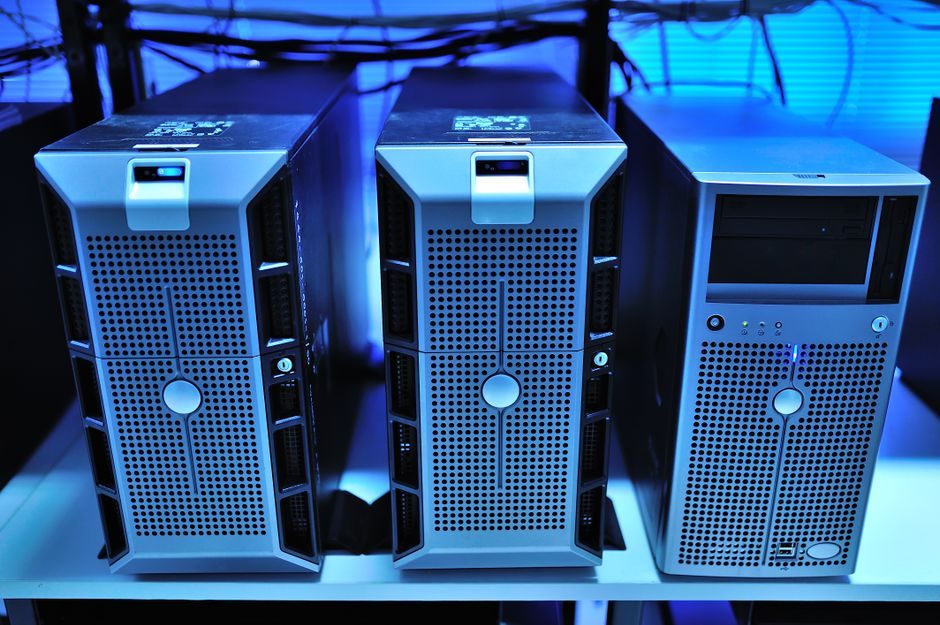
Storage rack selection is a load-geometry decision before it is a vendor decision: bay ratings span roughly 800 lb (light-duty shelving) to 30,000+ lb (heavy pallet rack) per pair of beams, and the wrong class wastes floor cube or collapses under live load [S2]. The decision tree begins with the unit load (pallet weight, carton footprint, or piece size), then the lift equipment in play, then the building envelope (clear height, column grid, floor flatness), then the throughput target (SST vs. FIFO vs. ASRS).
For most general-merchandise and 3PL operations, selective pallet rack remains the default because every pallet position is individually accessible with no FIFO constraint, and beam heights are field-adjustable in 2-inch increments. For high-density cold storage, drive-in or ASRS configurations trade selectivity for cube utilization, often reaching 85-90% volumetric efficiency versus 35-40% for conventional selective layouts [S5]. A 2026 build-out that ignores these trade-offs almost always over-spends on steel or under-builds for growth.
Load Class, Bay Geometry, and Beam Capacity
Beam capacity is published per pair and assumes the load is centered, uniformly distributed, and supported by properly-engaged beam-end clips — a stipulation the industry repeats because field failures overwhelmingly trace to clip disengagement or overloaded decks, not raw steel yield [S2]. Akro-Mils wire shelving systems, for example, carry 800 lb to 6,500 lb per shelf depending on configuration, while light-duty 4-inch shelf bins top out at 7 lb per bin (Model 30110, 11-5/8" L x 2-3/4" W x 4" H) [S2]. Heavy-duty storage rack frames from Asian OEMs are typically rated 20,000-30,000 lb per bay when the upright height stays under 30 ft and beam levels are limited to 4-5, with capacity dropping as both height and number of beam levels climb.
For seismic Zone 4 installations (UBC/IBC equivalent) or any project where forklift impact is plausible, anchor pull-out and base-plate thickness become governing variables rather than beam capacity alone. Floor flatness must meet ACI 117 F-min tolerances before any rack is plumbed, and the first 2-3 bays out of a rack row are the most impact-exposed — a layout fact, not a vendor talking point.
Five Rack Classes and Their Throughput-Cube Trade-off
Selective pallet rack gives 100% SKU selectivity at roughly 35-40% cube utilization and is the only class that supports any pallet position being reached without moving neighbors. Drive-in and drive-through rack push cube to ~75-80% but force last-in/first-out (LIFO) or first-in/first-out (FIFO) respectively, with drive-through adding one extra aisle face and a higher damage risk on the inner rails. Cantilever rack — sometimes called linear guide-style for long goods — handles lumber, pipe, and bar stock on arms that bolt into a continuous column; load increases with arm length and base-anchor count. [S1]
Pallet flow rack uses inclined rollers or skates and runs FIFO at 60-70% cube, with each lane typically holding 10-20 pallets deep. Push-back rack (LIFO on nested carts) reaches 70-80% cube for 2-6 pallets deep.
Who Should Use What: Decision Criteria for Specifiers

Specifying rack for an order-pick, piece-flow operation (think medical parts, small electronics, pharma picking): start with 4-inch shelf bins on 12/18/24-inch deep shelving rated to the bin load; Akro-Mils 30110-series bins at 7 lb per bin are a typical benchmark, and the shelving system scales to 6,500 lb per shelf in heavier wire/steel configurations [S2]. For bulk pallet storage with mid-volume SKUs and frequent cycle counts, selective pallet rack is the floor. For slow-moving, high-density cold storage or long-term reserve, drive-in or storage cage stackable cells are usually the right answer.
If ceiling height exceeds 30 ft, the conversation shifts to either high-bay selective (narrow-aisle turret trucks at 80%+ cube) or full ASRS, because operator reach and OSHA fall-zone rules cap manual options around 25-28 ft. If seismic risk is high, brand-neutral engineered drawings stamped for the local code (IBC, Eurocode 8, NZS 1170) are non-negotiable — and OEM-issued "seismic-rated" claims without a project-specific submittal package are not equivalent. For retail and consumer-facing displays (supermarkets, sporting goods), the rack is half merchandising hardware and half structural — a hybrid spec that often pulls in crossed-roller guide drawer slides for high-traffic fixtures.
Installation, Anchoring, and Inspection Discipline
Oracle's Exadata rack-installation procedure, while written for IT gear, codifies the same seven steps any industrial racking project should follow: review safety documentation, confirm rack specifications, confirm maintenance clearances, review configuration restrictions, review safety precautions, gather tools, and verify prerequisites before any frame is stood up [S1]. The same logic applies to power cabling: confirm whether power enters overhead or underfloor before routing PDU feeds, and verify cord lengths against rack depth.
Three inspection gates matter: (1) plumbness of uprights within 1/4 inch over the full height before any load is placed, (2) beam-clip engagement with safety pins or beam-end clips fully seated at every level, and (3) anchor torque verified to spec (typically 150-300 ft-lb for 5/8" wedge anchors in 4,000+ psi concrete). Annual inspection should include a sweep for fork-truck impact damage on the first three frames of every row, missing safety clips, and any beam deflection visible to the eye. Industry guidance (RMI/ANSI MH16.1 in the US, EN 15635 in the EU) treats these as mandatory, not advisory.
Failure Modes, Constraints, and Cost Traps
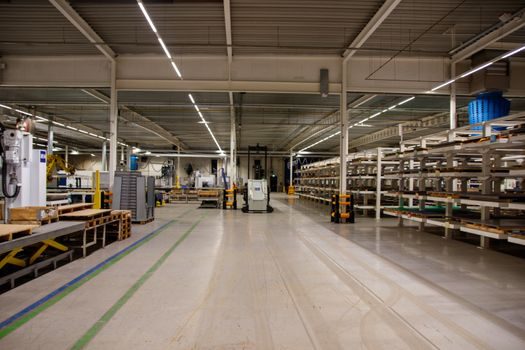
Three failure modes account for the bulk of industrial rack collapses in incident data: (1) overloaded beams (load exceeds rated capacity, often because pallet weights crept up post-installation), (2) damaged uprights from forklift impact, and (3) improperly anchored base plates. The cheapest fix is also the most often skipped: column protectors (heavy-gauge steel guards bolted to the floor) on the end frames of every row, and row-end guards at every aisle entry. The most expensive mis-spec is under-building for growth — adding a third or fourth beam level later is straightforward, but raising a row from 20 ft to 30 ft typically means new frames, new anchors, and a permit re-check. [S2]
Lead time is the silent constraint. Standard selective pallet rack from Asian or domestic OEMs runs 4-6 weeks for stocked sizes and 8-12 weeks for engineered, seismic-rated, or hot-dip-galvanized product. ASRS systems with stacker cranes are 9-18 months from PO to commissioning, and that window has lengthened since 2024 as crane and conveyor vendors consolidated. If a project is fast-tracking, the lever is reducing custom colors, finishes, and beam-level counts, not cutting capacity.
Standards, Sourcing, and Vendor Selection Signals
Reputable industrial rack OEMs carry ISO 9001 quality-system certification and a CE/EN marking for EU deliveries, with R-Mark or RMI/ANSI MH16.1 conformance for US projects. For cold storage or food-grade, powder-coat over galvanized substrate is common; for outdoor or corrosive environments, hot-dip galvanizing after fabrication extends service life by 8-15 years versus painted. Engineered submittals (general arrangement drawings, anchor calculations, seismic calcs) are the deliverable that separates a rack vendor from a rack manufacturer — if the supplier will not stamp drawings, they are not a rack manufacturer, they are a broker. [S3]
For data-center and IT integrations, the rack selection process documented in the Red Hat Ceph Storage hardware guide recommends workload-matched rack-level solutions with tested server vendors, an approach that translates cleanly to industrial automation cells and ASRS — buy the rack as part of a tested bundle, not as an a la carte steel frame [S5]. For broader manufacturing-automation context, see how this connects to upstream process infrastructure in this data center cooling automation stack breakdown and to downstream fab-level controls in this 2026 wafer fab automation maturity read. Storage rack sits at the physical-MES interface; treat it the same way — engineered, documented, and load-tested before the first pallet lands.