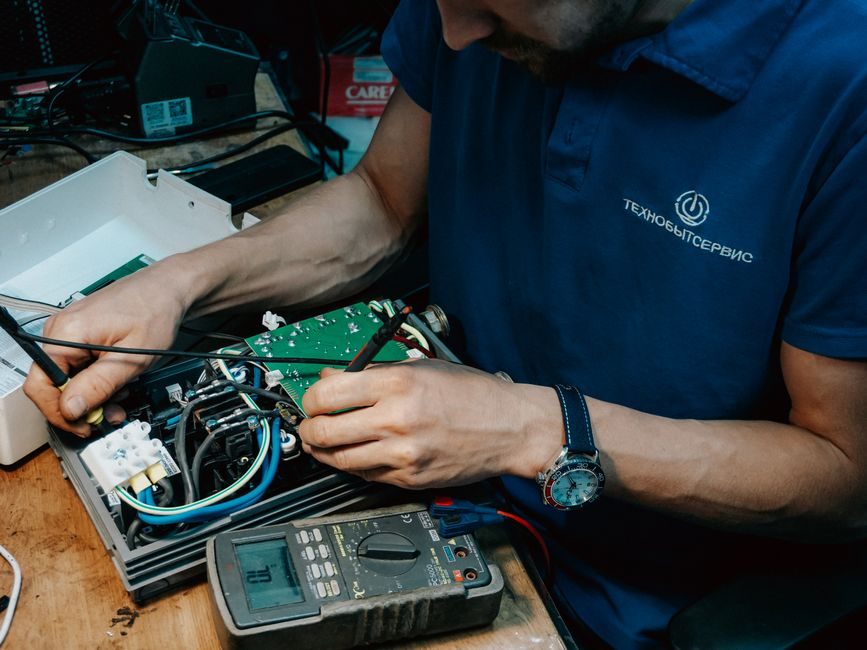
Micro-ohmmeters running the four-wire (Kelvin) method at 10–600 A test current resolve contact resistance to 0.1 µΩ with ±0.15% + 1 µΩ accuracy, while general-purpose clamp meters typically stop at 0.01 Ω resolution on a single-turn loop [S1][S3].
The choice matters because a 0.5 mΩ drift in a bolted bus-bar joint — invisible to a clamp meter — can flag a loose connection weeks before thermal runaway, and the same drift is the basis of mechanical-strength acceptance criteria in switchgear and motor-winding QA [S4][S8].
Why the four-wire method dominates sub-milliohm work
Four-wire (Kelvin) measurement injects a known current through one pair of leads and senses voltage across a second pair, so lead resistance and probe-tip contact resistance drop out of the reading [S1]. KoCoS PROMET-series instruments use this topology and force up to 600 A through the device under test, which pushes measurement uncertainty below the µΩ band even on production-floor bus bars [S1].
Multimeters — including the two-wire bench DMM most engineers reach for first — add the test-lead resistance (typically 0.2–2 Ω) and probe-tip contact resistance directly into the result, and that error becomes a substantial fraction of the reading once the DUT drops below 1 Ω [S2][S7]. Burster's microohm/milliohmmeter line keys on the same point: the four-wire method is the only way to "reliably measure micro-ohm and milliohm resistances" for motor windings, coils and contact-resistance work [S8].
Clamp-meter strengths — and the resolution ceiling
A clamp meter's core advantage is non-contact current measurement: clamp around a conductor, read amps, no break in the circuit [S2]. Fluke's own comparison puts clamp-meter resolution at "the nearest tenth or hundredth of a unit" against DMM milliunit resolution, and DMMs in turn top out around 20 A unless paired with a plug-in current clamp [S2].
That topology is wrong for mechanical-integrity testing. A clamp meter measures the loop, not the joint — it sums cable resistance, termination resistance and DUT resistance into one number, with no way to isolate the bolt, weld or contact you actually want to grade [S2][S5]. Sanwa and Powertech both classify the clamp meter as a "safer, quicker" current tool rather than a low-resistance acceptance instrument [S5][S6].
Mechanical-strength proxies that only a micro-ohmmeter sees
Joint integrity, weld continuity and winding turn-to-turn resistance are all judged against absolute µΩ thresholds in QA. Megger's low-resistance guide lists cable joints, welds, bus bars and switchgear as the four canonical targets for 100+ A micro-ohmmeters, and warns that operators who run a 10 A test and then see improved resistance readings need to re-baseline before comparing to factory data [S4].
Burster's product literature ties the same point to motor and coil QA: the four-wire measurement method is what makes "reliable" micro-ohm and milliohm readings possible for winding tests, where a small rise in phase resistance is a known indicator of turn insulation degradation long before a motor fails on a servo-motor drive [S8]. A clamp meter cannot detect that drift — its least-significant digit is too coarse.
Comparison on the four decision criteria that actually matter
Side-by-side on the metrics a QA engineer cares about: (1) Best resolution — micro-ohmmeter 0.1 µΩ at 10 A on the AEMC 6292, clamp meter typically 10 mΩ [S3]. (2) Test current — micro-ohmmeter 5–600 A, clamp meter 0 A injected (passive inductive current sense) [S1][S2]. (3) Probe topology — micro-ohmmeter four-wire Kelvin with combined or separate C/P probes, clamp meter single-jaw inductive pickup [S1][S4]. (4) Primary use — micro-ohmmeter absolute joint/winding resistance for acceptance, clamp meter live-circuit load current for diagnostics [S2][S6].
Pick the micro-ohmmeter when you have a de-energized joint, weld or winding and need a number that ties to a published acceptance threshold. Pick the clamp meter when the circuit is live, you only need current, and the joint is irrelevant to the question. The two instruments do not overlap on a mechanical-integrity test — the clamp meter's 10 mΩ least count is roughly 100× too coarse to grade a 50 µΩ bolted joint.
Probe configuration and the operator traps
Megger documents three common Kelvin lead layouts: combined current/potential probes, separate C and P probes spaced 180° apart on the joint, and C-clamps or Kelvin clips for bus-bar work [S4]. The 180° separation matters because the potential leads must sit inside the current-injection points, otherwise part of the bulk material resistance is added to the contact reading [S4]. KoCoS highlights the same point operationally: "Kelvin clamps and test probes" are part of the value proposition because they hold the geometry while the operator applies 100–600 A [S1].
On the AEMC 6292 (200 A faceplate), the 10 A range resolves 1.0 µΩ – 5.0 mΩ at 0.1 µΩ resolution with ±0.15% ± 1 µΩ accuracy, while the 10 mA range covers 4–4000 Ω at 100 mΩ resolution — a 10⁶:1 dynamic range in one box, which a clamp meter cannot approach [S3]. That spread is why a single micro-ohmmeter replaces both a DMM and a clamp meter on a joint-inspection cart.
Standards anchoring and sourcing
Low-resistance acceptance numbers in switchgear QA are typically tied to manufacturer datasheets and the relevant switchgear test standards, while process-side instruments such as pressure transmitters, flow meters and solenoid-actuated industrial valves feed the same kind of low-resistance contact data into the plant PLC for trend monitoring. The takeaway: do not let procurement substitute a clamp meter for a micro-ohmmeter on a joint-acceptance procedure, and do not let a micro-ohmmeter substitute for a clamp meter on a live load-current check — they are different instruments for different questions [S1][S2][S4].
Trackable signals: Ex-rated micro-ohmmeters for hazardous-area joint work, and rising 100+ A battery-pack cell-connection QC in EV lines where 4-wire Kelvin is the only way to keep µΩ-grade inter-cell resistance auditable per cell.