Mining gearboxes are sized by three numbers that engineers must lock first: peak output torque, service factor under shock load, and thermal limit at the installation altitude. NORD's MAXXDRIVE industrial gear units publish a top output of 2,495,900 lb-in and are routinely engineered into crushers, mills, and high-capacity conveyors, paired with IE5+ motors and intelligent VFDs [S2].
The most common families specified for mining duties are helical, bevel-helical, and planetary, with parallel-shaft and worm units filling auxiliary roles [S1][S3]. Selection is driven by torque density, shaft orientation, and the dust/shock environment, not by catalog price. For broader process context, see the industrial gear encyclopedia entry and a related application piece on shield machine selection for mining.
Gear family comparison for crushers, conveyors, and hoists
Helical gearboxes are the baseline choice where high efficiency and continuous duty dominate, with low noise and smooth load distribution favouring conveyor and pump drives [S1]. Bevel and helical-bevel units add a directional change, transmitting power between intersecting shafts with typical ratios from 1:1 up to about 6:1, which fits crusher driveshafts and right-angle conveyor heads [S3]. Planetary gearboxes deliver the highest torque density in the smallest envelope, and are the default for cutter heads, winches, and mobile crusher tracks [S1][S4].
Spur gears (1:1 to 6:1) and worm gears (5:1 up to 100:1) cover lower-power feeders and hoist/winch reductions, with worm units accepting the highest single-stage ratio but at lower efficiency (up to about 90%) [S3]. A worked mining example in industry guidance runs a 1480 rpm, 500 Nm motor through a 28.5:1 reducer at 94% efficiency to deliver 51.9 rpm and 13,395 Nm at the drum, with 4.6 kW of heat loss that must be rejected through the case or an oil cooler [S4]. A wider industrial reference for reducer sizing across sectors is covered in the worm gear reducer selection for marine deck machinery write-up.
Torque class, service factor, and thermal limit
Top-end industrial mining gear units now publish torque ratings up to 2,495,900 lb-in, while mid-range helical-bevel UNICASE units cover up to 442,500 lb-in across 11 case sizes [S2]. Below that, the same UNICASE parallel-shaft family targets space-constrained drives on drills, excavators, and crushers [S2]. The MAXXDRIVE XT two-stage design extends thermal capacity through a ribbed UNICASE housing and an enhanced axial fan, often removing the need for external cooling on hot sites [S2].
Mining loads are rarely steady, so the drive train is derated against impact, not against nameplate torque. Cutter-head pick hits on hard rock or sandstone bands produce shock loads several times nominal, and industry practice applies a service factor of 1.5 to 2.5 on top of the rated torque; undersizing the service factor typically initiates pitting on planet teeth, then broken pins, then ring-gear shear [S4]. Planetary backlash is held in a 0.10–0.25 mm band at the output: tighter binds under thermal growth, looser than 0.25 mm causes audible chatter that fatigues splines on reversing duty [S4].
Housing, sealing, and dust survival
One-piece UNICASE housings are the dominant heavy-mining architecture because they raise structural rigidity and limit leak paths, which matters when temperature swings and abrasive dust are constant [S2]. MAXXDRIVE units can be specced with axial fans, internal cooling coils, oil coolers, oil heaters, splash lubrication, and disc/drum brakes, and accept swing bases, backstops, and auxiliary drives to absorb starting transients on conveyor and bucket-elevator duty [S2].
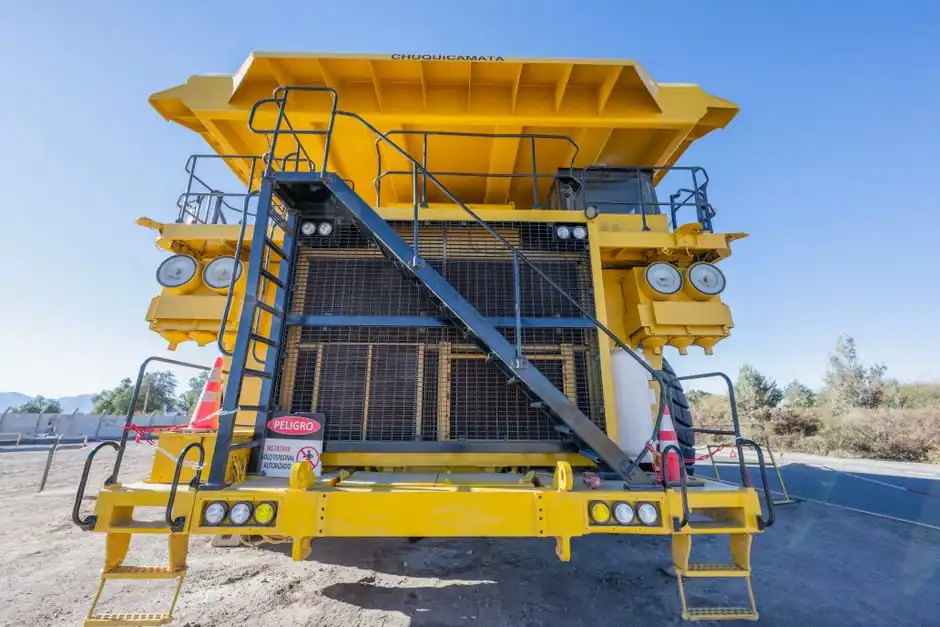
Helical-bevel UNICASE units add high axial and radial load capacity, minimum backlash, and the GRIPMAXX keyless bushing system for shaft mounting, with heavy-duty bearing options and spread bearing/flange mount designs used on in-pit crushing and screening plants [S2]. The corollary on the materials side: the heavy mobile equipment these gearboxes feed (haul trucks, shovels, drill rigs) is covered separately in the mining dump truck encyclopedia entry.
Selection criteria: who needs which family
For high-torque, continuous, low-noise conveyor and crusher service, default to helical or helical-bevel units; for the highest torque density in a compact envelope (cutter drums, winches, track drives), default to planetary with a multi-stage or planetary-bevel hybrid arrangement [S1][S4]. For directional change at right angles with precise ratio control (1:1 to 6:1), bevel gears are the standard answer, while worm gears (5:1 to 100:1) are reserved for hoists, winches, and elevators where high reduction in a small space outweighs efficiency loss [S3].
Who this is NOT for: a one-size gearbox spec is wrong for any operation. Each mining site has its own load profile, dust load, ambient temperature, and altitude, and a unit that is correct for a 25°C underground coal conveyor will underperform on a 45°C surface copper concentrator [S1][S4]. A 300 kW continuous miner running through an 88% efficient drive train already dumps 36 kW of heat into the oil, so the thermal envelope must be calculated, not assumed [S4].
Common failure modes and limits to engineer against
First-failure signatures on planetary mining gearboxes trace back to shock and thermal overload: planet-tooth pitting, planet-pin fracture, then catastrophic ring-gear shear when the service factor is too low for the duty [S4]. On worm and helical units, mesh efficiency losses convert directly to oil-bulk temperature, and the typical failure path is oil-viscosity collapse followed by bearing distress if the case, cooler, or mine ventilation cannot carry the heat away [S4].
Backlash outside the 0.10–0.25 mm planetary band binds or chatters, and a mis-sized service factor is the single most common root cause of premature gearbox retirement in mobile mining equipment [S4]. Practical limits to spec against: shock loads several times nominal, continuous service at 88–94% drivetrain efficiency, and thermal rejection that scales with motor power (about 12% of input power as heat at 88% efficiency, rising as efficiency drops) [S4].
Standards, sourcing, and verification
Third-party testing, inspection, and certification play a growing role in mining gearbox sourcing, with multidisciplinary engineering support covering heat-treatment process improvement, QA/QC oversight, steel shop fabrication inspection, NDT, and structural steel and masonry inspection on processing plant assets [S5]. For reducers destined for hazardous areas, prime movers include flameproof induction motors for gassy coal seams, while hydraulic motors are used where electrical infrastructure cannot reach the face [S4].
Sourcing checklist before placing an order: confirm housing type (one-piece UNICASE preferred for dust survival), torque rating in lb-in matched to the worst-case shock load x service factor (1.5 to 2.5), thermal rating with or without external cooling, available options (backstops, brakes, oil heaters/coolers, auxiliary drives, GRIPMAXX bushings), and the supplier's NDT/QA documentation trail [S2][S4][S5]. Two trackable signals to watch through the rest of 2026: continued migration from IE3 to IE5+ motor classes paired with industrial gear units, and the spread of two-stage ribbed-housing designs that drop the external oil cooler in high-temperature surface operations [S2].
Component reference pages worth checking: industrial adhesive.