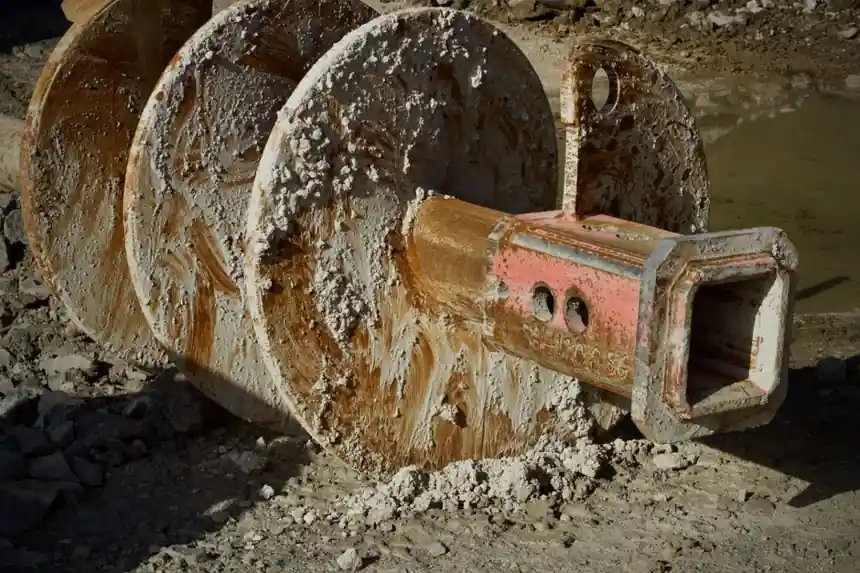
A DTH drilling rig generates percussive energy inside the borehole, with the hammer positioned directly behind the bit, while a top hammer rig strikes the drill string at the surface and transmits impact energy downward through the rods [S1][S2]. The mechanical split is the single biggest driver of penetration rate, hole straightness, and compressor sizing on any mining or quarry site.
The two methods target different operating envelopes: top hammer rigs cover 25–127 mm hole diameters at depths typically under 20–25 m, and DTH rigs cover larger diameters and deeper holes where the rock unconfined compressive strength (UCS) exceeds 200 MPa [S2]. Picking the wrong system on a 30 m granite blast pattern will burn compressor fuel and waste rod strings; picking it right usually decides whether a quarry bench is drilled in one shift or three.
Working Principle and Energy Path
DTH drilling locates the pneumatic hammer at the bottom of the drill string, so the piston strikes an anvil linked directly to the bit and the exhaust air flushes cuttings up the annulus [S1][S3]. Because the impact source travels with the bit, the energy does not have to traverse threaded rod joints, and the heavy hammer body also acts as a stabilising guide that limits hole deviation in hard, abrasive rock [S4].
Top hammer drilling runs the percussion mechanism on the rig itself, often called a drifter, and sends each blow through the shank adapter and every rod in the string to the bit [S2]. Each threaded joint absorbs a measurable share of the stress wave as heat and vibration, so penetration rate degrades with depth and the bit receives progressively less usable energy [S4]. Typical surface operating envelopes for top hammer are 2,000–5,000 blows per minute at 60–200 rpm rotation, with hole diameters up to 127 mm and depths usually capped near 20 m [S2].
Operating Envelope Comparison: Diameter, Depth, Rock Hardness
The selection matrix that experienced site engineers apply is straightforward when reduced to numbers. Top hammer rigs fit 25–127 mm holes under 20–25 m in stable, uniform hard rock; DTH rigs cover diameters from roughly 100 mm up to 250 mm or more at depths that can exceed 100 m, with peak efficiency above 200 MPa UCS [S2]. Below 200 MPa the DTH hammer’s piston stroke is too aggressive, energy is wasted, bit wear accelerates, and cuttings evacuation suffers because soft rock cannot absorb the blow efficiently [S2].
Compressed-air demand is the other hard differentiator. DTH rigs require a high-pressure rotary screw air compressor sized to the hammer, typically operating in the 17–30 bar range to drive the piston and lift cuttings out of the annulus, while top hammer rigs run at lower pressures and can be matched to smaller portable compressors [S3]. For quarry and aggregate pits this compressor pairing is what locks a fleet into DTH for deep production holes, and into top hammer for bench prep and pre-split work where mobility matters more than hole depth [S1][S3].
Drilling Efficiency in Hard Rock Conditions
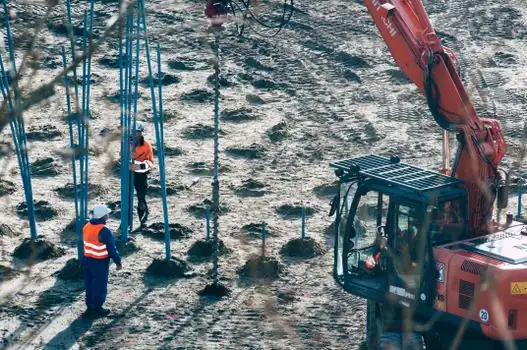
Hammer drilling from the top struggles with hole deviation in granite and basalt because long rods flex under percussive load, and each additional rod section adds a reflective joint that bleeds energy [S4]. DTH drilling keeps the hammer at the bottom, so the energy transfer is described in field guides as nearly 100% efficient at the bit face, and the straight-hole accuracy is what enables clean blasting patterns in hard-rock quarry benches [S4].
Penetration rate data published by rig manufacturers converges on the same rule of thumb: top hammer leads at shallow depths and small diameters on medium-hard rock, but DTH pulls ahead once the hole goes past roughly 20 m or the rock UCS climbs above 200 MPa, because DTH does not pay the per-joint energy penalty [S2][S4]. This is also why DTH is the default for blast-hole drilling in open-pit mines, water-well work through variable strata, and foundation piling on hard formations, while top hammer dominates aggregate quarrying, small construction blasts, and bench-scale pre-split drilling [S1][S2].
Equipment, Maintenance, and Site Footprint
The two systems are not interchangeable on the same carrier. A DTH rig needs a heavy-duty high-pressure rotary screw air compressor plumbed to the hammer, a drill string sized for the hammer’s weight, and a rotary head with sufficient torque to turn the hammer plus bit; the assembly is heavier per metre of hole but needs fewer rod joints for a given depth [S3][S4]. Top hammer rigs are typically lighter, more mobile, and easier to redeploy across a small quarry or urban construction site, which is why they remain the default for short-hole production drilling [S1][S2].
Maintenance loads track the duty cycle. DTH hammers live with the bit, so the wear parts (piston, cylinder, bit shank) see constant abrasive flush and need scheduled inspection every few hundred metres in granite; top hammer wear concentrates at the shank adapter and the rod threads, where joint fatigue and stress-wave damage shorten rod life as hole depth grows [S1][S3]. For a deeper look at how a small pneumatic drifter is classified against heavier rotary rigs, see our guide to rotary drilling rig categories and the parallel engineering notes on impact drill handheld classes.
Decision Criteria: DTH vs Top Hammer at a Glance

Use this criteria matrix on the bidding table before specifying a rig. Hole diameter under 127 mm and depth under 20 m in medium-hard rock points to top hammer; diameter over 100 mm and depth over 20 m in granite, basalt, or limestone above 200 MPa UCS points to DTH [S2][S4]. Compressed-air supply must be sized first: a DTH fleet without a 17–30 bar rotary screw compressor simply will not work, while a top hammer fleet on a 7–12 bar portable compressor is over-spec for a DTH hammer and under-utilised on a top hammer [S3].
Mobility versus accuracy is the next axis. Top hammer rigs redeploy faster and cost less per metre on shallow aggregate and construction work, but DTH rigs produce straighter, less-deviated blast holes in deep hard-rock benches, which directly reduces explosive loading errors and improves fragmentation [S1][S3][S4]. If the project shifts between these regimes, a quarry typically runs both: DTH for production blast holes and a smaller top hammer unit for bench prep and pre-split drilling, with the air impact wrench and pneumatic tool chain handling the steel change-out between strings.
Real Use Cases and Failure Modes
Field-proven DTH applications include hard-rock quarry blast holes in granite, basalt, and limestone, open-pit and underground production drilling, deep water-well bores through mixed strata, and foundation piling for bridges and high-rise builds where hole straightness controls rebar cage placement [S1][S3]. Top hammer use cases concentrate in small-diameter bench drilling, aggregate production, quarry pre-split, and construction site preparation where rod handling and rig mobility dominate the cycle [S1][S2].
Common failure modes mirror the energy path. On top hammer rigs, operators see rod-joint fatigue, premature bit wear from energy loss, and hole deviation in deep hard rock; on DTH rigs, the recurring pain points are piston and cylinder wear in abrasive rock, slow penetration in soft formations below 200 MPa, and compressor starvation when the rotary screw unit is undersized for the hammer demand [S2][S3][S4]. The corrective lever is rarely “try harder”: it is matching the hammer class to the rock UCS band and verifying that the compressor curve holds pressure at the rated airflow for the full drill string length.
Selection Checklist for 2026 Specs

Step one is rock UCS: anything consistently above 200 MPa with abrasive quartz content routes to DTH, anything softer and more uniform routes to top hammer unless hole depth forces the issue [S2]. Step two is hole geometry: small-diameter shallow blast holes stay on top hammer for mobility; large-diameter or deep blast holes go to DTH for straightness and per-metre energy at depth [S1][S4]. Step three is compressor capacity: confirm the rotary screw air compressor on the carrier can sustain rated pressure and flow at the planned drill string length before committing to a DTH rig class [S3].
Specifiers building a tender in 2026 should also account for the maintenance load difference: DTH hammers demand scheduled piston and shank inspection in hard rock, while top hammer fleets absorb cost in rod replacement and shank-adapter rebuilds. For a more granular view of the pneumatic and impact tool families that share this percussion supply chain, see the air impact wrench and pneumatic tool chain. Operators who already run a mixed fleet often benchmark cycle-time on the same bench with both methods, then standardise the DTH rig for production and keep a smaller top hammer unit for prep work.
Next trackable signal: watch the 2026 OEM updates to high-pressure DTH hammer models rated above 30 bar, which target granite benches beyond 200 MPa UCS, and cross-check rotary screw air compressor catalogues for paired 25–35 bar airflow curves. If you are sizing a flow meter on the compressor manifold to verify that airflow under load, the published DTH hammer consumption curves are the spec to anchor against.
Background reading: Power Trowel Installation: Unbox-to-First-Pass Procedure.