Offshore wind monopile production lines have standardized around a tandem twin-arc submerged-arc welding (SAW) gantry sized for diameters up to 12 m, with 4000 kg rated platform load, 3250 mm lifting stroke, and 1800 mm/min platform lift speed [S5].
Around that welding cell, the rest of the line is a chain of heavy-duty fit-up rotators, liftable turning rolls, and post-weld NDT stations (UT, MT, dimensional), where the bottleneck is now the inspection bay, not the arc [S2]. For context on the NDT equipment class, see the NDT equipment reference.
What the Tandem Twin-Arc Gantry Actually Specifies
The platform that has become the de facto monopile outer-seam cell is the motorized gantry, model LHM from Ronniewell, CE/ISO certified, 380-460 V three-phase input, with 3 kW x 2 travel motors and 4 kW x 2 lifting motors, rail inner span 6300 mm on 38 kg/m rail, travel speed 700-7000 mm/min, and platform bottom height range 3350-6600 mm [S5][S1]. The "tandem twin arc" label refers to two SAW arcs in series on a single head, doubling deposition rate versus a single-arc SAW and producing the deep, single-pass welds required on 50-110 mm monopile wall plate [S5][S7]. Travel is rail-bound and motorized in both axes, so the head can be parked at any seam clock position while the section rotates on the mating rotator set.
Adjacent manipulators in the same family include the LHM-85 motorized trolley gantry (CE/ISO/CSA certified) for offshore tower welding and the LH4040 dual-head dual-wire SAW manipulator for T-type stiffening ring seams, all rated for 415 V / 3-phase / 50 Hz input [S3]. Lincoln Electric and ESAB are the two power-source brands most often quoted for the SAW heads on these platforms [S1][S5]. Wider welding-tool selection context is covered in the welding and cutting tool reference.
Rotator and Fit-Up Stack Behind the Welding Cell
A complete monopile line stacks three rotator classes, each with a different load envelope. The lightest stage is fit-up: 250-700 t traversing or stationary fit-up rotators, including 400 t arms-folded turning rolls and 1000 t traveling fit-up rotators used to assemble can sections before tack welding [S4]. The mid stage is welding: 500-2000 t traversing and traveling welding rotators, with 700 t hydraulic jack-up rotators handling the cantilever lift as the seam grows [S4]. The final stage is the closing weld: 2000-3000 t final-assembling rotators, supplied in 2000 t configurations to CITIC Heavy Industries, TIANNENG Heavy Industries, and FORMOSA Heavy Industries, and 1200 t configurations to China HUADIAN and Guoheng Heavy Industries, plus 1200 t dual-station linkage working at SHENSHAN wind power [S4].
Anti-deformation correction sits between fit-up and welding: out-of-roundness, flange flatness, and axial straightness are verified and corrected before any SAW pass, because a 12 m diameter shell will magnify any fit-up error into a multi-millimetre seam gap that tandem twin-arc cannot bridge in a single pass [S2]. Once the seams are deposited, the same stations run surface preparation and offshore-spec coating application before the shell moves to NDT [S2].
NDT Throughput: Where the Line Actually Slows Down
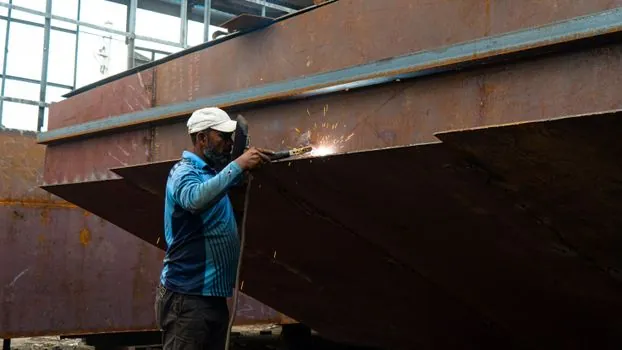
The NDT stations on a monopile line run three inspection modes: ultrasonic testing (UT) for volumetric defects through the full wall thickness, magnetic particle testing (MT) for surface and near-surface defects on the weld toe, and dimensional inspection for out-of-roundness, axial straightness, and flange flatness on the finished can [S2]. Every longitudinal seam and every circumferential seam must clear all three before the can advances to coating, so NDT time is a function of total seam length, not shell diameter [S2].
UT is the slowest leg because the probe must scan the full weld length in a calibrated raster; phased-array UT (PAUT) cuts that time versus conventional UT by replacing serial probe traverses with electronically steered beams, but it still must cover 100% of the seam volume. MT is faster but consumes the seam zone with wet fluorescent particles and demagnetization. Dimensional inspection runs to tolerances typically inside 0.1% of diameter on a 10 m monopile, which is a 10 mm envelope at the outer fibre, demanding laser or total-station measurement rather than tape. For coverage of the wider quality-control toolchain, see the electrical automation reference and the construction machinery and equipment reference.
Selection Criteria: Welding Line, NDT Bay, or Both
Three configurations are typical on the market. A fit-up-and-welding-only line (Ronniewell LHM gantry plus 500-700 t rotators, 10000-100000 USD/set price band, 5-8 week delivery, 50 sets/year supply capability) suits a fabricator that outsources NDT to a third-party inspection house [S5][S1]. A welding line plus in-house UT/MT (adds motorized UT crawlers, MT benches, and a demag station) suits a fabricator with 50-150 monopiles per year who needs predictable QA cycle time. A full turnkey line (fit-up rotators through coating booth, including anti-deformation correction and final dimensional inspection) is the configuration ABK Machinery quotes for foundation fabricators and is the only option that lets the line own its own throughput clock rather than wait on an external NDT queue [S2].
Decision rule for a new monopile fab: if planned annual output is below 30 monopiles, outsource NDT. Between 30 and 100, install a single in-line UT/MT bay sized to your longest seam. Above 100 monopiles per year, build parallel NDT cells, because tandem twin-arc SAW will outpace a single UT bay by roughly 2:1 on deposition time alone, and the line will sit waiting on inspection if the bay is undersized [S2][S7].
Failure Modes and Constraints Buyers Underestimate
Four constraints bite first-time monopile line buyers. First, rail span versus shell diameter: the LHM platform rail inner span is 6300 mm, so any monopile over roughly 11 m diameter needs the rails re-laid or a different gantry class [S5]. Second, power-source commonality: the platform spec lists "US LINCOLN / ESAB" power sources as the assumed fit, and wire-feed geometry, flux delivery, and travel-skew compensation are tuned for those brands; substituting a generic SAW head usually means re-commissioning the tandem arc spacing [S1][S5]. Third, lifting-stroke versus operator ergonomics: the 3250 mm stroke is enough to cover a 12 m can from the outside, but operators still work at height, so the gantry has to be paired with man-lifts or step platforms rated for the same 4000 kg live load [S5]. Fourth, fit-up rotator capacity versus final-assembling rotator capacity: mismatches are common, and a 700 t fit-up rotator cannot hand off to a 2000 t final rotator without an intermediate lift station, otherwise the closing weld sees the full monopile mass on a rotator not sized for it [S4].
Sourcing, Standards, and Trackable Signals
Two suppliers currently dominate the public specs for this equipment class: Wuxi Ronniewell Machinery Equipment (model LHM, LHM-40, LHM-85, LH4040) with CE/ISO and CSA certification options [S1][S3][S4][S5][S6], and Wuxi ABK Machinery for the integrated line, including the HJK series heavy-duty welding rotators and the anti-deformation correction stations [S2]. Price band for the welding gantry alone is 10000-100000 USD/set at MOQ 1 set, with 5-8 week delivery and 50 sets/year supply capability [S1][S5]. For broader process-engineering context on the welding envelope and arc physics, see arc welding AC vs DC penetration mechanics.
The 12 m diameter ceiling on the LHM platform is also a leading indicator: if a 14-15 m monopile class standardizes (it is already being scoped for 18-20 MW turbines), the existing gantry rail spans will need redesign before the welding cell can scale with it [S5][S7].