Mushroom-head pushbuttons remain the most common emergency-stop actuator, but pull-cord switches are the specified form wherever the hazard runs along a line that the operator cannot reach in one step [S4].
For a 30 mm panel-mount station guarding a hydraulic press, the red mushroom on a yellow background is the default; for a 60 m belt conveyor, a tensioned pull-wire with cord-break monitoring is the only practical reach envelope [S2].
Two Form Factors, Two Reach Envelopes
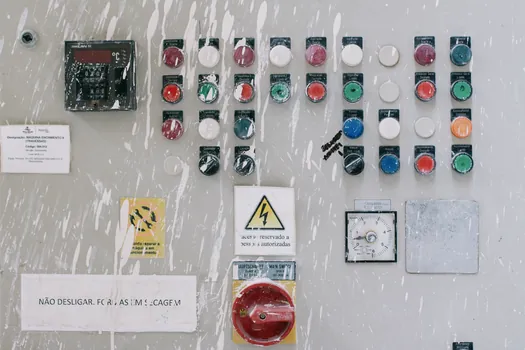
The mushroom-head pushbutton is defined by a rounded, extended actuator head, traditionally European in profile, mounted on a yellow background and operated by a single deliberate palm or finger press [S9]. Its strength is recognition: the red-on-yellow contrast and oversized head are visible from 3-5 m on a typical shop floor, and the actuator is self-latching in the stop position [S8]. For any fixed operator station, the mushroom button is the lowest-friction choice because reset, labelling, and panel cut-out dimensions are standardized across IEC 60947-5-5 supply.
Pull-cord (or pull-wire) e-stops use a tensioned steel cable running along the machine length, with a switch that trips on applied pull or on cable break [S2]. Reach is the entire cable span, commonly 10-100 m per switch on conveyor lines, which is why conveyor standards such as ASME B20.1 and the EN 617/618/619/620 family reference pull-cord devices for bulk-handling equipment [S2]. Cord-break monitoring is the key differentiator: if the wire is cut or comes off an anchor, the normally closed contacts open, and the switch latches until deliberate reset [S4].
Selection Criteria: Reach, Reset, and Recognizability
Three engineering criteria drive the choice, and the two form factors score differently on each. Reach envelope: a mushroom button protects roughly the arm-span of the operator standing at it; a pull-cord protects the full cable run, so any operator alongside the machine can trip it [S2][S4]. Reset action: mushroom pushbuttons latch on press and require twist, pull, or key release; pull-cord switches also latch but additionally require re-tensioning the cable and a deliberate reset, which adds 30-60 s to restart versus a button [S4][S7]. Recognizability: red mushroom on yellow is the universal panic-stop symbol, while pull-cord switches are recognized mainly in conveying, packaging, and perimeter-machine applications, which can confuse operators cross-trained on other equipment [S4][S5].
For installations where both criteria apply, plant designers often specify both: mushroom buttons at each operator station and pull-cords along unguarded conveyor runs, with the cord switches wired in series with the same safety relay [S2][S3].
Standards Governing the Actuator Itself

The mushroom-head geometry, color, and marking are governed by IEC 60947-5-5 for low-voltage controlgear, which is the standard buyers should cite on every e-stop datasheet regardless of form factor [S2]. For conveyor installations, the additional machinery standards are ASME B20.1 (2015) in North America, and EN 617:2001+A1:2010, EN 618:2002+A1:2010, EN 619:2002+A1:2010, and EN 620:2002+A1:2010 for European continuous-handling equipment, covering silos, mechanical bulk handling, unit loads, and fixed belt conveyors respectively [S2]. NFPA 79 covers industrial machinery e-stops in the United States, and Annex C is the typical reference when a panel designer is asked which equipment class the standard applies to [S3].
For the broader machine-safety risk assessment that justifies where each device goes, ISO 12100 and ISO 13850 are the upstream references; ISO 13850 specifically defines the e-stop function as a complementary protective measure, not a primary safeguard [S2][S4]. Color and marking are tied to ISO 13850 and IEC 60204-1 for electrical machinery, both of which require the red actuator on yellow background, with the yellow surround optional but strongly recommended for visibility [S7][S9].
Where Each Form Factor Fails
Mushroom buttons fail in three predictable ways: they protect only the spot where they are mounted, so an operator 20 m down a conveyor line has no reachable e-stop; they are vulnerable to accidental actuation if mounted on a moving cart or vibrating skid; and the twist-release variants can be defeated by an operator who simply twists and restarts without diagnosing the cause [S4][S7]. For conveyor and perimeter applications, the consensus among safety practitioners is that the mushroom button is the wrong device, no matter how many are installed along the line [S2][S4].
Pull-cord switches fail differently: the most common misapplication is incorrect cable tension, which causes nuisance trips or, worse, failure to trip on a real pull [S2]. Cable supports must be spaced so sag does not mask a real activation, and the switch must be anchored so a cable break itself opens the NC contact [S2][S4]. In the upstream oil and gas context, pull-to-actuate is sometimes used as a perimeter trip wire around a hazardous area, but it is generally not recognized by the same standards that govern a fixed panic-stop button, so designers should treat it as a complementary device, not a substitute [S3]. For broader machine-safety context, see the industrial e-stop selection guide for the function-level differences between categories 0 and 1 stops.
Decision Matrix: Mushroom vs Pull-Cord
Five criteria let a specifier draw the line. (1) Reach envelope: mushroom covers one operator station, pull-cord covers 10-100 m of line. (2) Reset time: mushroom resets in 5-10 s by twist/pull, pull-cord needs re-tension plus reset, typically 30-60 s. (3) Standards umbrella: both fall under IEC 60947-5-5; pull-cord on conveyors also requires ASME B20.1 or EN 617-620 series. (4) Recognition: mushroom is universal, pull-cord is conveyor-specific. (5) Failure mode: mushroom risks accidental actuation; pull-cord risks mis-tension and missed trip if installed poorly [S2][S4][S7]. For a fixed CNC, hydraulic press, or robot cell, specify mushroom push-pull or twist-release on a yellow background. For belt conveyors, palletizers, or any machine longer than one operator's reach, specify pull-cord with cord-break monitoring, and wire it into the same safety relay as the station buttons [S2][S4]. The emergency stop button reference covers the panel-side mounting details for the mushroom form.
Sourcing and Supply Notes
Pull-cord e-stops are stocked by all major safety-component suppliers including OMRON/STI, Pilz, Rockwell Allen-Bradley, Schmersal, Siemens, and Telemecanique, so a buyer rarely needs to source a new vendor just to add a cord switch [S2]. Mushroom-head e-stops have a similarly broad supply base, with ABB offering both traditional panel-mount and surface-mount variants for different enclosure types [S1]. For the broader emergency-stop ecosystem, including emergency lighting and rescue-path hardware, the design intent is layered: e-stop stops the hazard, the rest of the chain handles evacuation.
Trackable next signal: any plant that upgrades to ISO 13850:2015 compliance should re-validate the reset-time penalty of pull-cord switches against cycle-time KPIs, because the 30-60 s reset is often the hidden cost driver when a conveyor line is converted from button-only to button-plus-cord. Also worth monitoring is the IEC 60947-5-5 supply chain for cable-tension monitoring modules, which several vendors now integrate into the switch body rather than offering as a separate accessory.
For related coverage, see K and N Markings on Safety Lenses: What Specifiers Need to Verify.