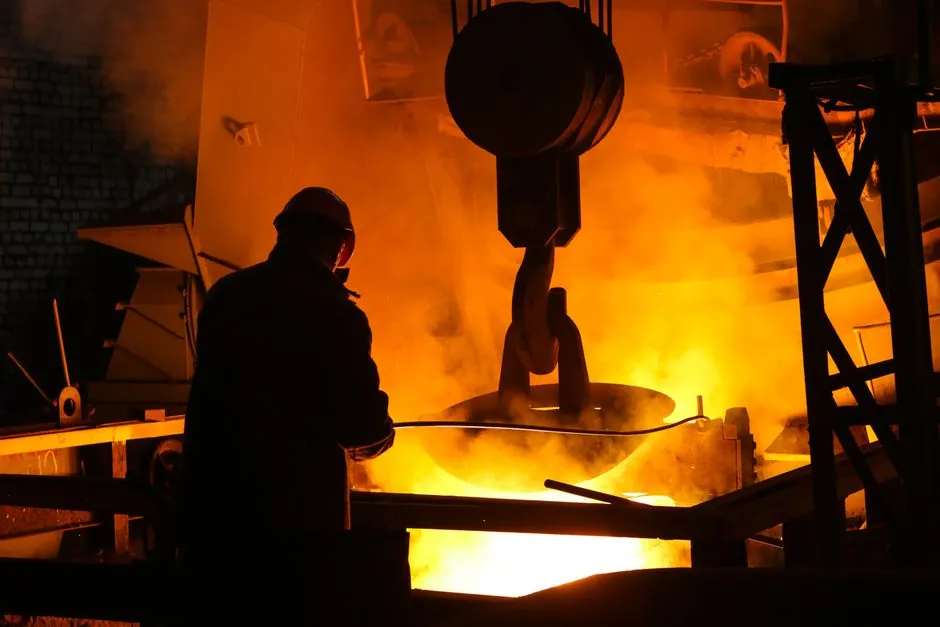
Nickel-base alloys now compete directly with P20, H13, and S7 tool steels in plastic-injection, die-casting, and glass-mold cavities, with the grade choice driven by melt temperature, corrosion exposure, and cycle-count targets rather than hardness alone [S1][S4].
For tooling engineers, the practical question is no longer whether to use a nickel alloy, but which one: Inconel 718 (UNS N07718, W.Nr. 2.4668) and Inconel 625 (UNS N06625, W.Nr. 2.4856) dominate high-temperature mold inserts, while Hastelloy C-276 (UNS N10276, W.Nr. 2.4819) and Monel 400/500 (UNS N04400/N05500) cover corrosion-loaded melt paths and seawater-cooled back plates [S1]. The chain from vacuum-induction melt through electroslag remelting (ESR) and free forging to finished forging or seamless tube is the spec chain that determines inclusion count, grain flow, and fatigue life in the cavity.
Where Nickel Alloys Beat Tool Steel in a Mold
Conventional P20 (pre-hardened ~30-32 HRC) and H13 (52-56 HRC after temper) tool steels lose hardness above 550-600°C, which is the operating range for hot-runner manifolds running glass-filled PPS, PEEK, or metal-powder-filled compounds, and for die-casting cores exposed to 650-700°C aluminum melt [S1].
Nickel alloys such as Inconel 718 retain yield strength above 1000 MPa at 650°C, and the precipitation-hardened variant (AMS 5662 / AMS 5663 bar) reaches 1400-1500 MPa UTS at room temperature after the two-step age at 720°C / 620°C, making it the most commonly specified nickel superalloy for injection-mold inserts that must survive >1 million cycles without cracking [S1]. For glass-mold and hot-corner inserts, Inconel 625 (NiCr22Mo9Nb, NA21) is preferred when chloride-bearing cooling water or fluoropolymer release-agent chemistry attacks standard H13, since its 9% Mo content stabilises pitting resistance [S1].
Grade Map: Inconel, Hastelloy, Incoloy, Monel for Tooling
Four families cover roughly 90% of mold and die applications: Inconel 718/625 for hot strength, Hastelloy C-276 for aggressive corrosion, Incoloy 800/800H for thermal-shock resistance, and Monel 400/500 for marine and hydrofluoric-acid service [S1].
On a side-by-side decision criteria basis, the typical selection map looks like this: Inconel 718 (UNS N07718) targets 650-700°C hot-runner and die-cast cores with the best balance of strength, weldability, and availability; Inconel 625 (UNS N06625) covers 600-800°C service where chloride pitting resistance is required and higher Cr (22%) is acceptable; Hastelloy C-276 (UNS N10276, NiMo16Cr15W) is the default for HCl, H2SO4, and wet Cl2 service up to ~1100°C, with W content improving hot-corrosion resistance; Incoloy 800H (UNS N08810) and 800 (UNS N08800, 0Cr20Ni32AlTi) deliver oxidation resistance to 1100°C in glass-mold plungers and continuous-casting components, with 800H being the higher-carbon, solution-annealed variant; Monel 400 (UNS N04400, Ni68Cu28Al chemistry family, W.Nr. 2.4360) is the seawater and HF-resistant grade for cooling-channel jackets, while Monel K-500 (UNS N05500, W.Nr. 2.4375) adds Al and Ti for age-hardening to ~150 HB in valve-seat and pump-impeller duties [S1]. For comparison, Ni-based small-diameter welded and drawn tubing is produced in OD ranges as tight as 0.010-0.280 in (0.25-7.11 mm), which matches the heater-channel and thermocouple-well diameters in hot-runner systems [S2].
Spec Chain: From Vacuum Smelt to Mold Insert
Quality of a nickel-alloy mold insert is set at the melt, not at the machine: vacuum induction melting (VIM) followed by electroslag remelting (ESR) is the standard duplex route for Inconel 718 and Hastelloy C-276, and Shanghai LANZHU lists VIM + ESR + free forging + die forging as the in-house process chain for end forgings, ring forgings, and valve bodies [S1].
EOS similarly markets nickel-alloy powders (IN718, IN625, Hastelloy X / C-276) for laser powder-bed fusion (LPBF) and direct energy deposition (DED) of conformal-cooling mold inserts, with stated benefits of cycle-time reduction and uniform冷却 channels unreachable by conventional drilling [S4]. For mold-base carriers and mold base frames, Inconel 718 forgings are typically supplied to ASTM B637 (bar/billet) or AMS 5662/5663, with ultrasonic testing per ASTM A604 / SEP 1921 to detect the 1-3 mm freckle defects that propagate into fatigue cracks under thermal cycling. For die-casting die casting shot sleeves and plunger tips, the dominant spec is Hastelloy C-276 centrifugally cast tube or ESR bar, machined and age-hardened where Monel K-500 is not adequate.
Corrosion, Temperature, and Thermal-Shock Limits
Inconel 718 is rated for continuous service to ~650°C with brief excursions to 980°C, Inconel 625 to ~980°C continuous, Hastelloy C-276 to ~1090°C in oxidising atmospheres and ~400°C in reducing HCl service, and Incoloy 800H to ~1100°C with creep-rupture data per ASME SB-409 [S1].
Thermal-shock resistance is the variable that separates mold alloys from generic heat-resistant castings: Incoloy 800H, with 32% Ni and 20% Cr, is engineered for repeated thermal cycling in ethylene-cracking and glass-feed applications, and its low coefficient of thermal expansion (~14-15 × 10⁻⁶ /°C at 20-300°C) limits insert loosening in steel mold bases. Hastelloy X (UNS N06002), supplied by LANZHU as seamless tube, pipe, ring, and sleeve, is the default for gas-turbine and casting mold components operating to 1200°C with high creep-rupture strength, and is also the workhorse for aerospace and nickel alloy heat-shield tooling. Monel 400 stands out in HF pickling and seawater cooling circuits, where its ~30% Cu content resists chloride pitting that would attack 316L stainless, and is the established grade for plastic-mold cooling channels on coastal or offshore tooling.
Selection Criteria and Decision Gates
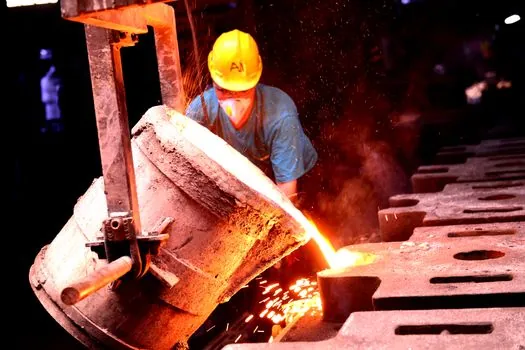
The first gate is melt temperature at the cavity surface: below 400°C, P20 or H13 still wins on cost; between 400-600°C, H13 or hot-work tool steel is borderline; above 600°C, Inconel 718 or 625 becomes the rational choice, and above 900°C, Incoloy 800H, Hastelloy X, or Haynes 230 are required [S1][S4].
The second gate is corrosion chemistry: chloride-bearing cooling water, fluorine-bearing release agents, or acidic plating baths push the answer toward Inconel 625, Hastelloy C-276, or Monel 400, while neutral oil or water-glycol cooling allows cheaper tool steel. The third gate is cycle count and surface finish: nickel alloys do not take a mirror polish as easily as pre-hardened P20 (which can be mirror-polished to SPI-A1), so for optical-grade or transparent-part cavities, electroless-nickel-plated aluminum bronze inserts are still used. The fourth gate is lead time: bar and tube stock of Inconel 718, 625, and Monel 400 in common OD/ID combinations is available from inventory distributors in 2-4 week lead times, while custom ESR-forged Hastelloy C-276 die blocks run 12-20 weeks, and LPBF-printed Inconel 718 conformal-cooling inserts sit in the 6-10 week range depending on build envelope [S1][S2][S4].
Worked Examples and Where Nickel Alloys Are NOT the Right Answer
For a 48-cavity cap-mold running 30% glass-filled PA66 at 290°C melt and 110°C mold surface, P20 or H13 inserts remain the economic default; switching to Inconel 718 is justified only when the production lot exceeds ~5 million shots or when glass-filled compounds >40% erode the cavity [S1].
For a zinc die-cast telephone enclosure, zinc die casting machine tooling typically uses H13 with PVD coating; Inconel 625 is reserved for the shot sleeve and gooseneck where 420°C zinc melt plus corrosion from water-based release agents degrades H13 over 200,000+ shots. For an automotive airbag inflator housing, where nickel alloy selection overlaps with aerospace specs, Inconel 718 conforms to AMS 5663 and NACE MR0175 (where sour service is required) and replaces maraging 300 in the hot section. Conversely, nickel alloys are not the right answer for high-volume cosmetic injection molds under SPI-A1 polish spec, for sub-400°C rubber molds where aluminum bronze outperforms, or for short-run prototypes where lead-time cost dominates. Tooling engineers should also remember that small-diameter cooling-channel tubing, in OD ranges down to 0.010 in (0.25 mm), is more commonly supplied in 300-series stainless or nickel alloy 825 welded-and-drawn stock than in solid-drilled cores, which sets a practical lower bound on channel pitch [S2].
Trackable signals for the next planning cycle: VIM + ESR forging capacity additions by Shanghai LANZHU and peer mills (announced in their 2026 product lists covering Inconel 718, 625, Hastelloy C-276, Monel 400/K-500, Incoloy 800/800H), and continued expansion of EOS-style nickel-alloy powder libraries (IN718, IN625, Hastelloy X, C-276) for LPBF conformal-cooling inserts [S1][S4].