Offshore substation fabrication entered 2026 with a market estimated at USD 7.34 billion.
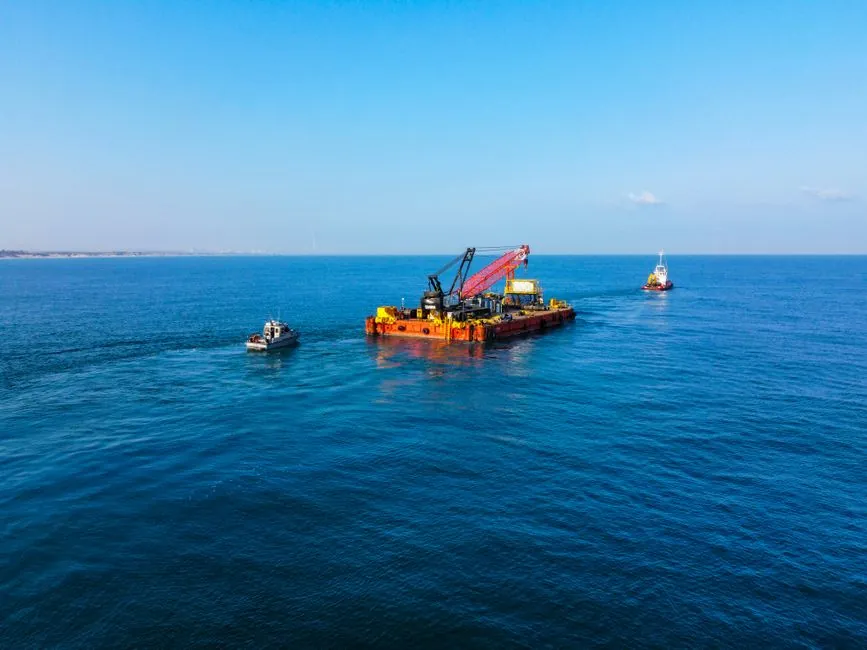
At a 12 September 2026 ceremony, PTSC M&C marked the successful completion, load-out and sail-away of four offshore substations for the Baltica 2 Offshore Wind Farm from its Vung Tau fabrication yard.
What Offshore Substation Capacity Actually Covers
Offshore substation topside fabrication includes the integrated deck structure and the electrical equipment housed on it, while the jacket serves as the seabed foundation. The topside collects turbine power, transforms it for export, switches the connected cables, and supplies auxiliary power and control systems [S1].
Capacity is therefore not a simple steel-output metric. A fabricator must combine yard area, engineering hours, qualified welding and coating capacity, transformer and converter installation, cable-deck arrangements, marine load-out, and access to a suitable installation vessel.
2026 Demand and Capacity Indicators
The global offshore wind substation market was estimated at USD 7.34 billion in 2026.
The market was projected to reach USD 7.77 billion in 2027 and USD 10.36 billion by 2032, representing a 5.92% compound annual growth rate over 2027–2032.
Longer planning horizon, more than 260 AC and DC offshore substations operating by 2035. Fabricators responding through acquisitions, yard conversions, diversification, and new entrants [S3].
Batch Fabrication Is Proving on Schedule
Baltica 2 provides a 2026 benchmark for repeated topside delivery. The approximately 1.5 GW project lies about 40 kilometres off Poland and required four offshore substations.
At a 12 September 2026 ceremony, PTSC M&C marked the successful completion, load-out and sail-away of four offshore substations for the Baltica 2 Offshore Wind Farm. The sequence demonstrates why load-out engineering, port coordination, vessel readiness, load transfer, and sea-fastening must be included in fabrication capacity planning.
Offshore substation construction is characterised by long lead times and large-scale fabrication.
HVAC, HVDC, Fixed and Floating Compared
For procurement, HVAC favors mature AC designs and fixed-platform integration, while HVDC concentrates more conversion equipment into a larger topside with greater yard and installation-asset demands. Fixed platforms held 78.3% of the 2026 market, compared with the smaller floating segment, although floating platforms are forecast to grow faster at 7.3% annually through 2032 [S4].
On capacity criterion, an HVAC fixed project generally places less weight on converter-platform yard space than a large HVDC project. On schedule criterion, fixed solutions benefit from established jacket installation routes, whereas floating substations introduce marine-system and structural-standardisation interfaces.
These distinctions prevent a misleading yard-capacity ranking. A yard with sufficient steel space may still lack transformer handling, converter assembly, high-voltage expertise, marine load-out, or a compatible installation vessel.
Who Needs Fabrication Capacity and Who Does Not
Developers with firm grid-connection schedules benefit from qualified EPCI capacity because transfer of integration risk can protect the delivery programme. The Baltica 2 package required four topsides and four modular support frames to progress from fabrication into offshore electrical integration [S2].
Pure manufacturers without installation assets face a weaker commercial position. Spinergie notes that some fabricators are forming partnerships with heavy-lift vessel managers to secure integrated contracts. This matters when the topside weight exceeds the ordinary lift envelope and installation logistics become part of fabrication risk [S3].
Smaller suppliers are not excluded, but modularisation, scope discipline, and early heavy-lift booking are essential.
Yard Expansion, Bottlenecks and Execution Risk
Eiffage Smulders expanded through the HSM Offshore acquisition and the Hillebrand yard, while a partnership with Neptun Werft supported conversion of the Rostock site for large HVDC topsides. Atlantique Offshore Energy entered smaller DC work through 320 kV HVDC topsides, and Dragados Offshore planned a new Campamento yard while assessing reactivation of its Mexican yard for jackets [S3].
CRIST entered the AC market with its first EPCI contract for Ocean Winds’ BC-Wind project. Such entries add supplier diversity, but they do not remove the underlying constraints: large DC fabrication cycles above two years, scarce HV components, limited installation vessels, and competition with profitable oil and gas fabrication [S3].
Saipem describes a semi-submersible installation asset with 14,000-tonne dual-crane lift capacity, illustrating the scale of lifting infrastructure involved in offshore wind construction [S7]. Heerema likewise markets offshore substation installation as a specialist service, reinforcing the linkage between fabrication and marine execution [S8].
Standardization and Sourcing Discipline
The procurement boundary must cover electrical configuration and marine execution, not only steel fabrication. NYSERDA’s September 2026 material identifies the topside, jacket, J-tubes, cable deck, helideck, main crane, boat landing, and walk-to-work landing zone as the principal offshore substation interfaces [S1].
Fabricators should secure transformers, converter equipment, HV switchgear, cables, and installation-vessel slots against the project schedule. Specification claims should be checked against the selected HVAC or HVDC architecture, the 2 GW connection standard being procured, and the topside’s verified mass and lifting arrangement [S3][S4].
A trackable delivery signal is the number of yards demonstrating completed offshore-substation load-out, and the Baltica 2 campaign marked the load-out and sail-away of four offshore substations from PTSC M&C’s fabrication yard.