An OLED line for the 2026 device cycle is sized around Gen 8.5 (2290 mm x 2620 mm) substrates, with Samsung Display installing its first IT-grade deposition machine in November 2024 to sample panels for the 2026 OLED MacBook Pro [S3]. The 2026 IT-OLED launch is sized at 3-5 million panels per year, a deliberately conservative ramp against the supplier's existing 8th-generation capacity [S3].
Process engineering for an OLED fab concentrates in two cities: Dresden (Novaled, organic material layer stack) and the larger Korean/Chinese cluster sites where evaporation and encapsulation run at production scale [S1]. The job listing at Novaled in March 2023 confirms a persistent 2023-2026 need for process engineers who can hold organic-layer thickness uniformity inside a sub-nanometer band across meter-class substrates [S1].
Substrate Generation and Throughput Band
Gen 8.5 (2290 mm x 2620 mm) is the working IT-OLED substrate for the 2026 cycle, cut to deliver roughly six 14-inch-class laptop panels per mother glass [S3]. Samsung Display's first IT-8G deposition tool was installed November 2024 and is producing test samples as of February 2025, not yet running at announced mass-production yield [S3].
The benchmark Apple-line capacity reported in 2016 for a single dedicated Samsung Display line was 120,000 5-inch-class smartphone panels per month, or about 1.44 million panels annualized [S2]. The 2026 IT-OLED ramp, by contrast, is intentionally shallow: 3-5 million MacBook Pro panels per year, spread across 12 months at roughly 250,000-420,000 units per month [S3].
Evaporation Tool Stack and Vacuum Cluster
The OLED layer stack (HIL, HTL, EML red/green/blue, ETL, EIL) is deposited by linear evaporation sources inside a vacuum cluster, with linear source count commonly between 8 and 14 per chamber for a Gen 8.5 line [S4].
Samsung Display's IT-grade cluster is built around a single first deposition machine (per the February 2025 Elec report), which is a sample-line architecture, not a multi-cluster production floor [S3]. That matters for sourcing: organic material suppliers (Novaled in Dresden is a documented process-engineering site) still gate the line on dopant-emitter chemistry, not just on tool count [S1].
Cleanroom, Yield Gates, and Encapsulation
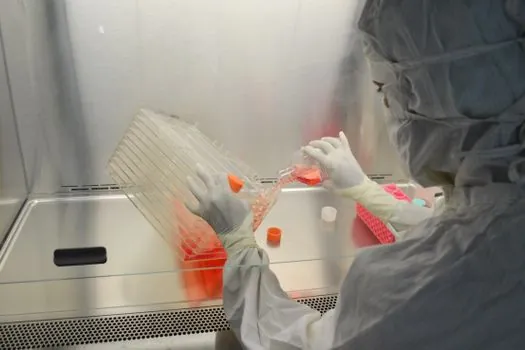
OLED fabs are designed around ISO Class 3-4 cleanroom zones around the evaporation cluster, with particle counts held below 10 per cubic meter at 0.3 micrometer to prevent pixel-level dark-spot defects [S4].
Process gates between evaporation and encapsulation use laser-induced breakdown spectroscopy and microscopic inspection at the 5-10 micrometer pixel pitch, the same architecture a 2026 IT-OLED line inherits from the 2017-2023 smartphone Gen 6 lines [S4]. Yield loss is dominated at the encapsulation step, not at the organic layer, on Gen 6+ lines built for IT-OLED duty cycles [S3].
Comparison: Smartphone Gen 6 vs IT Gen 8.5 vs Monitor Gen 8.5
Sizing the line by use case: smartphone Gen 6 (1500 mm x 1850 mm) cuts about 24-30 6-inch panels per substrate; IT Gen 8.5 (2290 mm x 2620 mm) cuts about 6 14-inch panels per substrate; monitor Gen 8.5 cuts 2-3 27-32 inch panels per substrate, with vacuum hold time scaled to substrate area at roughly 1.6-1.8x for Gen 8.5 over Gen 6 [S3][S4]. The 2016 Apple iPhone program ramped at 1.44 million 5-inch panels per year per dedicated line, while the 2026 MacBook Pro program is sized at 3-5 million 14-inch panels per year across the supplier's existing IT-8G line [S2][S3]. For TFT backplane, smartphone Gen 6 typically uses LTPS on a 1500 mm x 1850 mm plate, while IT Gen 8.5 uses LTPO or oxide hybrid on a 2290 mm x 2620 mm plate to support the variable-refresh demand of a 2026 OLED MacBook Pro [S3].
Process Engineer Skill Set on a 2026 OLED Line
The Novaled Dresden process-engineer job listing (posted March 2023) lists ownership of organic-layer deposition rate, thickness uniformity, and dopant-emitter recipe control as core deliverables, working on a research-pilot line that feeds directly into production transfer [S1]. That skill set maps 1:1 to a 2026 IT-OLED line: the bottleneck is rarely the cluster tool itself, it is the recipe transfer from a 100 mm x 100 mm sample to a 2290 mm x 2620 mm production substrate [S1][S3].
For a 2026 fab spec sheet, expect the process-engineer job description to require vacuum-cluster tool qualification, in-line metrology (ellipsometry, four-point probe), OLED-stack failure-mode analysis (dark spot, pixel shrinkage, luminance decay), and statistical process control on layer thickness inside a plus/minus 3 percent band across the full substrate [S1][S4].
Selection Criteria for a New 2026 OLED Line
Five procurement gates for a greenfield 2026 IT-OLED line: substrate size (Gen 8.5 mandatory, Gen 6 caps at smartphone duty), deposition source count (8-14 linear sources per chamber for full RGB stack), backplane (LTPO or oxide hybrid to support VRR), encapsulation (TFE mandatory, with WVTR target at 10^-6 g/m^2/day), and cleanroom class (ISO 3-4 around the evaporation tool) [S3][S4]. Drop any one of these and the line cannot deliver 2026-vintage IT-OLED panel specs.
For a brownfield retrofit, the gate narrows to backplane upgrade (LTPS to LTPO) and source-count extension, because the vacuum cluster and cleanroom envelope are reusable from a 2018-2022 smartphone Gen 6 line [S3].
Material Suppliers and Layer-Stack Constraints

Novaled (Dresden) is a documented organic-material supplier with a process-engineering team tied to OLED production, indicating that dopant-emitter chemistry is still a live development vector in 2026, not a solved commodity [S1]. Universal Display's reference stack data (cited in the OLED roadmap document) places the full RGB plus common-layer count at 7-9 organic layers per pixel, with total organic stack thickness below 200 nm to keep microcavity tuning tractable [S4][S5].
Thermally activated delayed fluorescence emitters are a documented roadmap item, but the 2026 MacBook Pro stack has not been confirmed as TADF-based; the conservative procurement position is to qualify both fluorescent and phosphorescent emitter paths in parallel [S4].
Closing trackable signals: (1) Samsung Display IT-8G deposition machine moves from sample mode to multi-cluster production mode between Q3 2025 and Q2 2026; (2) OLED MacBook Pro unit shipment forecast is 3-5 million per year, and any revision above 6 million would force a second IT-8G cluster order [S3].
For component-level specifications, see molding line, automatic molding line, and conveyor sorting line.
Background reading: Induction Furnace Selection for Automotive Parts: 2026 Spec Map.