
Optical glass families are sorted on the nD–VD diagram: traditional crown (K) covers nD>1.60 with VD>50, and flint (F) covers everything else, with the V55 boundary separating the two main groups [S6]. Crown grades are typically used as positive lens elements and flint grades as negative elements, which is why doublets and triplets are almost always a K-on-F pairing [S6].
The map extends well beyond K vs. F: alkali borosilicates host standard crowns, aluminosilicates host light crowns (LK), alkali-free borosilicates host dense crowns and barium flints, and lead-potassium silicates host most commercial flint grades, including the heavy flints used in high-dispersion prisms [S6]. Glass manufacturers such as OHARA publish full nD/VD tables and partial dispersion data on their corporate product pages, with ECOGLASS separately offering hand-molded prototype and small-series optics for shapes that are not pressable [S1][S4].
Crown vs Flint: The Refractive Index and Abbe Number Decision
Every catalog grade of optical glass can be plotted on a single nD vs VD chart, and the chart itself is the classification system: nD>1.60 with VD>50 sits in the K (crown) region, while the F (flint) region covers the high-index, low-Abbe corner plus the low-index tail below V55 [S6]. OHARA's product page indexes its grades against this same chart, supplying nD, VD, and partial-dispersion (Pg,F) data so designers can pick achromatic pairs that correct secondary spectrum [S4].
For an achromatic doublet the rule of thumb is to mix a low-dispersion crown (high VD) with a high-dispersion flint (low VD): the most common pairs sit near BK7 (nD≈1.517, VD≈64) and SF2/SF6 (nD≈1.64–1.81, VD≈34–25), which puts them on opposite corners of the chart [S4][S5]. Heavy flints such as SF66 and SF71 push nD past 1.90 with VD in the low 20s, which is what enables compact prism spectrometers but also drives the need for lead-arsenic or lanthanum-borate chemistry to keep transmission acceptable in the blue [S4].
Chemistry-Bound Sub-Families: Silicate Systems That Drive Cost and Performance
The four dominant silicate families behind the nD–VD map are: alkali borosilicate for standard crowns, aluminosilicate for light crowns (LK/LAK), alkali-free borosilicate for dense crowns and barium flints (BAK/BAF), and lead-potassium silicate for the flint series (LF/SF) [S6]. Lead oxide content is what pushes nD upward and VD downward, which is why lead-potassium silicates dominate the F corner of the chart [S6].
Outside the traditional lead-silicate flints, rare-earth and lanthanum-borate grades (often sold as LaK, LaF, or TaF series) deliver high nD with relatively high VD, an anomalous-crown behavior that is critical for apochromatic triplets that target three-wavelength color correction [S4]. ECOGLASS highlights a complementary axis: even with a fixed chemistry, the same family of optical glass can be made as a pressable gob, a strip, or a hand-molded blank, and the forming route is what determines minimum order quantity and achievable surface figure [S1].
Functional Classifications: Beyond Bulk Optics
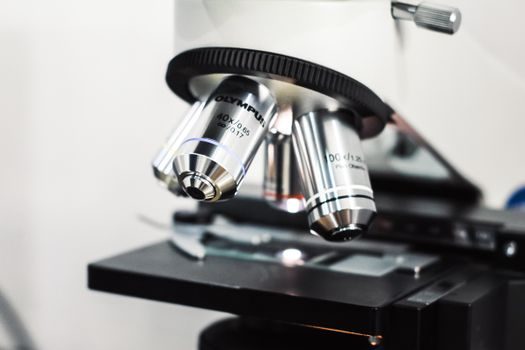
OHARA's site indexes clear optical glass, low-expansion glass-ceramics, and infrared-transmitting grades on the same product tree, so the chemistry-axis and the function-axis have to be read together [S4].
Functional glass families are commonly grouped as: crown/flint (refractive optics), filter glass (colored cutoff and bandpass, including selenium-cadmium and cadmium-sulfide pigmented enamels for signal and decorative optics), infrared glass (chalcogenide and fluoride for 3–12 µm), laser glass (rare-earth doped for gain media), and radiation-resistant glass (cerium-stabilized for nuclear and space imaging) [S2][S3][S5]. Selenium-cadmium pigments, used in glass enamels, are documented in classical Glass and Ceramics work as a route to tunable red-to-yellow cutoff filters, and CdS nanoparticle doping in silicate glass is documented as an absorption-edge shifter, moving the fundamental edge from 380 nm to 480 nm as particle size grows from 3 to 5.2 nm under thermal treatment [S2][S3].
Comparison Table: Five Core Optical Glass Sub-Families
The main optical-glass sub-families line up against four decision criteria as follows: chemistry (silicate base), typical nD range, typical VD range, and primary role in a lens stack. [S2]
Standard crown (K/BK): alkali borosilicate, nD ≈ 1.50–1.53, VD ≈ 60–66, used as the positive element in achromats and triplet objectives [S4][S6]. Light crown (LK/LAK): aluminosilicate (with lanthanum-borate variants for LaK), nD ≈ 1.45–1.72, VD ≈ 55–60, used where low weight or apochromatic partial dispersion is required [S4][S6]. Dense crown and barium flint (BAK/BAF): alkali-free borosilicate, nD ≈ 1.57–1.65, VD ≈ 50–60, used in mid-power objectives and field lenses [S6]. Flint and dense flint (F/SF): lead-potassium silicate, nD ≈ 1.57–1.93, VD ≈ 30–45, used as the negative element in achromats and as prism material [S4][S6]. Heavy flint and lanthanum flint (SF/LaF): high-lead or lanthanum-borate, nD ≈ 1.85–2.10, VD ≈ 20–30, used in high-dispersion prisms, short focal-length optics, and athermalized systems where index, dispersion, and low thermal expansion have to be balanced [S4].
Selection Criteria and Common Failure Modes

Specifying an optical glass grade is a five-axis tradeoff: refractive index, Abbe number, partial dispersion (Pg,F), thermal expansion, and internal transmittance, and the most common spec error is matching only nD and VD while ignoring partial dispersion, which then leaves secondary color uncorrected in wide-aperture lenses [S4][S5]. Another common failure is picking a high-nD lead flint for a UV application, because most lead-silicate flints cut off below 400 nm; OHARA's product tables publish internal transmittance curves so this check is done at selection rather than at first article inspection [S4].
A third failure mode is forming-route mismatch: ECOGLASS states that hand molding is the only realistic route for prototypes, asymmetric shapes, and small series, while press-molding and continuous strip drawing are what make large-volume SKUs economical, so a spec sheet that ignores forming constraints will usually fail at the cost-of-goods stage [S1]. Finally, RoHS-driven lead replacement has pushed many heavy flints toward lanthanum-borate and titanium-silicate chemistries, and a spec that still calls for SF66 or SF71 in a 2026 consumer-grade product needs a documented exemption or a substitute grade [S4].
Standards, Sourcing, and Cross-Reference
ISO 12123 (optical glass blanks), ISO 8037 (interferometric reference flats), and ISO 10110 (optical elements drawing standards) are the three standards that govern the paperwork side of an optical-glass purchase, and most catalog data sheets from OHARA, SCHOTT, and HOYA are aligned to them even when the certificate is not printed on the datasheet [S4][S5]. For filter glasses the relevant instrument is a spectral transmittance curve measured per ISO 13697, and for infrared grades the transmission band is typically called out in 3–5 µm or 8–12 µm windows rather than in nD/VD pairs [S4].
For sourcing, OHARA's product index is a good first reference for nD, VD, Pg,F, and internal transmittance; ECOGLASS is the right first call for hand-molded prototypes, small series, and shapes that catalogs do not list; and the Springer chapter "Optical Glass: An Engineered Material" remains the canonical chemistry-and-properties primer behind the nD/VD map [S1][S4][S5]. Engineers working across material families can cross-reference related decisions on the Quartz Material Types and Classifications spec map, since fused silica and optical crown glasses share the same achromat-design discipline, and on the Infrared Gas Detector Types, NDIR vs TDL Trade-offs page, where the chalcogenide IR glass grades above are typically the optical substrate for NDIR cells. The Quartz Material TCO: Cost Drivers, Service-Life Levers, Spec Gates page is a useful cross-reference for total-cost modeling, because crown and flint cost is driven less by raw chemistry than by melting yield, annealing, and inspection scrap rates.
Spec-level background on the components involved: optical glass, optical comparator, and glass fiber.