Open-deck order picker platforms and three-sided cage enclosures solve different problems on the same aisle: open platforms give the operator a larger unobstructed working footprint for bulky or high-volume case picks, while cage enclosures (mesh or strap) act as a passive barrier that keeps packages from sliding off the deck and onto the operator or a pedestrian below [S2][S3].
On an order picker the operator rides up with the load, so fall-from-height and falling-object hazards compound at every metre of lift, and the spec choice between order picker platform configurations is the single biggest safety decision before lift height and rack layout are even discussed [S7].
When the Open Platform Is the Right Spec
Open-deck order picker platforms maximize usable floor area on the deck, which directly increases pick rate when SKUs are large, irregular, or stacked in totes that need two-handed handling [S8]. The Modular Order Picker Platform (OPPM) is the typical open-footprint configuration, designed for bulkier items or high-volume case picking where the operator needs unrestricted reach across the deck [S8].
Open platforms also reduce dead weight on the mast, which lets specifiers hold payload capacity at the rated limit of the truck rather than spending it on cage steel, and aluminum open platforms from makers such as New Age Industrial pair that weight saving with natural corrosion resistance and easier sanitization in food, pharma, and cold-chain aisles [S1]. Deck height synchronization to the order picker machine deck and grip-tape surfacing are still mandatory on the open spec; without matched deck height and anti-slip surfacing, the open footprint gains nothing and trip risk rises [S3].
When the Cage Enclosure Is the Right Spec
Cage enclosures, built as a mesh or strap barrier on three sides of the platform, are the default for any pick above 1.8 m where falling objects or an operator stumble could put a load onto someone below, and the same mesh/strap design preserves forward and downward sight lines so the operator does not trade safety for visibility [S3]. Extended railings that reach the machine deck and optional latched doors on the fourth side add a second containment layer for tall case picks or carton-heavy SKUs [S3].
On the OEM side, the Crown SP 1500 Series order picker combines a caged operator position with what Crown describes as the industry's first mid-console window, a large upper window, and openings in the centre and sides of the floorboard, so the cage does not block the view of pedestrians, rack uprights, or the floor directly below when the platform is fully elevated [S4]. This combination, caged platform plus engineered sight lines, is the template that modern OSHA 1910.178-compliant order picker spec sheets now follow [S4].
Decision Matrix: Open vs Cage on Four Criteria

Specifiers comparing the two configurations should score each on four criteria, with the cage scoring higher as fall height, item weight, or pedestrian density below the aisle increases: [S3]
1. Falling-object containment: open platforms rely on shelves pitched toward the back plus lip barriers, while cage enclosures add a three-sided mesh/strap physical barrier; the cage wins any time the pick weight exceeds roughly 9 kg or the pick is unrestrained in a tote [S3].
2. Operator visibility: open platforms have zero sight obstruction by definition; caged platforms on Crown-class trucks retain forward, downward, and side visibility through engineered window cut-outs, so the visibility penalty of caging is now small for most picking tasks [S4].
3. Deck footprint and pick rate: open platforms deliver a larger unobstructed deck for bulky or high-volume case picking, which is the core reason modular OPPM-style decks are specified for e-commerce full-case aisles [S8].
4. Weight and payload: aluminum open platforms cut empty weight, preserve rated payload, and resist corrosion; caged steel platforms add 30-60 kg of structure that must be netted out of the remaining capacity, a real penalty on smaller order pickers [S1][S3].
Material, Hardware, and Locking Specs to Lock In
Regardless of open or caged spec, three hardware details are non-negotiable on the data sheet: deck height matched to the order picker machine deck with grip-tape surfacing, a replaceable solid oak gripper block that locks the platform to the machine carriage to prevent unexpected disengagement, and a hook-and-chain or equivalent mast restraint as a secondary tie [S3][S6].
Aluminum is the dominant material for the deck and accessories on modern order picker platforms because it combines low density with adequate strength for typical 90-180 kg payloads, and the non-porous surface cleans and sanitizes easily for food, beverage, and pharmaceutical aisles [S1]. Cages are typically welded steel mesh or high-tenacity polyester strap, with mesh preferred where the operator needs a rigid hand-hold and strap preferred where weight must stay minimal [S3].
Failure Modes, Limits, and What the Standards Actually Require
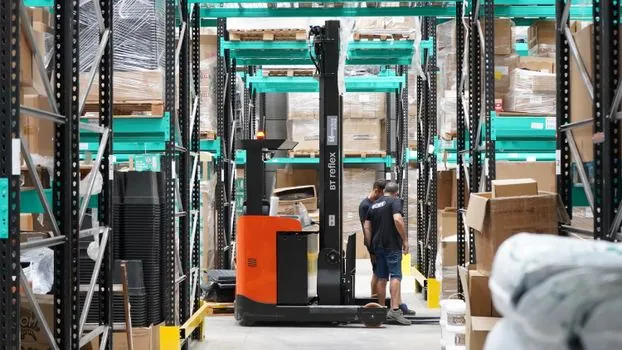
The dominant failure mode on an open platform is not the platform itself but the load: an unrestrained tote sliding off the deck onto the operator below, or a load shift that pins the operator against the mast during travel [S3][S7]. The dominant failure mode on a caged platform is reduced visibility, which on legacy trucks can produce "tunnel vision" at height and force operators to slow, lean, or stop to verify clearances [S4].
Two standards drive the spec in North America: OSHA 1910.178 governs powered industrial truck operator training and the requirement that the truck be suitable for the environment, and ANSI/ITSDF B56.1 covers the safety standard for low-lift and high-lift trucks including order pickers, with explicit requirements for operator platforms, guardrails, and load retention. Mesh or strap cage enclosures on three sides, deck-height matching, and a positive mechanical lock to the carriage are all responses to those requirements, not optional features [S3][S6]. For lift heights above the truck's rated platform elevation, the spec must also account for the truck's stability limits, since the operator-plus-payload moment arm grows with every metre of mast extension [S7].
Use-Case Recommendations and Field Cues
Specify an open platform when the aisle is dedicated to bulky SKUs such as furniture, appliances, or large totes, when pick heights stay under roughly 1.8 m, and when the operator is the only person in the aisle for the duration of the pick [S5][S8]. Specify a caged platform with extended railings when pedestrian or counterbalance traffic shares the aisle, when individual case weights exceed 9 kg, and when average pick heights routinely cross 2.5 m [S3][S4].
Operators moving from a caged truck to an open OPPM, or vice versa, need a short re-orientation because reach envelope, sight lines, and load-securement habits all change, a point raised in field guidance on visibility-driven order picker safety [S4]. Where mixed fleets share the same aisle, custom-fit platforms sized to the specific order picker machine, like the build-to-order approach used by Koke Inc., eliminate the deck-height mismatch that causes most open-platform trip incidents [S5].
Two trackable signals to watch: Crown's SP 1500 visibility package (mid-console window, upper window, floorboard openings) is a leading indicator of how OEM engineering is closing the visibility gap that historically favoured open platforms, and aluminum modular OPPM designs are a leading indicator of where open platforms are still winning on payload and sanitization [S1][S4]. Operators planning a 2026 fleet refresh should benchmark both signals before locking the spec, and cross-check platform trolley compatibility if the same pickers will be re-deployed onto non-lift routes. A separate deep-dive on mast visibility in 2026 order picker lithium-ion and telematics builds shows how the same visibility logic is now being pushed into the truck's telematics layer.
The underlying component specifications are covered under storage cage.