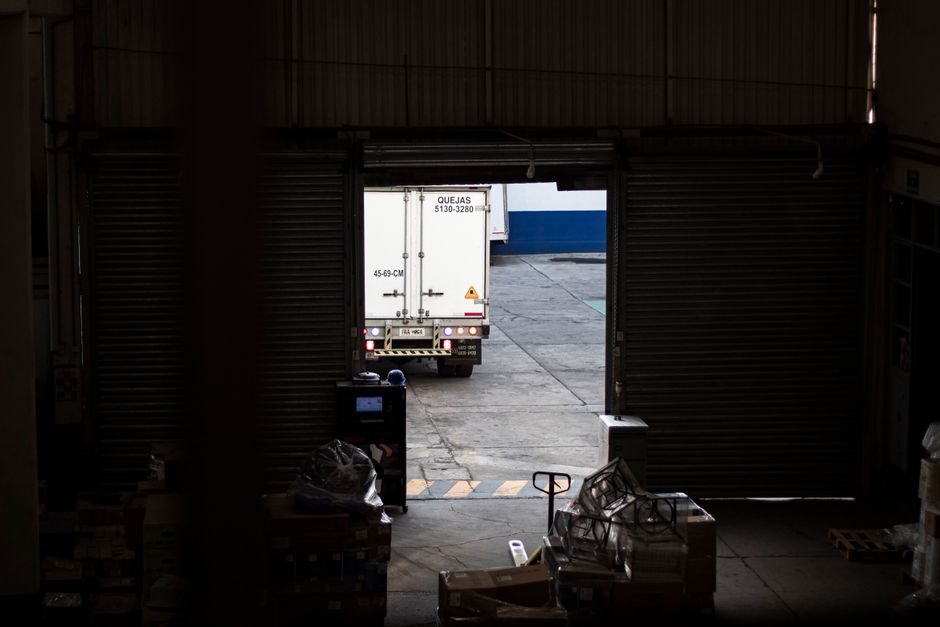
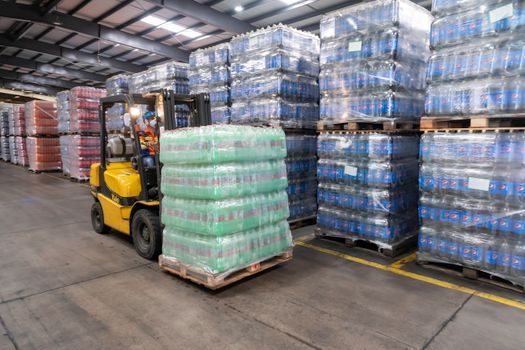
An order picker with 3,610–4,275 mm working height and 1,200 kg capacity belongs in case-pick and small-SKU zones, while a forklift rated 2,000–2,500 kg is the right tool for pallet-to-pallet transport on loading docks and in standard 3.5–4.0 m aisles [S1].
DirectIndustry's category page lists 11 manufacturers and 25 products under "forklift order-picker," with Raymond's 5600 topping out at 4,560 mm (456 in) platform height and 3,000 lb (≈1,360 kg) capacity, and Mitsubishi's VELiA ES low-level line covering 1,115 / 765 / 135 mm platforms at 2,000 / 1,200 / 2,500 kg [S1].
Working height and lift envelope are the first decision split
Low-level order pickers like the OPB12-25N2 series (VELiA ES) keep the operator on a platform that elevates only 135–1,115 mm, intended for first- and second-level case picking from pallet flow rack [S1].
Mid- and high-level stock pickers such as the Raymond 550-OPC30TT with a 366 in (≈9,290 mm) mast, and Crown's SP series stockpicker, lift the operator and load together so the picker stands at the slot face instead of reaching with a long-handle hook [S2][S6].
Standard forklifts — including diesel and electric counterbalanced trucks in the Hangcha product mix — typically stop at 3,000–6,000 mm lift with a 2,000–2,500 kg rated load and ground-level forks, so they win on lift mass but lose on second-level SKU access [S9].
Capacity ratings line up differently for each class
Raymond's high-level 5600 orderpicker is rated 3,000 lb (≈1,360 kg) at 456 in platform height, paired with a 36 V electrical system for shift-long picking cycles [S1].
Mitsubishi's OPH12 series carries 1,200 kg at 3,610–4,275 mm working height, with a pallet-locking device clamping stringers from 3 mm (1.25 in) up to 150 mm (5.9 in) so the picker is not constantly jumping off to re-centre a half-engaged pallet [S1].
A Toyota 6BPU15-style high-level order picker and the Komatsu CS-series medium/low-level picker sit in the same 1,000–2,000 kg band, while a typical Class I counterbalanced forklift doubles that load envelope at the cost of requiring ≥3.0 m aisle width and overhead clearance for the mast in the parked position [S4][S7].
Manoeuvrability and aisle-width physics
Compact electric order pickers such as the BOP15S-9 work a 610 mm platform height at 1,360 kg, and the VNA-style Elevah 40 Tires unit picks 200 kg at 4 m working height in very-narrow-aisle racks [S1].
These picker chassis typically use articulated steer or tight-radius rear steer, allowing operation in 2.2–2.8 m aisles that a sit-down counterbalanced forklift physically cannot navigate with a 1,000 mm pallet [S1].
A side-by-side reach truck vs forklift comparison shows the same constraint from another angle: reach trucks keep a 1,000–2,000 kg payload and gain 2.4–2.9 m aisle access by tilting the mast forward, but they are still ground-level fork trucks, not platform-elevating pickers.
Power source, duty cycle, and warehouse zoning
Nearly every stockpicker and low-level order picker in the DirectIndustry list is electric (lead-acid or Li-ion 24–80 V), which keeps emissions inside the picking aisle and lets the truck regenerate during frequent stop/start cycles [S1][S6].
Crown's SP stockpicker, Raymond's 550-OPC30TT (wire-guided for automated aisle travel), and Mitsubishi's VELiA ES share that electric-only DNA, while diesel forklifts in the Hangcha line stay outside the rack structure for pallet put-away and truck loading [S2][S6][S9].
Safety, operator training, and standards exposure
Order pickers at working heights above 1,200 mm require either a fixed guardrail or a restraint harness depending on local OSHA/EN 1726-1-derived rules, and platform-locking interlocks must prevent lift motion unless both feet are inside the operator station [S1].
Forklifts, in contrast, are governed by operator-licensing regimes (OSHA 1910.178 in the US, equivalent national rules elsewhere) and counterweighted stability calculations, with a tip-over axis that does not exist for an elevated picker platform.
Wire-guided units like the Raymond 550-OPC30TT add a buried inductive loop so the truck self-steers down the aisle, removing the manual-steer error mode that dominates low-level picker incidents [S2].
Cost, total cost of ownership, and used-market reality
A restored Raymond 550-OPC30TT standup electric order picker with a 366 in mast was listed at US $34,950 on the used market [S2].
Maintenance documentation for legacy units such as the Nissan RCOS-1 orderpicker is still actively brokered on secondary channels, supporting a 15–20-year service life when battery, mast rollers, and drive motor are rebuilt on schedule [S3].
Decision matrix: pick the truck by use case

For case picking at 0–1,200 mm platform height in narrow aisles, a low-level order picker like the VELiA ES OPB12-25N2 (1,200 kg, 765 mm) is the right call [S1].
For pick faces at 3,600–4,275 mm with 1,200 kg unit loads, a high-level stockpicker such as the OPH12 or Crown SP series delivers the slot-face access and 1,360 kg capacity that no standard forklift can match in the same aisle footprint [S1][S6].
For pallet put-away, dock loading, and trailer unloading, a counterbalanced forklift at 2,000–2,500 kg remains the only sensible tool, and pairing it with a separate order picker for the pick face is standard practice in distribution-centre design [S9].
The wrong choice looks like a forklift chasing single-case picks across 200 m of warehouse, or an order picker trying to unload a 2,500 kg pallet at the dock — both failure modes are still common, and both are solved by matching lift height, capacity, and aisle class to the actual SKU velocity profile.
Detailed specification references: rough terrain forklift.