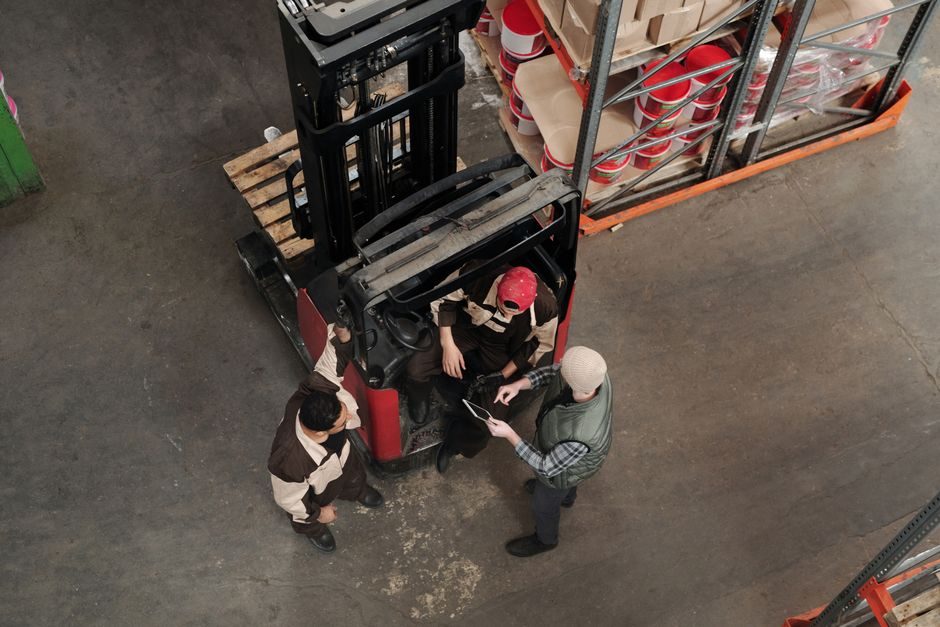
Order pickers are battery-electric Class II narrow-aisle trucks built to lift an operator plus a small load to the picking face, with 2026 production models spanning 1,250 kg / 2,500 lb mid-level units and 3,000 lb high-level stock pickers [S1][S7]. The Crown SP 3500 series lists 1.25 t capacity at a 600 mm load centre on polyurethane tyres Ø 330 x 140 mm front and Ø 150 x 70 mm rear, with a 24 V / 500-800 Ah battery and 1 x / 4 wheel drive configuration [S1]. Toyota's current order picker line ships with a 3,000 lb load capacity, 24/36 V battery options, and AC drive plus lift motors across three available models [S7].
Across the Raymond, Crown, CLARK, and Toyota catalogs the term "order picker" covers everything from a 1,000 lb platform truck that lifts only 24-36 in. to a man-aboard turret truck that takes a picker to the top of a 30+ ft rack bay [S2][S3][S4]. That spread drives application: a 3PL cross-dock, a pharma picking aisle, and a 40-ft-high case-flow rack each justify a different class of machine, and mis-sizing a low-level picker for high-bay work is the most common specification error seen in retrofit projects [S3][S5].
Four Functional Types and What Each One Actually Does
The Crown SP 3511 and SP 3521 sub-models separate into TL (tiller) and TT (tiller-truck) operator configurations, with lift heights (h3) ranging up to 8,840 mm+ on the SP 3521 and overhead-guard heights fixed at 2,325 mm across the family [S1]. Low-level order pickers — sometimes called "stock pickers" — typically cap platform lift at 1.8-2.4 m and are driven with the mast down for in-aisle travel; high-level or man-aboard units carry the operator to 7-12 m and only travel with the platform partially lowered in guided-aisle mode [S2][S3]. The Crown SP 3521's 0.23 m/s lift speed with load and 0.41 m/s without load, paired with AC traction and electro-magnetic regenerative service brake, characterise the high-level performance band most 2026 warehouses now specify for cold-chain and e-commerce work [S1].
Conger Industries, a Wisconsin material-handling dealer, breaks the category into low-level platform, high-level stock picker, man-aboard, and cherry-picker subclasses, with cherry picker used interchangeably for vertical-mast personnel lifts in retail stockrooms [S2]. CLARK's OSX15 and OSQ models are cited as the electric order-picker benchmark for that dealer channel, offering regenerative braking, on-board diagnostics, and AC drive and hydraulic motors as standard fitments [S2]. Raymond's published range — series 5300, 5500, and follow-on high-level models — targets piece-picking, case picking, split-case fulfilment, and high-SKU operations in e-commerce and pharma [S3]. Toyota's 5000 Series orderpicker spec sheet restricts operation to level floors and allows driving fully lowered and unloaded up a 6%-incline ramp no longer than 100 ft — a hard envelope figure any floor surveyor should carry into the spec meeting [S4].
Selection Criteria: Load, Lift, Aisle, and Battery Envelope
The four decision gates that determine which order picker fits are load capacity at the rated load centre, maximum platform lift height, minimum working-aisle width (Ast), and battery voltage/amp-hour class [S1][S2][S7]. On the Crown SP 3500, load capacity Q is 1.25 t at a 600 mm load centre, with the 600 x 100 x 50 mm standard forks and optional fork lengths running 760 / 915 / 990 / 1065 / 1220 / 1370 / 1525 / 1830 / 2135 mm to match different pallet footprints [S1]. Working-aisle figures vary with truck and operator-platform width: SP 3511/3521 transfer-aisle widths for 1000 x 1200 mm pallets traverse at 3,540-3,560 mm and for 800 x 1200 mm pallets at 3,360-3,380 mm, with a 400 mm clearance assumption built in [S1].
Battery envelope is the second gate and often the overlooked one. Crown specifies a maximum battery box of 360 x 920 x 790 mm at 24 V / 500-800 Ah K5, with a 690 kg minimum battery mass — a figure that directly drives counterweight, axle load distribution, and truck stability at full lift [S1]. Toyota's published order picker line runs 24/36 V and lifts 3,000 lb with three model sizes covering 74-83 in. length to forkface, an envelope that puts a hard floor under any retro-floor-rail retrofit [S7]. The Conger overview notes that order picker voltages in the field span 24, 36, and 48 V, with 48 V typically reserved for high-level or man-aboard trucks that need higher sustained traction current [S2].
Application Map: Which Type Goes Where
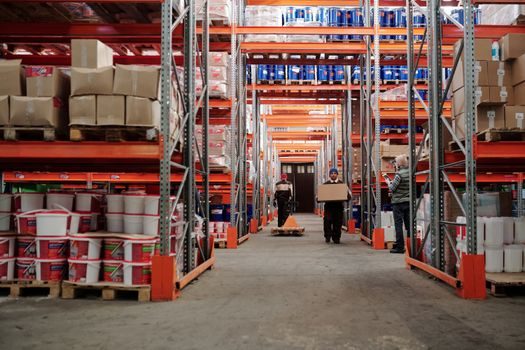
Low-level platform pickers fit ground-level piece-picking, tote replenishment, and pick-to-cart workflows where lift rarely exceeds the operator's standing reach; they replace ladders and scissors lifts and are the right answer for distribution-centre aisles with single-level carton flow racks [S2][S3]. High-level stock pickers — the Crown SP 3500 family, Toyota 5000 Series, Raymond 5300/5500 — go into 20-30 ft rack bays doing case picking, split-case picking, and high-SKU replenishment where the picker travels vertically as well as horizontally on each pick cycle [S1][S3][S4]. Man-aboard order pickers and turret-style units are reserved for the deepest pick faces and very narrow aisles, where the truck itself becomes a guided shuttle in a 1.5-2.0 m wide aisle [S3].
Cross-referenced against picking methods, order pickers dovetail with pick-to-light, voice picking, and RF-terminal workflows — Raymond's published guidance tags order pickers as the primary piece-picking hardware for e-commerce, pharma, and 3PL operations that lean on visual or audio pick direction [S3][S6]. DARR Equipment's coverage adds a 3,000 lb typical weight-limit figure to the general order-picker definition, a value that lines up with the Toyota 3,000 lb class and the Crown 1.25 t (≈2,755 lb) tier as the two mass classes dominating North American fleet sales [S5][S7].
Limits, Failure Modes, and What Order Pickers Will Not Do
Order pickers are not pallet movers, and any attempt to use a 1.25 t stock picker to shift a full 4,000 lb pallet will either trip the capacity derate or, worse, overload the mast at the rated load centre [S1][S2]. The Crown SP 3500 spec sheet explicitly notes that capacity may be subject to derating if the load centre (fork length) is longer than rated or the platform width is wider than standard — meaning the published 1.25 t is a best-case figure, not a universal one [S1]. Operator presence is mandatory: each manually operated picker carries a deadman pedal that must be depressed for the unit to power, a fail-safe Conger flags as a non-negotiable on any used-truck audit [S2].
Floor-slope envelope is the next hard limit. Toyota's published 5000 Series bulletin restricts operation to level floors and caps the unloaded lowered travel ramp at 6% incline over a 100 ft maximum run [S4]. Cold-storage and outdoor-yard applications are not the design case for any Class II narrow-aisle picker in the Crown, Toyota, or Raymond public spec sheets reviewed here; the rubber compound, IP rating, and battery heating provisions are all specified for conditioned-space duty [S1][S4][S7].
Standards, Sourcing, and Trackable 2026 Signals
Order pickers fall under Class II (Electric Motor Narrow Aisle Trucks) in the formal forklift classification system, and the major OEM spec sheets align their load-centre, stability, and braking tests to that class [S2]. The S2/S7 sourcing pattern — dealer-level guidance from Conger plus OEM public spec sheets from Crown, Toyota, and Raymond — gives the buyer a working spec envelope without proprietary dealer data: 1,000-3,000 lb load, 1.8-12 m platform lift, 24/36/48 V battery, 600 mm load centre, and polyurethane tyres as the default track [S1][S2][S7]. For facilities already running pallet jacks, the pallet jack supplier landscape for 2026 sets a useful price-band and spec-gate baseline since low-level order pickers often share the same 24 V battery class and tyre sizing as electric pallet jacks. Warehouses scaling from pallet jacks to reach trucks and pickers will find the reach truck selection map for 2026 a useful companion for aisle-width and mast-height trade-offs. For buyers stepping into automated picking, an order picker reference page in the SourceBySpec catalog summarises the load-class, lift-class, and aisle-class terminology used across these OEM spec sheets.
Trackable signals for the rest of 2026: (a) the Crown SP 3500 family spec sheet dated 2024-09-27 remains the latest public datasheet in the APAC PDF library, so any 2026 model refresh — likely a higher-capacity or higher-lift variant — will surface first as a Crown PDF revision; (b) Toyota's public order picker page references three available models and 3,000 lb capacity, a count that typically expands when a 48 V or man-aboard variant is added to the catalog; (c) the 24 V / 500-800 Ah K5 battery envelope on the SP 3500 is the cleanest spec-driven hook for a 2026 lithium retrofit, since it brackets the Ah class a LiFePO4 swap must match to keep the truck's counterweight valid [S1][S7].
Spec-level background on the components involved: pressure transmitter, and flow meter.