A 4,400 lb low-profile manual pallet jack retails new around US$687.99 on secondary marketplaces, while electric walkie pallet trucks from established lines list around US$3,195 with 2,600 lb capacity and 3-hour runtime per charge [S2][S3]. Heavy-duty forklifts from the same supply base reach 42 t rated capacity, roughly 19x the strongest manual jack on the used market [S1][S10].
Both machine classes move GMA pallets, but the decision hinges on lift height, throughput, and aisle geometry, not raw lift rating. Operators who treat pallet jacks as cheap forklifts overspend on labor; operators who spec forklifts for ground-level transfers overspend on capex and licensing [S4].
Load Capacity, Lift Height, and Power Class
Manual pallet jacks typically max out at 5,000-5,500 lb with a 3 in lowered / 7.5-8 in raised fork face, engineered exclusively for floor-to-floor pallet transfers on standard 48 in forks [S2][S4]. Electric walkie pallet trucks raise that to 2,600-6,000 lb with powered travel, lifting only a few inches off the deck but eliminating the operator push force on every cycle [S2][S5].
Counterbalanced forklifts start near 3,000 lb at 189 in mast height for sit-down electric units and climb to 42,000 lb (42 t) heavy-lift diesel classes sold by the same Chinese OEM cluster that supplies the jack market [S1]. Mast lift heights of 189-240 in are common on standard warehouse trucks; rough-terrain variants add 4WD masts up to 24 ft for yard work [S4]. Across both product groups, drive wheels are typically polyurethane for indoor warehouse floors and solid rubber for outdoor use, with 8 in drive / 2.75 in load wheels a recurring OEM spec on compact electric jacks [S2][S6].
Total Cost of Ownership: Per-Pallet Economics
LiftOne's cost-per-pallet model is the cleanest public benchmark: forklifts carry higher upfront price, scheduled maintenance (500-hour service intervals are typical), operator certification, and fuel or charging infrastructure, while pallet jacks cut all three lines and add only manual labor minutes per move [S4]. A 2020 Raymond 8210 walkie pallet jack with 500 hours on the clock sold for US$4,950 in the secondary market, illustrating the depreciation cliff once a unit leaves fleet service [S10].
Used market pricing puts a working manual jack at US$600-700, an electric walkie at US$3,200-5,000, and a sit-down electric forklift with mast in the US$15,000-45,000 range depending on hours and battery type [S3][S10]. Big Joe's lithium-ion option claims 4x the cycle life of lead-acid, with 2.5-hour recharge versus 8-10 hours on conventional flooded batteries, which compresses the TCO gap when a facility runs two or more shifts [S2].
Use-Case Matrix: When Each Machine Wins
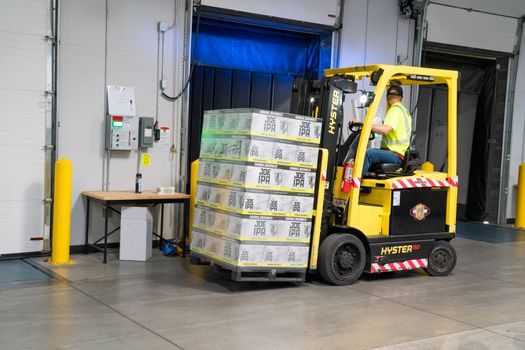
Pick a manual or electric pallet jack when the move is floor-to-floor, the aisle is under 8 ft, the load is under 6,000 lb, and the operator can push or ride for a full shift without lifting above fork-face height [S4][S5]. Crown's WP Series explicitly markets this envelope: 4-250 Ah battery options, 712 mm head length, walkie configuration for in-store retail and light manufacturing where a sit-down truck cannot fit [S8].
Pick a counterbalanced or reach forklift when loads must clear 189 in (about 4.8 m), the operator must stack racks above one pallet position, or the throughput exceeds roughly 30 pallets per operator per hour, a threshold where manual pushing breaks down ergonomically [S4]. Rough-terrain and heavy-lift diesels in the 35-42 t class belong on construction sites, lumber yards, and steel-service centers, not on warehouse slab [S1]. For a fuller pallet stacker option that splits the gap, see the spec-first map in Reach Truck Types and 2026 Selection.
Operator Skill, Certification, and Safety Footprint
OSHA 1910.178 requires operator training and evaluation for any powered industrial truck with a lift function above fork-face level, which captures every forklift and electric pallet truck with a raise button, but exempts manually pushed hand trucks below the lift threshold [S4]. That single regulatory line is why a facility can deploy a manual jack without certified operators but cannot legally run a powered pallet jack without documented training records.
Maneuverability differs sharply: the Big Joe walkie jack quotes a 185° steering arc, tight enough for standard 8-9 ft grocery aisles, while a sit-down counterbalanced forklift needs a 12-13 ft aisle for 90° stacking and a 10-11 ft right-angle turn [S2][S4]. Lithium-ion battery packs also remove the acid-spill containment and ventilation requirements tied to flooded lead-acid charging, which simplifies sit-down electric forklift deployments inside food-grade and cold-storage buildings [S2][S5].
Sourcing, Standards, and Supplier Landscape
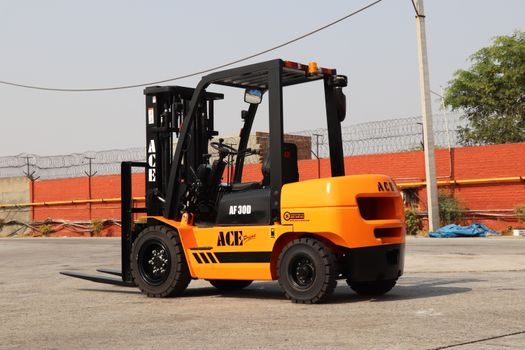
Xiamen Mhepro i-Equipment in Fujian advertises the full product mix: manual pallet jacks, electric pallet jacks, mini electric forklifts, and 42 t heavy-duty forklifts under one corporate identity [S1].
Western OEM documentation from Toyota, Crown, and Big Joe converges on the same load-range envelope (2,500-6,000 lb for walkie electrics) and the same data-plate convention for model and serial lookup, which matters for parts cross-reference across Chinese and Western units [S2][S5][S8]. For pallet rack and storage layouts sized to either machine, the working spec is a 48 in x 40 in GMA footprint with 4 in fork pockets and a 6 in underclearance, regardless of which truck loads it. Buyers running the comparison in parallel with other equipment categories can also weigh How to Choose a Pallet Jack: Five Spec Gates Before You Buy for the jack-only decision.
Decision Rules: A Spec-First Selection Map
Match the machine to four hard numbers, in order: load weight, lift height, aisle width, and shifts per day. Under 6,000 lb / under 12 in lift / under 8 ft aisle / one shift, a manual or electric pallet jack is the cost-correct answer and beats a forklift on every TCO line [S2][S3][S4]. Over 6,000 lb, over 189 in lift, or over two shifts, a forklift is the only spec that satisfies the requirement and the OSHA training rule.
The split-decision zone, 4,000-6,000 lb loads with 60-189 in lift heights, belongs to electric walkie pallet trucks with extended mast options and to stand-on reach units, not to either extreme. Buyers in that band should price a used electric walkie (US$3,200-5,000, 500 hours) against a new entry-level sit-down electric forklift (US$18,000-25,000) and weight lithium-ion versus lead-acid battery cost at the shift count they actually run [S2][S5][S10].
Track two signals through the second half of 2026: Chinese OEM response-rate movement on Alibaba for walkie electrics, and any lithium-ion price-per-kWh reset that compresses the 4x cycle-life premium back toward parity with lead-acid [S2][S9]. Either shift will tilt the crossover point where a jack stops being cheaper than a forklift on a per-pallet-moved basis.