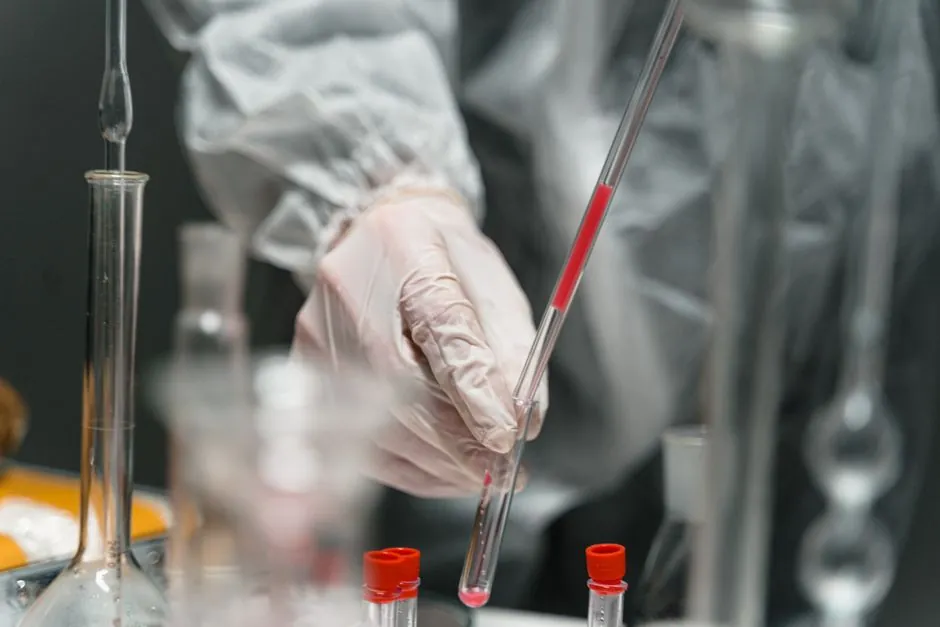
Inside a pH probe, the active surface is a thin, ion-selective glass bulb whose voltage tracks hydrogen-ion activity on a 0-14 logarithmic scale; inside an ORP probe, that glass bulb is replaced by a solid noble-metal element, usually platinum, whose voltage tracks the electron-exchange tendency of every dissolved redox couple in the sample, expressed directly in millivolts [S1][S3][S4].
Both probes share the same reference system (commonly Ag/AgCl in 0.1 mol/L KCl), the same porous junction, the same glass or polymer body, and the same high-impedance mV measurement chain, which is why an ORP sensor can usually be read on a standard pH meter input [S3][S4].
Two sensing elements, one shared reference half-cell
A combined pH electrode contains seven functional parts: a glass body, a reference half-cell (silver/silver chloride or calomel), a ceramic or fiber junction, an external 0.1 mol/L KCl reference solution, an internal 0.1 mol/L KCl buffer, an internal lead, and the glass sensing bulb, where a small amount of AgCl can precipitate over service life [S4].
An ORP electrode keeps items 1-6 essentially unchanged, including the 0.1 mol/L KCl reference fill and the Ag/AgCl internal lead, and substitutes a noble-metal disk or wire for the glass bulb [S3][S4]. Hamilton's process notes confirm the working principle: a pH probe cannot be used for redox measurements, and METTLER-TOLEDO's lab product page repeats the same warning verbatim [S1][S2].
Glass membrane vs platinum or gold disk
The pH glass is a hydrated lithium-sodium silicate layer that develops a phase-boundary potential proportional to log[H+]; the metal element in an ORP sensor is an inert conductor whose surface potential is set by the exchange-current density of whatever redox couples are present [S3].
Xylem Analytics specifies the metal as "usually platinum or gold" and explains that the charge exchange at that surface, relative to the reference half-cell, is what produces the millivolt output read on a pH meter [S3]. Platinum is the default because it is chemically inert across the full usable aqueous range, approximately +/- 2000 mV versus the Standard Hydrogen Electrode depending on chemistry; gold is preferred in strongly oxidizing media where platinum would risk oxide film growth [S3][S5].
What the two probes actually measure
A pH probe returns a dimensionless number on a 0-14 scale reflecting hydrogen-ion activity; an ORP probe returns a raw millivolt reading reflecting the sum of all redox couples acting simultaneously at the metal surface, which is why IUPAC and Hamilton both label ORP a non-selective, mixed-potential measurement [S1][S5].
The standard reference is DIN 38404-6:1984-05, which codifies the design, handling, and functional check of ORP electrodes in water matrices and which calls out platinum as the typical noble metal [S3]. Because the signal is mixed, a single ORP number cannot be back-converted to a pH value and cannot be trusted as a universal "water safety" threshold on its own [S5].
Calibration, verification, and temperature behavior
pH probes are calibrated against standard buffer solutions, typically a 2-point or 3-point calibration at pH 4 and pH 7, with documented temperature compensation in the meter [S4].
ORP electrodes are not calibrated in the same sense; they are functionally checked in a potassium ferrocyanide II / ferrocyanide III redox standard whose expected mV value is read off a temperature table, and the measured value is reported together with the sample temperature, since there is no reliable pH-style automatic compensation for ORP behavior [S3]. The ferri/ferro cyanide check is a verification, not an adjustment, and readings will drift if the metal surface fouls with oil, grease, or oxide film [S3][S4].
When to use which, and why both often run together
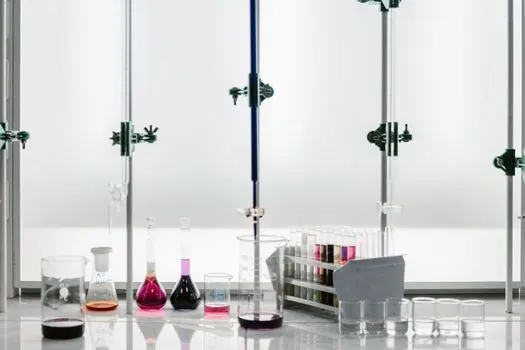
Use a pH probe for acid-base control in neutralization, effluent compliance, and chemical-feed trim; add an ORP probe where a defined oxidation or reduction stage needs to be monitored, such as chlorine or ozone disinfection in drinking water and pools, cyanide destruction in electroplating wastewater, and the breakpoint chlorination step in wastewater nitrification or de-nitrification [S3][S5].
In chlorinated water, pH shifts the hypochlorous acid / hypochlorite balance, which in turn moves the ORP reading, so the two probes are routinely mounted on the same flow cell tap and reported together, with the explicit caveat that neither replaces a real disinfectant-residual test or a microbiological plate count [S5]. A side-by-side decision table: pH = hydrogen-ion activity, dimensionless, 0-14 typical range, glass membrane, calibrates with buffers, auto-temp-comp available; ORP = mixed redox potential, raw mV, +/- 2000 mV range usable, platinum or gold disk, checks against ferri/ferro cyanide, document temperature but do not auto-compensate [S4][S5].
Limits, failure modes, and what to watch on the plant floor
pH probes drift as the glass membrane leaches alkali and as the reference junction clogs, and they are damaged by long immersion in deionized water; conditioning uses 3.8-4.0 mol/L KCl or pH 4 / pH 7 buffer, never pure water [S4].
ORP probes fail for different reasons: the platinum surface oxidizes, picks up sulfide or organic films, or is polished away, and they need a clean, chemically active sample to give a stable reading at all, so clean surface water and most groundwaters will simply sit at a noisy baseline until a redox couple is introduced [S3]. Never install multiple probes in the same beaker or pipe spool without isolation, since they electrically interfere through the shared electrolyte and produce unstable readings [S4]. For comparison shopping on ORP-compatible meters and probes, the industrial pH/ORP analyzer category covers the transmitter side, while a process pressure transmitter often sits in the same panel to log the line pressure and temperature that the ORP reading needs annotated against [S1][S3][S4].
Two trackable signals for the next procurement cycle: confirm whether your site's standard for ORP verification is still DIN 38404-6 or has been superseded, and verify that any new ORP probe ships with a documented noble-metal identity (platinum vs gold) and a reference-junction material, since both drive service interval and chemical compatibility more than the headline mV range.
Background reading: How an LCR Meter Derives Impedance from an AC Bridge Measurement.