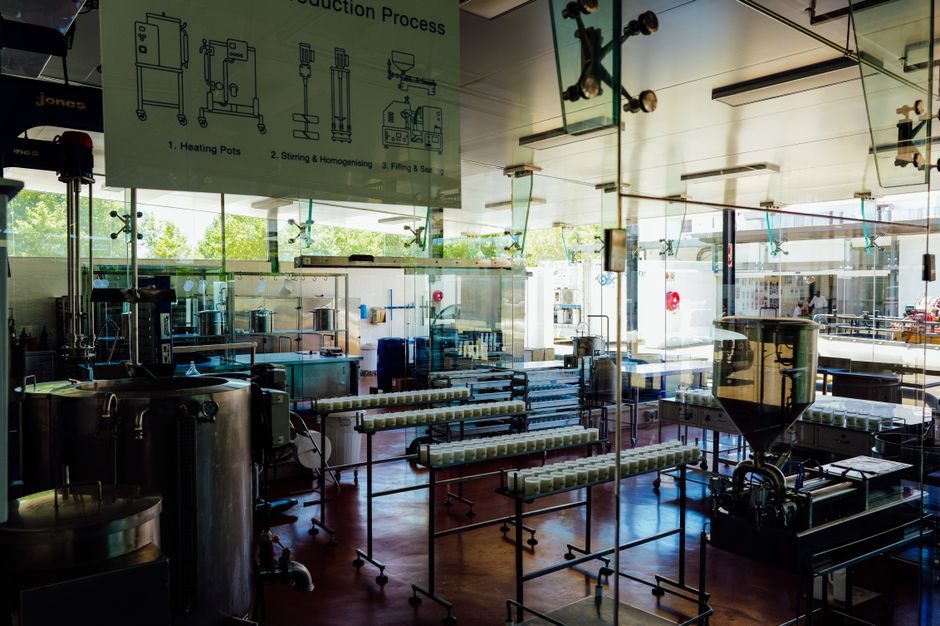
Enclosed-track overhead conveyors in 304 or 316 stainless steel running 20-200 FPM are the dominant specification for new food and beverage (F&B) overhead conveyor lines, with USDA, 3-A Sanitary Standards, and BISSC listed as the governing hygienic codes per a 2026 industry conveyor-requirements table [S4].
Selection is driven by four hard gates — product load and mass, washdown/corrosion exposure, line speed matched to process cycle time, and food-contact material grade — before any cost model is built, and the overhead conveyor category itself is engineered to capitalize on vertical space while keeping floor traffic clear of the product path [S2].
Track Type: Enclosed-Track vs I-Beam vs Power-and-Free
Enclosed-track overhead conveyor has become the standard for high-throughput paint lines, food and beverage manufacturing, and pharmaceutical production, where the protective housing limits employee exposure to moving parts and helps prevent foreign object damage, per IQS Directory's 2026-06-16 editorial update [S2]. I-beam overhead conveyors remain a lower-cost option for heavy automotive or finishing loads, but the open flange collects residue and is rarely specified for direct food contact zones. Power-and-free configurations split the load bar from the drive chain, enabling accumulation and indexing — useful at washdown stations, cook tanks, or spiral freezers where the part must dwell without stopping the line.
For F&B duty, enclosed-track delivers three measurable advantages: a sealed chain/trolley path that limits lubricant shedding onto product, a smoother washdown surface (no exposed I-beam flange), and compatibility with stainless or polymer trolley components. A chain conveyor running in an enclosed track also tolerates the sharp curves and elevation changes typical of a snack or beverage plant where floor space is constrained [S2].
Material of Construction and Hygienic Compliance
Stainless steel provides corrosion resistance, easy cleaning, durability, and compliance with food safety standards, which is why 304/316 stainless framing is the default frame material for F&B conveyors, with 316 specified for chloride-rich washdown and salty or acidic product exposure [S3][S4]. 3-A Sanitary Standards and BISSC ( Baking Industry Sanitation Standards Committee) govern the hygienic design of equipment and conveyors respectively, while USDA acceptance and FDA 21 CFR frame the U.S. food-contact side; in washdown zones, electropolished 316L surfaces and sealed bearings are the typical engineering response, not just to the standard, but to the wash chemistry itself [S4].
When the product zone sees daily chemical sanitizing (caustic, chlorine, or quat-ammonium), 316L is the safer pin because 304 will pit at weld heat-affected zones and at gasket-crevice locations. The same 2026 industry table maps F&B frame to 304/316 stainless and to typical line speeds of 20-200 FPM — a relatively slow band compared to packaging lines (30-300 FPM) or warehouse conveyors (100-600 FPM) — and that band is set by the product itself, not the conveyor: bottles tip, dough sheets tear, and pans walk if the chain is over-driven [S4].
Capacity, Speed, and Load Gates
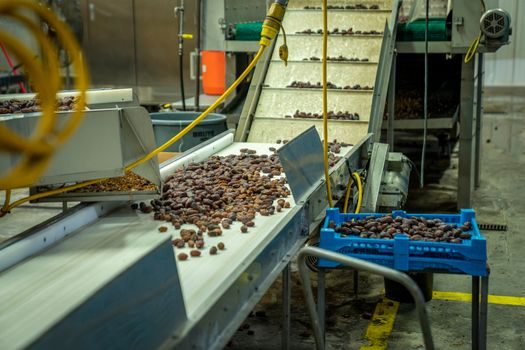
Overhead conveyor payload is set by trolley pitch, chain rating, and drive torque, with small-product F&B lines typically spec'd to a 120 lb per trolley load capacity, all-stainless construction, plastic chain belting, and standardized 4" to 24" width increments in conveyor catalog offerings [S6]. Line speed in food plants is almost always at the lower end of the conveyor's mechanical range so that operators can intervene at inspection, seasoning, or reject stations, with 20-200 FPM matching the rhythm of operator-paced packing tables, not the 300-600 FPM speeds seen in parcel handling [S4].
For a half-liter PET beverage line, overhead conveyors are often specified to index bottles through inverted-air rinse, fill, cap, and tunnel-pasteurizer zones — a sequence where accumulation and power-and-free logic are more valuable than raw speed. For a snack or bakery line, the gating constraint is typically dwell time at a fryer or proofer entry, which forces the conveyor to be a thermal-rated system (oven, proofer) rather than a standard enclosed track. Process Technology's HC200 sanitary conveyor line demonstrates the spec pattern: sanitary design, stainless construction, metric fasteners, and food/pharmaceutical scope — a fingerprint of how F&B OEMs are standardizing the spec [S6].
Selection Criteria: Product, Plant Layout, Automation
Conveyor selection in food processing is dominated by six variables — product type, production capacity, hygiene requirements, factory layout, automation level, and maintenance requirements — and the conveyor is then customized in length, width, speed, material, elevation, and automation controls to match them [S3]. A brewery, dairy, or pet-food plant, for example, will spec for CIP (clean-in-place) compatibility and 316L wetted surfaces; a frozen-food line will spec for low-temperature chain lubrication and stainless trolley bearings rated for -20 °C or below.
Overhead conveyors prove less intrusive than floor-based systems and are particularly ideal for moving items within environments deemed hazardous or inaccessible to humans, such as ovens, paint booths, chemical handling zones — a design philosophy that maps directly onto F&B cook tunnels, enrobers, and washdown galleries [S2]. Where floor space is tight, an overhead loop above a packaging line can free a full lane of floor for forklift or palletizer traffic; where the line is long and elevation changes are needed, the suspended track negotiates multi-floor routing with the smallest structural footprint. For a parallel spec view on a related sector, the Overhead Conveyor Selection for Cold Chain Logistics walkthrough covers low-temperature chain lubricants and trolley bearing materials, several of which apply equally to frozen-food F&B duty.
Comparison: Enclosed-Track vs I-Beam vs Power-and-Free for F&B
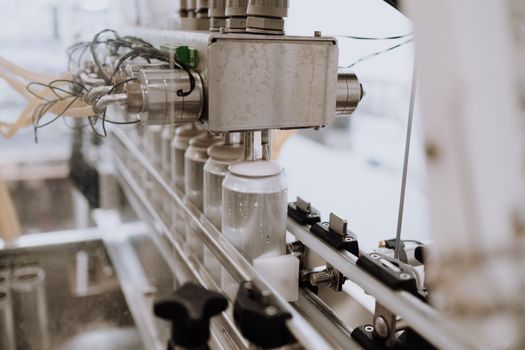
The three competing track topologies each carry distinct spec profiles when lined up against F&B decision criteria, and the right answer depends on which criterion is gating. Enclosed-track scores high on hygiene and operator safety, medium on load capacity, and medium on cost; I-beam scores high on load capacity and low cost, but low on hygiene and safety; power-and-free scores high on process control and accumulation, medium-to-high on cost, and medium on hygiene depending on trolley design. The trade-off that is often missed: an I-beam system can be retrofitted with a strip curtain or polymer shroud to look hygienic, but the open flange still traps wash water and product residue — and that residue is the source of most F&B audit findings, not the chain itself [S2].
Speed and capacity bands reinforce the same ranking: F&B at 20-200 FPM is a slow-to-medium band driven by operator-paced packaging, so the high-speed advantage of I-beam is wasted; F&B payload is generally light (per-trolley ≤120 lb typical catalog rating), so the heavy-load advantage of I-beam is also wasted. Enclosed-track wins on the two F&B-binding criteria, which is why the conveyor chain running in an enclosed track is the F&B default. The reader comparing this to in-floor or tabletop systems should also note the belt conveyor family: belts are cheaper for straight runs, but overhead tracks become the better answer wherever the path must climb, curve tightly, or pass over operator workstations without a guard rail.
Limitations, Failure Modes, and Sourcing
The dominant failure modes on F&B overhead conveyors are corrosion at welds and pivots, lubricant migration onto product, trolley-bearing seizure in cold or wet zones, and chain elongation from under-spec drive torque — all of which are addressed by material grade, food-grade H1 lubricant, sealed bearings, and correctly sized drives. A real risk worth flagging: when a plant retrofits an existing I-beam line for a new sanitary product, it often tries to seal the open track with a strip rather than replacing the track — the strip fails, the residue returns, and the audit finding stays. Floveyor's 2026-05-22 selection guide frames the broader rule that applies here: "Adhering to industry regulations is not just about following the law — it's about ensuring consumer safety" [S1].
For sourcing, the verifiable 2026 signals are: BISSC and 3-A Sanitary Standards remain the named hygienic codes for U.S. F&B conveyor lines; USDA acceptance and FDA 21 CFR remain the named food-contact frames; typical speed band 20-200 FPM, 304/316 stainless framing, all-stainless HC200-class sanitary units with 4"-24" widths and 120 lb trolley load, and metric fastener standardization are the documented catalog-level data points to anchor RFQs against [S4][S6]. Conveyor system selection and standards compliance in 2026 also consistently point to customization in length, width, speed, material, elevation, and automation controls — a reflection of how plant-by-plant F&B layouts drive engineering rather than off-the-shelf catalog picks [S3]. For a contrast on a different process conveyor class where pneumatic conveying may replace overhead, the pneumatic conveyor reference outlines where enclosed-track overhead stops being the right answer — typically when the product is bulk powder and the line is single-floor with long horizontal runs.