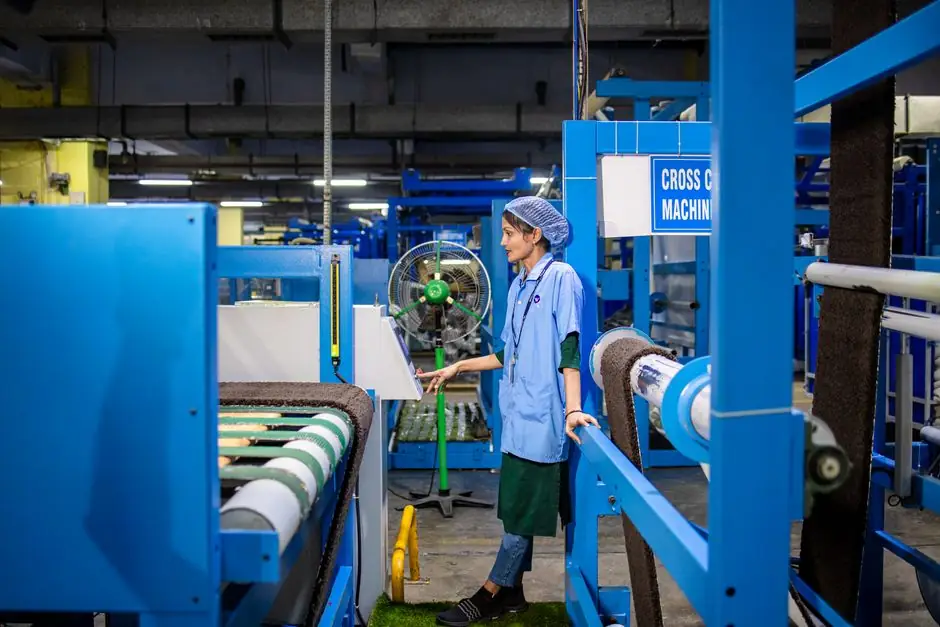
BIW assembly lines specify overhead conveyor trolleys in three distinct payload bands: 50–500 kg for doors, cockpits, and powertrain modules; up to 3,000 kg per carrier for complete bodies-in-white; and custom 7 t heavy-duty EMS designs for special vehicle programmes [S5].
Track family, chain pitch, drive topology, and ambient temperature class together fix the practical load envelope more than carrier hardware alone, so the trolley selection problem is really a track + drive + accumulation selection problem [S2][S4].
Three Load Bands for Automotive Carriers
Dürr's electric monorail system (EMS) explicitly splits the automotive market into two named bands: a lightweight EMS rated to 500 kg for doors, cockpits, engines, and sub-assemblies, and a heavy-duty EMS rated to 3,000 kg for transporting complete bodies, with special designs documented up to 7,000 kg [S5]. A general industry reference for overhead conveyors cites 50–5,000 kg per trolley as the working envelope, depending on wheel and track combination [S8].
For BIW final assembly specifically, PAC-LINE markets a medium-capacity enclosed-track overhead conveyor aimed at body-in-white, automotive door, and related assembly duty [S3]. The 500 kg / 3,000 kg / 7 t benchmark set is therefore the practical reference window that engineers should map their BIW carrier count and cycle time against, not the headline "max" figure on a sales drawing.
Track Family vs Load Capacity
Enclosed-track overhead conveyors are typically rated 100–400 lb per carrier and run 5–60 FPM, which makes them suitable only for light sub-assemblies and components, not whole bodies [S2][S4]. I-beam monorail systems scale much further: Cisco-Eagle's catalogue shows a 3 in track at 200 lb per trolley, a 4 in track at 400 lb, and a 6 in track at 1,200 lb per trolley [S6]. Dürr's I-beam-equivalent electric monorail system extends this into the automotive-tonnage range by combining heavier track sections, paired twin trolleys (T.T.S.), and dedicated drive modules [S5].
Power and free systems occupy the middle of the capacity chart at roughly 250–1,500 lb per carrier and are the dominant choice where BIW bodies must accumulate, switch, or stop for station work [S2][S4]. A locking assembly at each carrier lets the body stay stationary while the drive chain continues underneath, which is the defining advantage of P&F for indexed body lines. The trade-off is installed cost: a 2026 vendor guide puts enclosed track at 1.0× baseline, I-beam monorail at about 1.4×, and power and free at 2.8–3.5× baseline cost [S4].
Temperature, Duty Cycle, and Carrier Hardware
Paint-shop and e-coat BIW carriers must survive bake-oven exposure, so maximum ambient temperature is a hard constraint, not a footnote. Enclosed track is generally limited to around 120 °C, I-beam monorail to roughly 220 °C, and power and free to about 200 °C [S4]. I-beam monorail's open architecture, where every wheel and bearing is visible and lubricatable, is the practical reason it dominates paint lines and foundries [S4].
For body lifting and indexing, Dürr's Vertical Adjustable Carrier (VAC) uses a polyurethane belt with integrated steel cables designed for 3 t payloads, paired with C-, T-, or four-arm hangers and a scissor stroke of up to 4.5 m for ergonomic workstation heights [S5]. Twin-trolley (T.T.S.) systems, in contrast, run on paired aluminium-rail modules with no lubrication and are offered in classic, light (≤500 kg), heavy (≤6,500 kg, used in aircraft), and inverted floor-conveyor variants [S5]. Pairing a VAC lift with a platform trolley base is a common way to bridge overhead and floor transport on the same body, while a load cell in the hanger loop is the cleanest way to verify the actual per-carrier mass during commissioning rather than trusting the nameplate.
Comparison: Enclosed Track vs I-Beam Monorail vs Power and Free
For a BIW line, the choice reduces to a small set of decision criteria that can be lined up directly [S2][S4][S5]:
1. Payload per carrier. Enclosed track tops out near 180 kg (400 lb) and is unsuitable for complete bodies. I-beam monorail spans roughly 70–550 kg (150–1,200 lb) per trolley in standard track sizes [S6], and electric monorail systems extend that to 500–3,000 kg with specials to 7 t [S5]. Power and free covers 115–680 kg (250–1,500 lb) per carrier in its standard automotive window [S4].
2. Stop, accumulate, and switch. Only power and free can stop and accumulate a body without halting the main drive chain; enclosed track and I-beam monorail run continuously [S2][S4]. For an overhead conveyor carrying whole bodies between welding, inspection, and trim stations, that capability is usually mandatory, which is why P&F and twin-trolley variants dominate BIW shops.
3. Ambient temperature. Enclosed track 120 °C, P&F 200 °C, I-beam monorail 220 °C [S4]. A body that has to pass through a 180–200 °C paint bake after leaving the BIW area pushes the designer toward I-beam or P&F, not enclosed track.
4. Installed cost. Enclosed track 1.0×, I-beam monorail ~1.4×, power and free 2.8–3.5× [S4]. A vendor cost guide is a starting point, not a quote, but the 3× gap between enclosed track and P&F is consistent across published references and is the main reason small-component lines stay on enclosed track while body lines pay for P&F or twin-trolley.
Standards, Sourcing, and Engineering Verification
BIW overhead conveyors are typically engineered against automotive-specific safety standards, with Dürr explicitly stating that its standardised modular VAC and T.T.S. systems meet "all worldwide safety standards in the automotive industry" without naming a single standard on the public product page [S5]. For a real specification, the engineer should pull the supplier's CE / UL / OEM-specific declaration of conformity for the installed track, drive, and locking hardware, not rely on the marketing line.
For independent verification of capacity, in-line weighing with a load cell on the hanger pin is the most common commissioning check, while a strain-gauged electronic load on the drive motor gives a continuous system-level read on total suspended mass. For lines that run both heavy bodies and light sub-assemblies, dual-rated trolleys with a documented derating curve (for example, 1,200 lb at 30 FPM, 800 lb at 60 FPM) should be specified explicitly in the RFQ, since the nameplate figure is almost always the slow-speed maximum.
Common Sizing Mistakes in BIW Trolley Selection
Three errors recur on real projects. First, specifying the carrier from the body's bare mass without adding fixture, hanger, and BIW tooling mass, which routinely adds 20–40% to the suspended load and can push a 2,500 kg line into the 3,000 kg-plus EMS band [S5][S8]. Second, choosing enclosed track for whole-body duty to save cost; the 400 lb ceiling per carrier [S2][S4] rules this out for any complete body, and the resulting chain elongation or trolley-wheel damage is the most common warranty dispute on retrofit BIW lines.
Third, ignoring accumulation and switching requirements until layout design is locked, which forces expensive P&F retrofits later. A locking assembly is what makes P&F accumulation work, and a platform trolley base is what lets the same carrier interface with floor conveyors at the trim and final assembly handoff. Specifying these interfaces during concept, not after layout freeze, is the single biggest cost lever on a greenfield BIW overhead line.
Track two signals over the next planning cycle: (1) the published 2026 capacity ceiling for BIW-class overhead conveyors, which currently sits at the 7,000 kg special-design mark set by Dürr's heavy-duty EMS [S5], and (2) the gradual migration from lubricated steel-chain monorail to lubrication-free twin-trolley (T.T.S.) systems in paint and final assembly, driven by noise, particulate, and energy targets rather than by load capacity [S5]. For related background on selection methodology, see the spec-driven bearing-assembly piece Single Row vs Double Row Tapered Roller Bearing Assembly: Spec-Driven Selection.