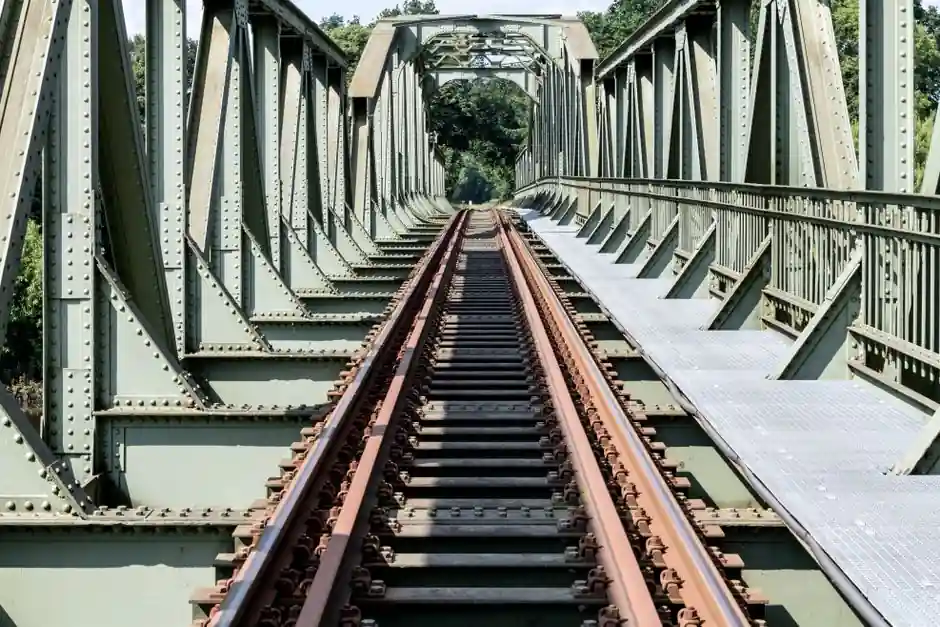
An overhead conveyor is selected first by track profile: enclosed tubular track for clean, tight-curve lines up to 14,000 lb, or open I-beam rail for heavy, lower-cost industrial runs from X348 (3 in pitch, 500 lb) through X678 (6 in pitch, 2,000 lb) drop-forged rivetless chain [S3].
Enclosed track is a tubular or box-section rail that fully wraps the chain and trolley wheels, whereas I-beam systems ride a standard structural S-section (S3 x 5.7, S4 x 7.7, S6 x 12.5) with the chain pinned in the web and trolleys rolling on the lower flange [S1][S3]. The two profiles diverge on capacity, curve radius, contamination tolerance, lubrication strategy, and installed cost, so a spec-driven comparison, not habit, should drive the line call.
Track Geometry and Load Capacity by Profile
Enclosed track geometries routinely deliver up to 14,000 lb system capacity, with the 5 in pitch UH-5075-S at 5 tons and 7 in pitch UH-7075-HA at 7 tons being the workhorses for medium- and heavy-duty enclosed lines [S3]. Caldan-style enclosed profiles ship in 180 mm (3 ton) and 270 mm (5 ton) pitches for compact paint and finishing cells [S3]. By contrast, an I-beam overhead conveyor running X348 chain on S3 x 5.7 rail is rated near 500 lb per trolley; X458 on S4 x 7.7 lifts about 1,000 lb; X678 on S6 x 12.5 reaches 2,000 lb [S3]. Imperial (inch-based) and metric I-beam standards both exist for overhead conveyor use, and the chain pitch must match the beam family selected [S6].
The single highest-leverage geometric difference is curve radius: enclosed track bends at 12–24 in, I-beam at 24–48 in, which is a 2:1 envelope advantage for tight plant footprints and multi-level routing [S3]. Modular enclosed sections also keep the cross-section height low, reducing finger-pinch exposure in workstation zones [S2].
Cleanliness, Lubrication, and Maintenance Behavior
Enclosed track surrounds the chain, so falling debris, dust, and lubricant drips cannot reach the product below; self-contained chain lubrication is internal and requires no external oiler [S3]. I-beam systems run with the chain exposed on the open web, so external lubrication is mandatory, contamination falls straight onto the load, and the chain needs visual inspection at each service interval [S1][S3]. For paint, powder-coat, food, beverage, pharmaceutical, and clean-room duty, the contamination argument alone usually forces the decision to enclosed profile [S1][S3].
Noise follows the same logic: enclosed rail dampens chain-on-rail impact and runs quieter, an underrated gain on stations where operators work directly under the line [S3]. Spanco notes that enclosed track workstation bridge cranes are also faster to install and easier to relocate later because the rail ships as modular aluminum or steel sections that bolt together on site [S9].
Installed Cost, Modification, and Supply Base
I-beam is the lower-first-cost option because the rail is standard structural steel stocked at any service center, the chain (X348/X458/X678) is multi-source, and field modifications are cut-and-weld simple [S3]. Enclosed track carries a higher unit price for the proprietary rail, but it consolidates the lubrication system, the safety guarding, and part of the structural support into one assembly, which compresses the bill of materials on a clean-room or paint line [S2][S3].
For facilities that expect to extend, reroute, or cannibalise the line in five to ten years, I-beam is the safer bet: components are interchangeable across vendors, and the open rail is trivial to inspect with a flashlight [S1]. Rapid Industries even publishes mixed systems, Enclosed Track over 3 in channel, 3 in I-beam over 3 in channel, 4 in I-beam over 4 in channel, as well as the Q Flex enclosed over 3 in channel, for plants that need both profiles on one power-and-free backbone [S7].
Application Fit: Where Each Profile Wins
Enclosed track is the right call for paint finishing, powder coating, food and beverage processing, pharmaceutical manufacturing, clean rooms, and any layout with tight curves or multi-level routing, typically through Caldan 180/270 mm or UH-5075-S / UH-7075-HA chain [S3]. I-beam is the right call for automotive assembly, heavy manufacturing, warehouse transport, and any application where routine visual chain inspection matters more than contamination control, with X458 and X678 chain on S4 x 7.7 and S6 x 12.5 rail covering most general-industrial loads [S3]. A related structural-steel decision, S-shape vs W-shape American beams, matters when the conveyor support structure is also being specced, and the trade-offs are laid out in S-shape vs W-shape American beams: spec comparison and selection.
Mazzella's 2025 guidance pushes the same direction for overhead cranes built on the same profiles: enclosed track crane systems are almost all under-hung, top-running style, capped near 3 tons (2-ton systems most common), and best suited to workstation and light assembly duty, while traditional I-beam and wide-flange crane runways carry heavier process loads [S5]. For paint-line planners already running an overhead bridge crane into a prep station, the enclosed track profile on the conveyor infeed often matches the crane rail for consistency of trolley behaviour and lubrication practice.
Selection Criteria: A Side-by-Side Decision Matrix
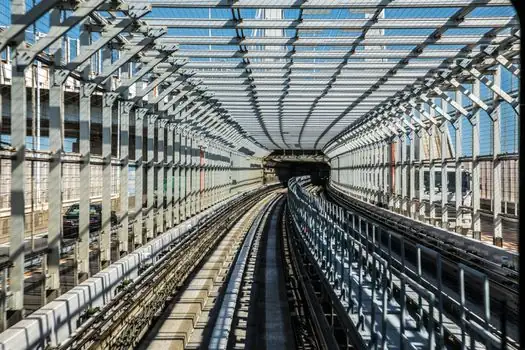
On load capacity alone, enclosed track up to 14,000 lb beats I-beam up to 10,000 lb per the comparison table in current supplier literature, but I-beam still covers the bulk of general industrial duty under 2,000 lb per chain [S3]. On minimum curve radius, enclosed track at 12–24 in beats I-beam at 24–48 in by roughly 2:1, which decides layout in retrofit plants with low ceilings [S3]. On cleanliness, enclosed is rated five stars versus three for I-beam because the closed profile blocks debris migration [S3]. On first cost, I-beam wins; on total installed cost for a guarded, lubricated, clean-rated line, the gap narrows once guarding and external lube skids are added to the I-beam scope [S2][S3].
For spec writing, the shortlist reduces to five questions: what is the per-trolley load, what is the minimum curve, is the environment clean or dirty, will the layout change in the next decade, and is operator noise a documented KPI. If three of five answers point to clean, tight, and stable, specify enclosed track with UH-5075-S or Caldan 270 mm chain on a modular rail; if three of five point to heavy, open, and adaptable, specify I-beam on S4 x 7.7 or S6 x 12.5 with X458 or X678 chain and budget for external lubrication [S3][S6].
Limits, Failure Modes, and Sourcing Watch-Outs
Enclosed track's closed profile is also its maintenance liability: internal wear on the trolley bearings and the captive chain is invisible from outside, so plants that skip borescope inspections tend to discover wear only after a trolley seizes [S1][S3]. I-beam's open rail exposes the chain to contamination and to accidental forklift or load impact, which is why impact zones on I-beam lines are usually guarded and why a dropped load can deform the lower flange enough to require a rail section replacement [S1].
On the supply side, genuine X348, X458, and X678 drop-forged rivetless chain is multi-vendor and field-serviceable; enclosed track components are more vendor-specific, so specifiers should confirm spare-part availability and lead time before locking the rail profile, especially for the Caldan 180/270 mm and the UH-5075-S / UH-7075-HA pitches [S3][S7]. For plants standardising on E-Trac 8 style enclosed rail, 1st Source publishes matching components, but the closed-section spare chain is not interchangeable with I-beam chain, a point that should be on the spare-parts BOM from day one [S8]. The next signal worth tracking is whether more vendors publish UL- or CE-rated enclosed track for collaborative-robot workcells, since cobot-painting cells are the fastest-growing enclosed-track application through 2026.
Spec-level background on the components involved: belt conveyor.