
A motor-in-head internal concrete vibrator stacks an electric motor and an eccentric rotor inside the cylindrical poker head, so the head is the prime mover rather than a remote-driven weight on a flexible shaft [S2][S5]. The hose that returns to the operator carries only stationary 42 V three-phase power and control wiring, which removes the rotating-shaft seal that conventional flexible-shaft designs have to manage [S1][S6].
Operating speed sits in the high-frequency band: published converter-driven heads run at 9000 vpm (150 Hz) or 12000 vpm (200 Hz) with head diameters from 35 mm to 125 mm and centrifugal force from 1.0 kN to 20 kN [S2]. Wacker Neuson's HMS modular line keeps the external drive motor and the head as separate modules, but lists induction-hardened shells and tool-free quick couplings as the field-service pattern for the same architecture [S4][S8].
Internal Cross-Section: Shell, Stator, Rotor-Eccentric, and Bearing Housing
The motor-in-head cross section reads, from outside in: a hardened cylindrical steel shell, an oil-sealed end cap with the power-entry boss, the stator winding pack, the rotor with an integrated eccentric weight, and a pair of bearings that locate the rotor and carry the eccentric reaction load [S2][S3]. The rotating eccentric is the only moving part inside the head, so vibration is generated at the head with no intermediate shaft, no flexible-drive core, and no torque loss between the motor and the offset mass [S2].
US patent 9,095,991 B2 (Oztec Industries, published 2015-08-04) defines a vibrator head as "an elongated body having a front end and a back end" with the back end attached to a rotating shaft input, and the elongated body housing the eccentric mechanism that produces the oscillation [S3]. That elongated-body envelope is the same envelope a motor-in-head design uses, except the rotating-shaft input is replaced by an internal stator winding and the eccentric is driven directly by the rotor [S2][S3].
Power Delivery: 42 V, 150 Hz / 200 Hz, and Why the Hose Has No Rotating Seal
Motor-in-head designs run on 42 V three-phase at 150 Hz or 200 Hz, supplied by a frequency converter on 3-phase 380 V / 50 Hz mains, which is why the hose is restricted to "stationary electrical wires" rather than a rotating shaft inside a protective cover [S1][S2][S6]. Published converter models ZJB150 and ZJB200 cover 1.2-18.5 kVA converter capacity and drive 1-10 heads in parallel from a single converter, with output at 3-phase 48 V [S2].
The 42 V converter-fed architecture is the safety case the vendor cites for European and Southeast Asian projects, where site labour-protection rules favour low-voltage hand tools and high cycle rates over 120/240 V direct-on-line shafts [S2]. Because the hose is stationary, the head can be rated for continuous immersion and the operator can swap heads on a quick-disconnect coupling without breaking a rotating seal, which is the field-service point Wacker Neuson emphasises on the HMS line [S4][S8].
Performance Map: Head Diameter, Frequency, Amplitude, and Centrifugal Force

The published ZDN poker-head range maps three variables together, and the table is the cleanest cross-reference for sizing [S2]:
ZDN125 at 150 Hz: 125 mm head, 9000 vpm, 3.4 mm amplitude, 20 kN centrifugal force. ZDN85 at 200 Hz: 85 mm head, 12000 vpm, 1.6 mm amplitude, 6.6 kN. ZDN60 at 200 Hz flexible-shaft: 60 mm head, 12000 vpm, 2.2 mm amplitude, 4.5 kN. ZDN35 at 200 Hz: 35 mm head, 12000 vpm, 1.8 mm amplitude, 1.0 kN [S2].
For the same 200 Hz excitation, smaller heads (35-60 mm) trade centrifugal force for higher amplitude, while larger heads (85-125 mm) trade amplitude for higher force, which is the same trade-off curve that governs any concrete vibrator head selection: bigger radius of action needs bigger force, congested rebar needs smaller diameter [S1][S5].
Comparison: Motor-in-Head vs External-Motor Shaft (Stick) Vibrators
Both architectures consolidate concrete by spinning an eccentric inside the head, but they differ on four practical decision criteria that show up on every pour plan [S1][S2][S6]:
Power transmission: motor-in-head uses a stationary 42 V three-phase wire bundle; stick vibrators use a rotating shaft inside a protective hose, lubricated and sealed at the head entry. Service scope: motor-in-head swaps heads on a quick coupling without breaking a rotating seal; stick vibrators need the flexible-shaft core pulled and re-greased. Safety voltage: motor-in-head is 42 V at the operator end; common stick-vibrator drive motors are 120 V or 240 V single-phase direct-on-line. Frequency: motor-in-head is high-frequency at 9000-12000 vpm from a frequency converter; stick vibrators run at mains frequency, typically 3600 vpm at 60 Hz, which is a slower, longer-amplitude consolidation cycle [S1][S2][S6].
For wall, column, and congested-rebar pours where head size must drop below 50 mm, the motor-in-head architecture with 35-60 mm ZDN heads is the typical European specification, and the underlying drive package is the same AC motor stator family used across the high-frequency converter product class [S2].
Wear Items, Failure Modes, and Maintenance Window
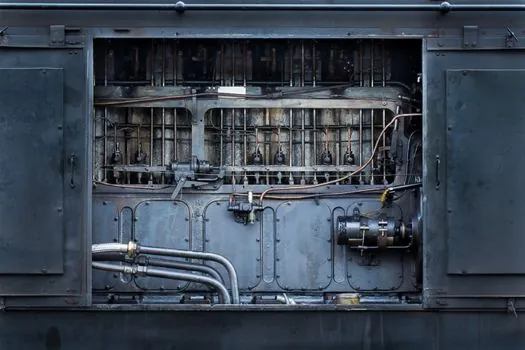
Inside the head, the wear surfaces are the induction-hardened shell OD, the stator-to-rotor air gap, the eccentric bearing pair, and the cable-entry seal [S2][S4]. Wacker Neuson publishes a carbon-brush life of "up to 500 operating hours" on its HMS external-motor modules, which is the published benchmark for the brush-grade change interval on the drive end of a high-frequency vibrator system [S4].
The two recurring failure modes on motor-in-head heads are bearing failure from concrete slurry ingress past a worn cable-entry seal, and stator winding burn-out from converter overcurrent or locked-rotor stalls in low-slump mixes [S1][S4]. On low-slump concrete, the operator is expected to use larger heads to keep insertion count down, and the radius of action is "a 1-ft to 2-ft radius" around each insertion point, so spacing of insertions is a process control, not a machine control [S1][S7].
Sourcing, Standards, and Selection Checklist
Motor-in-head systems are sold as a matched pair of frequency converter and poker head, not as a standalone head, because the 42 V three-phase output is defined by the converter model code (ZJB150 or ZJB200) [S2]. Selection checklist: confirm converter kVA and head count on the same model line, confirm head diameter against the minimum rebar spacing on the pour, confirm 42 V personnel-safety voltage for the site, and confirm the quick-disconnect coupling pattern if the head is being added to an existing HMS-style modular kit [S2][S4][S8].
Two trackable signals for the next planning cycle: the 150 Hz vs 200 Hz choice is being driven by labour-protection rules in EU and Southeast Asian projects, so demand for the higher-frequency ZJB200 converters is the most visible site-spec indicator [S2]; and the modular quick-disconnect pattern is what lets a single drive unit serve a range of head diameters, which is the cost case Wacker Neuson publishes for keeping one drive unit on a multi-head site [S4][S8].
For the relevant spec sheets and selection criteria, see steel section.
Background reading: Dozer Blade Laser Receiver: Specs, Mounting, Indicate vs Automatic.