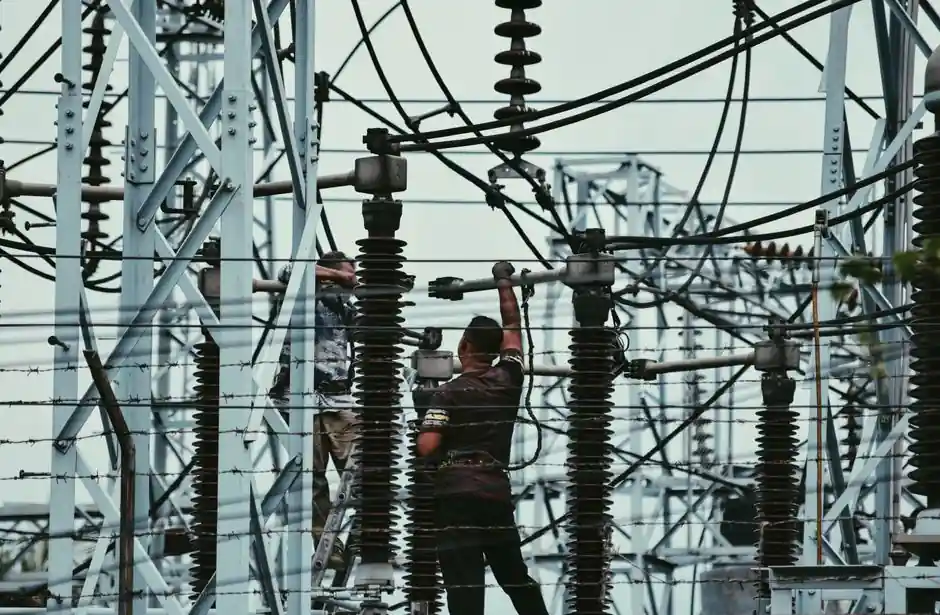
An oxygen (O2) detector for electrical confined-space entry must combine a 19.5% low-oxygen alarm, a 23.5% enrichment alarm, and a sensor with at least 24 months of calibration life to survive the dust, humidity, and switching-gear heat of a typical indoor substation or cable vault [S1].
OSHA requires that an O2 monitor be placed in any room where compressed gases or cryogenic liquids are used or stored indoors, and the practical floor density is one monitor per 400 to 600 sq ft (roughly one per 20 to 30 ft in any direction) [S3]. Electrical crews pulling cable, terminating transformers, or working in battery rooms need to layer that fixed monitor with a personal four-gas wearable so the worker carries the alarm, not just the room.
Why an O2 Detector, Not a CO Detector, Is the Primary Choice
An oxygen depletion sensor on a vent-free appliance trips at about 18.5% O2 by volume, a 2.5-point drop from the 21% baseline, which means 2.5% of another gas has already taken its place before the alarm fires [S2]. In a switchgear room that displacement gas is often SF6, nitrogen from purge cycles, or CO from an overheated UPS, so the O2 trend reads the hazard even when the toxic gas itself has not yet reached its TLV. For electrical work specifically, the oxygen detector is the lead instrument because it covers nitrogen purge, argon welding blankets, and dry-ice de-icing around generator rooms in a single channel.
CO detectors remain mandatory as a secondary layer: the CDC attributes over 10,000 US poisonings and 438 deaths per year to CO, with 400 ppm dangerous over hours and 1,600 ppm fatal within minutes [S2]. The correct pairing for an electrical crawlspace job is O2 first, CO second, with both alarms routed to the same personal monitor or paired fixed-point transmitter.
Sensor Type and Specification Trade-offs
Three sensing families dominate the electrical-work specification set, and the right pick depends on the room's humidity, the expected oxygen floor, and the maintenance interval. For battery rooms and UPS halls where the lower explosive limit is the bigger concern, an electrochemical sensor with a 0-30% O2 range, ±0.5% accuracy, and a T90 response under 30 seconds gives the best price-to-life ratio [S1].
For nitrogen-purged cable tunnels where O2 can sit at 16-18% for hours, a zirconia or paramagnetic sensor avoids the electrochemical drift that comes with sustained low-oxygen exposure and stays within spec down to 0.1% O2. For outdoor substation work, a non-depleting galvanic sensor costs less upfront but needs annual replacement; a typical industrial-grade O2 detector specifies a 2-year calibration interval, 24-month sensor life, and an IP65 housing for wash-down environments [S1]. Always check the cross-sensitivity table: a standard electrochemical O2 cell will drift if exposed to >1000 ppm CO2, which matters in concrete cable vaults with biological activity.
Installation Density, Mounting Height, and Zoning

OSHA's text on compressed gases is silent on spacing, so industry practice fills the gap: one oxygen deficiency monitor every 400 to 600 sq ft, equivalent to a sensor on a 20 to 30 ft grid across the room [S3]. Where a dewar or cylinder manifold sits, mount the monitor directly in the storage area; where gas enters through a pipe from outside, mount it at the main gas connection, the same physical point as the regulator or first-stage solenoid [S3].
Mounting height is set by the gas that may displace oxygen. Nitrogen and argon are heavier than air, so for a battery room or generator vault the sensor belongs at breathing-zone height, 4 to 6 ft off the floor, not on the ceiling. For hydrogen or helium leaks, which rise, the sensor moves to the high point. Barometric-pressure-compensated monitors are specified for any room above 3,000 ft elevation, because standard electrochemical cells will read artificially low under reduced pressure [S3]. For a dissolved oxygen meter in a wet well, the same pressure-compensation logic applies.
Alarms, Outputs, and Electrical Integration
Industrial O2 detectors for electrical rooms ship with three alarm tiers: low at 19.5% O2, high at 23.5% O2, and a TWA-style alert at 20.5% for trending. Each tier must trigger an audible horn at 95 dB at 1 m, a 360° strobe, and a vibration puck on personal units, and the detector should record the last 30 days of data at 1-minute resolution for incident review [S1].
Output options map to the electrical automation stack: a 4-20 mA analog loop for legacy SCADA, a Modbus RTU over RS-485 for modern BMS gateways, and relay contacts rated 5 A at 250 VAC for direct shunt-trip of the room's ventilation fan. For classified areas, specify an ATEX or IECEx-rated head and route the signal through an electrical measurement isolator; battery rooms with hydrogen venting usually sit just inside Zone 1, and the detector's certification label has to match.
Comparison of Common Detector Classes for Electrical Work
Side-by-side against four decision criteria, the three detector classes used most often on electrical jobs line up as follows. (1) Personal four-gas monitor: lowest cost per worker, 24-month battery, electrochemical O2, no fixed-mount output, best for cable-pulling crews on the move. (2) Fixed wall-mount O2 deficiency monitor: mid cost, 24-month calibration, 4-20 mA plus relay, IP65 housing, best for substations, battery rooms, and UPS halls [S3]. (3) Paramagnetic or zirconia analyzer: highest cost, 5-year sensor life, 0.1% O2 resolution, best for nitrogen-purged cable tunnels and SF6-filled switchgear rooms where an electrochemical cell would saturate. The cost ranking inverts only when life-cycle calibration labor is counted, at which point a 5-year paramagnetic head can match the total cost of three electrochemical swaps.
For most electrical contractors, the practical answer is a wall-mount fixed O2 deficiency monitor in each switchgear room plus a personal four-gas wearable per worker, a layout that satisfies OSHA's indoor compressed-gas rule and the per-worker awareness that confined-space work demands [S3]. The same zoning logic carries over to broader perimeter coverage, and a useful frame for that sits in Perimeter Alarm Selection: Four Detector Families, Five Decision Criteria if the job is large enough to need it.
Limitations, Failure Modes, and What Not to Buy
Oxygen detectors fail in three predictable ways, and each one matters on a live electrical job. First, electrochemical cells read low after a low-O2 excursion; if a worker walks into a 17% nitrogen-purged vault, the sensor may take 30 to 60 minutes in fresh air to recover, which is why confined-space entry should always use a freshly calibrated personal unit, not a room monitor dragged in for the task. Second, the wrong mounting height kills the reading: a ceiling-mounted sensor in a nitrogen-flooded crawlspace will stay at 20.9% for hours while the floor hits 14%. Third, an O2 detector does not see CO, H2S, or combustible gas; pairing it with the CO detector, calibrated to trip at 70 ppm per common US residential code, is the minimum layered protection, and the wider multi-gas logic is laid out in Toxic Gas Detector Selection for Chemical Plants: Sensor, Standard, and Layout. [S2]
Avoid disposable cartridge-style "oxygen safety" badges: they have no alarm, no output, and a 1-year shelf life that is usually half gone by the time they are clipped to a harness. For aerial work above switchgear, where the worker is on a boom rather than in a vault, a different category of equipment governs, and the relevant spec logic lives in Aerial Work Platform and Aerial Work Truck references rather than the O2 channel.
Standards, Calibration, and Trackable Signals
The reference numbers that govern an O2 detector on electrical work are the OSHA general-duty clause for atmospheric monitoring in compressed-gas rooms, the NFPA 70E framework for energized work permits, and the manufacturer's IECEx or ATEX certification if the room is classified [S3]. Calibration gas is normally 20.9% O2 in nitrogen balance, with a span check at 15.0% O2 every 90 days for fixed units and a bump test before each shift for personal monitors.
Two signals worth tracking over the next procurement cycle: the 2025-2026 shift in US electrical rooms from disposable electrochemical O2 sensors to long-life zirconia heads, driven by the 24-month versus 60-month service interval, and the slow convergence of personal four-gas wearables with fixed-mount output modules, so one device can clip to a harness in the morning and dock to a wall station in the afternoon. For a cross-reference on how those fixed points integrate with broader site alarm networks, the companion piece Gas Alarm Controller Selection Criteria for Mining Operations covers the controller-side spec logic in detail.