
Safety fences are not a single product category; they are a family of engineered barriers whose classification depends on what the fence must keep in, keep out, and resist, and engineering selection is driven by three orthogonal axes: forced-entry resistance (LPS 1175), vehicle ram rating (ASTM M/P series), and application class (perimeter, anti-climb, pool, anti-ram) [S2][S3][S4].
This reference walks through the eight widely used industrial and commercial safety fence types, the rating systems that govern their procurement, and a decision matrix for matching fence class to threat class, with notes on the codes and standards a process engineer or specifier will encounter on a 2026 datasheet.
The Three Independent Classification Axes
Specifiers routinely conflate perimeter fence "types" with security "ratings," but the industry uses three separate classification systems that should be tracked independently on every submittal [S2][S3][S4].
Axis 1: Application class. Common industrial categories include chain link, welded/steel wire mesh, palisade, electric, razor/barbed wire, anti-climb mesh, corrugated/expanded metal, and crash-rated anti-ram, each tied to a different use profile from utility substations to correctional facilities [S4]. For consumer and water-safety zones, pool fences are split further by construction type (removable vs permanent), material (PVC, aluminum, mesh, glass, wrought iron), and style (frameless, decorative) [S5].
Axis 2: Forced-entry resistance. Security classifications such as those defined in LPS 1175 measure how long a fence assembly can resist forced entry using a defined tool set; higher SR ratings correspond to longer delay times and more capable tool kits, which is the basis for high-security procurement in the UK and EMEA [S6].
Axis 3: Vehicle ram rating. The legacy U.S. Department of State K-rating system tested a 15,000 lb vehicle at 30 mph (K4), 40 mph (K8), and 50 mph (K12); ASTM has since updated these to the M30/M40/M50 ratings, each paired with a P1 to P4 penetration distance rating that measures how far the truck bed travels past the barrier, from 1 m or less (P1) to beyond 30 m (P4) [S3].
Main Fence Types and Their Operating Limits
High-security chain link is the lowest-cost industrial option and is widely used on utility and construction sites, with the standard upgrade being heavier-gauge wire and barbed or razor wire toppings, but it remains the easiest of the metal options to tamper with and should not be specified where cutting attack is credible [S2][S4].
Welded wire mesh panels and anti-climb meshes use tight apertures, often below 75 mm, and rigid panel construction that resists both cutting and scaling; these are the default industrial-site and data-center perimeter in 2026 and pair well with PIDS and CCTV overlays [S2][S4]. Palisade fencing uses heavy-duty I-beam posts with angle-iron or roll-formed pales and is favored in correctional and high-security facilities for its visible deterrent profile, but it cannot follow ground contours, which complicates installation on uneven perimeters [S2].
Electric and razor/barbed wire systems are typically layered on top of a structural fence, not used standalone, and rely on energizer monitoring in a guardhouse; the design weakness is single-point defeat of the energizer, so they are always specified as a secondary deterrent, not the primary barrier [S2][S4]. Corrugated and expanded metal panels add visual screening and cut resistance and are common in substations and equipment yards where line-of-sight into critical assets is undesirable [S4].
For pool safety, the dominant removable construction is mesh, while permanent options include glass, aluminum, wrought iron, vinyl, and PVC, and pool-fence selection is driven primarily by local code (typically 4 ft minimum height with self-closing, self-latching gates) rather than by security rating [S5].
Crash-Rated and Anti-Ram Fence Selection

Crash-rated, or anti-ram, fences are the highest tier of perimeter security and are specified where vehicle-borne attack is in the threat model, including government, military, banking, data center, chemical, power, and critical oil and gas sites [S3].
Selection is governed by ASTM M-rating / P-rating pairs: an M50/P1 fence will stop a 15,000 lb medium-duty truck at 50 mph and limit penetration to 1 m or less, while an M30/P4 fence will allow the same vehicle at 30 mph to travel more than 30 m past the barrier, and is only acceptable where a wide standoff is already engineered into the site [S3]. In practice, the highest tier (M50, equivalent to the legacy K12) is reserved for embassies, munitions storage, and similar Tier 1 sites; M30 to M40 covers most commercial high-security perimeters [S3].
Common anti-ram constructions include post-and-cable and post-and-rail systems that achieve M50 ratings, plus reinforced mesh and bollad-augmented mesh for lower M ratings, and these are normally combined with deeper foundations, anti-climb toppings, and PIDS to form a layered system rather than specified as a standalone product [S3][S4].
Comparison Matrix: How the Main Types Stack Up
Four decision criteria drive fence selection in 2026: forced-entry resistance, vehicle impact capability, typical cost, and the application environment it suits. [S3]
Chain link: low forced-entry resistance, no vehicle rating, lowest cost, suited to construction perimeters and utility yards with low threat [S2][S4]. Welded/anti-climb mesh: medium-to-high forced-entry resistance (LPS 1175 SR2 to SR3 typical), no vehicle rating, mid cost, default for industrial sites, data centers, and schools [S4][S6]. Palisade: high forced-entry resistance, no inherent vehicle rating, mid-to-high cost, used at correctional and high-security perimeters [S2]. Anti-ram / crash-rated: high forced-entry resistance plus M30 to M50 / P1 to P4 vehicle rating, highest cost, specified at government, military, and critical infrastructure sites [S3][S4].
This matrix is what an engineer should pin to the submittal wall: pick the threat first, then the rating, then the construction, in that order, and avoid letting aesthetic preference dictate a fence that fails the threat model.
Who Safety Fencing Is For, and Where It Is Not the Right Tool
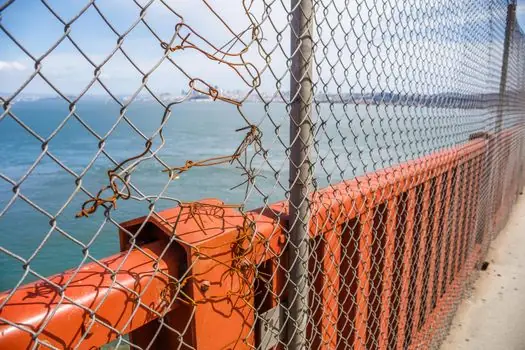
Safety fencing is the right tool when the threat is unauthorized human access, opportunistic theft, vehicle ram, fall into water, or boundary demarcation, and the right system is matched to the threat via the three classification axes [S2][S3][S4][S5].
It is not the right tool as a substitute for machine guarding. Where the hazard is moving machinery, a perimeter safety fence must comply with machine safety standards such as ISO 13849 and IEC 62061, with safety-rated interlocked gates and defined performance level (PL) targets, which is a different specification exercise than perimeter security fencing and is covered under our related guidance on safety relay selection 2026: types, PL/SIL targets, and the buyer's shortlist. For electrical-room perimeters, fence selection additionally intersects with arc-flash boundary and the lockout/tagout regime, and the Safety Fence Certification Checklist for Electrical Rooms: 2026 Walkthrough maps the certification evidence a submittal should carry.
Pool fences should be specified only after confirming the local residential pool code (height, gate, latch, and climb-resistance), and a fence that meets a high-security LPS 1175 rating is not automatically a compliant pool barrier, as the two standards measure different things [S5][S6].
Sourcing, Standards, and Trackable Signals
On any 2026 submittal, the standards citation block should reference at minimum: ASTM F2656 for vehicle crash testing (the basis of the M/P ratings), LPS 1175 for forced-entry resistance, and the local residential code for pool applications, with DoD UFC 4-022-02 added for U.S. anti-terrorism force protection and FAA guidance for airfield perimeters [S3][S4][S6].
Trackable signals for the next procurement cycle: the ASTM F2656 standard is the canonical U.S. reference for anti-ram fence ratings and pairs directly with the M/P system described above, and any fence datasheet citing only the legacy K-rating without an equivalent M/P value should be treated as incomplete [S3]. For higher-tier industrial sites, the trend is convergence on welded anti-climb mesh with LPS 1175 SR3 or higher certification, increasingly specified alongside electric-fence overlays and PIDS rather than as standalone barriers [S4][S6].
For perimeter projects that also touch hazardous-area classification, the construction machinery and equipment reference page covers adjacent equipment standards, and broader perimeter system design (lighting, detection, access control) is covered in the Access Control System Buying Guide 2026: Specs, Types, and Shortlist Logic, which pairs naturally with a fence specification on the same drawing set.
Detailed specification references: safety fence.