
A reach truck is an electric, narrow-aisle lift truck whose forks extend horizontally beyond the outriggers to retrieve pallets without swinging the chassis, typically rated 1.4–2.5 t at 600 mm load centre and powered by 24 V or 36 V lead-acid/Li-ion batteries [S2][S7].
Where conventional forklifts and reach trucks diverge is mast geometry and aisle width: reach-truck masts telescope to 7.0–12.0 m lift heights, and working aisle widths drop to 2.4–2.8 m for 1000×1200 mm Euro pallets, roughly 30–40% narrower than a counterbalanced [forklift](https://baike.sogou.com/v200876.htm) needs. The class sits between walkie pallet jacks and turret/VNA trucks in both cost and storage density.
Single (Stand-Up) Reach Trucks: The Default 8–10 ft Aisle Class
Single reach trucks place a stand-up operator compartment above the front wheels, with a single-stage or two-stage telescoping mast that lifts vertically without extending the forks forward at height [S2]. Toyota's RRE140HN and RRE160HN are seated variants in this class, rated 1400 kg and 1600 kg at 600 mm load centre on a 1342 mm wheelbase, with a 3190 kg service weight including battery [S5].
Spec ranges for this class compress into a tight band: load capacity 1.4–2.0 t, lift heights 4.0–9.5 m, mast tilt 3° forward / 4° backward, fork carriage DIN 15173 class 2A at 825 mm width, and 36 V nominal battery [S3][S5]. Working aisle widths in OEM Ast tables land at 2.5–2.9 m for 1000×1200 mm pallets — the band where single reach becomes the most cost-effective option per pallet position.
Double-Deep Reach Trucks: Two Pallets Per Bay, Tighter Aisles
Double-deep reach trucks add a longer reach stroke to access the second pallet position behind the first, typically 1200–1800 mm of fork extension versus 500–700 mm on single reach [S2]. This effectively halves the number of access aisles needed, but it forces the operator to commit to a SKU rotation strategy because the rear pallet must be moved before the front one can be retrieved.
Capacity is often derated 100–200 kg versus a single-reach equivalent due to the longer load moment arm, and the chassis is narrower (b1 = 1067 mm on Crown RR 5725-1.6) to preserve aisle performance [S3]. Most warehouses that adopt double-deep also lock in LIFO or strict batch inventory rules; FIFO operations are a poor fit because the rear pallet only becomes accessible after the front is pulled.
Multi-Directional and Turret Trucks: 360° Mast for Long Load Handling
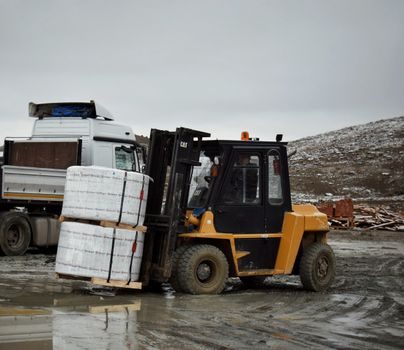
Multi-directional reach trucks — marketed as turret trucks by some OEMs — combine a 360° rotating mast with independently steered wheels, letting the chassis move sideways with long loads such as timber, panels, or carpet rolls without a separate sideloader [S2]. Crown's RR 5795S-2.0 illustrates the sit/stand variant, with a wider 1220 mm power-unit track and an additional 3rd load-side wheel versus the stand-only RR 5725 [S3].
Headlength (l2) extends to 1220 mm on RR 5795S versus 1040 mm on RR 5725 because the turret and rotating fork carriage need more chassis real estate, so planners must verify the bay depth and approach-aisle geometry before specifying [S3]. Traction motor sizing scales accordingly: 4.8 kW S2-60 min on RR 5700, paired with a 20.5 kW S3-15% lift motor on 36 V [S3].
Rider Reach Trucks: Elevated Platform for Pick-and-Stack
Rider reach trucks mount the operator on an elevating platform that rises with the load, blending the mast-reach function of a single reach with the operator-elevating function of an order picker [S2]. They split the use case between full-pallet retrieval at the bottom of the rack and case-level picking at the top, eliminating the need to swap trucks mid-shift.
Spec data on platform elevation is sparse in the public sheets reviewed — Total Lift's 2025-11 guide describes the function qualitatively rather than with a platform-rise millimetre value [S2]. Buyers specifying rider reach should request platform-rise speed (typical 0.2–0.4 m/s), platform capacity (usually 200–250 kg), and guard height at full elevation directly from the OEM data plate, because these are not standardised across the class.
Pantograph and Straddle Reach: Wide Load or Drive-In Rack
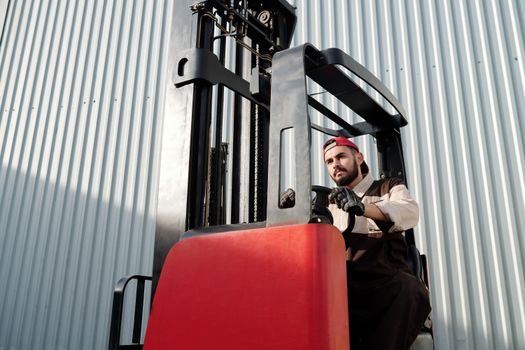
Pantograph reach trucks use a parallel-linkage fork carriage that pushes the load forward without the forks cantilevering off a single mast, suiting wide or delicate loads like printed reels and open-top trays. Straddle reach trucks use adjustable outriggers to span drive-in or pallet-flow racks where the wheel footprint must clear the rack rail — Crown's RR 5725 supports a 104 mm optional drive-in-rack third post and 865–1270 mm inside-straddle range in 25 mm increments to fit that application [S3].
Working aisle width for 800×1200 mm pallets (Ast 4.34) is published in the OEM dimension tables and typically lands 150–250 mm tighter than the 1000×1200 mm Ast 4.33 figure on the same truck [S3]. This is the single most misread spec in buyer specifications: Ast is pallet-size-dependent, and a quote that only lists one Ast value is incomplete.
Selection Criteria: Aisle, Height, Capacity, Battery, Floor
The decision matrix reduces to five numbers: aisle width, lift height, rated capacity at load centre, battery voltage, and floor flatness. On a side-by-side, single reach handles 2.6–2.9 m aisles up to 9.5 m lift, double-deep handles 2.5–2.8 m aisles up to 11 m with 80–90% of single-reach density benefit, and turret/multi-directional handles 1.8–2.2 m aisles up to 12 m at the cost of 2–3× unit price [S2][S3].
Battery voltage affects performance on Toyota RF1 lines: 24 V models (e.g., RF1-BE1X35/1X40) are rated at 5.5 MPH travel and 40 FPM lift full load, while 36 V models (e.g., RF1-BH1X35) reach 7.0 MPH travel and 70 FPM lift at the same 3,500 lb load capacity [S7]. Buyers running single-shift operations often justify 24 V on capex alone; two- and three-shift operations almost always pay back the 36 V premium inside 18 months on labour alone.
Limitations, Failure Modes, and What Reach Trucks Are Not For
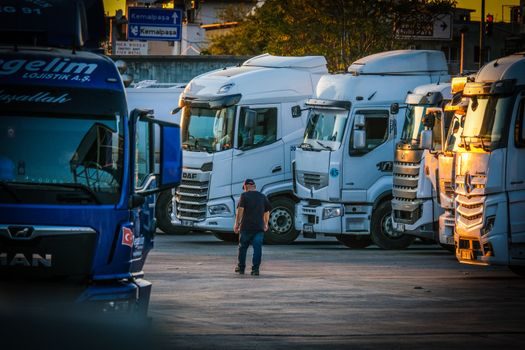
Reach trucks are not for outdoor use: poly tyres, exposed masts, and IP-rated but not weather-sealed electrical bays fail prematurely in rain, snow, or on uneven yard surfaces. They are also not for gradient loading — typical max ramp rating is 10–15% empty and 5–8% loaded, well below a [dump-truck](https://baike.sogou.com/v200876.htm) or rough-terrain forklift. [S3]
The dominant failure mode is mast/rail deflection at high lift with off-centre loads; derating begins at 8.0 m+ lift height when the load centre exceeds 600 mm or the load shifts during a panic stop [S3]. Operators without fork-tilt discipline (3°/4° standard) routinely crack mast channels within 2000 hours. Floor flatness tolerance is typically ±3 mm over 2 m, tighter than most warehouse slabs achieve without repair.
Standards, Sourcing, and Operator Certification
Reach-truck design references ISO 5053-1 for truck terminology and ANSI/ITSDF B56.1 (or EN ISO 3691-1 in the EU) for safety requirements; operator training in most jurisdictions falls under OSHA 1910.178(l) in the US or equivalent national codes [S1]. Crown's RR 5700 specs are published to the VDI 2198 / FEM data-sheet template, which is why the spec table reads as numbered 1.x through 8.x fields rather than a marketing block [S3].
For 2026 procurement, request Ast at both 1000×1200 and 800×1200 mm pallet sizes, lift speed under load (m/s) and no-load, battery kWh per shift cycle, and a derating curve versus load centre. [Toyota's RRE160HN spec sheet](https://media.toyota-forklifts.eu/published/21818_Original%20document_toyota%20mh.pdf) and [Crown's RR 5700 PDF](https://www.crown.com/dam/crown/pdfs/en-uk/specs/reach-truck-rr5700-spec-GB.pdf) both follow the FEM template; Hyster's 2027 R1.4–1.6 t brochure uses a narrative format that requires manual extraction of the same fields. Comparing them apples-to-apples means forcing all three into the same 1.x–8.x schema before quoting.
Two trackable signals for the next procurement cycle: OEM migration from 24 V to 36 V as the default 1.4–1.6 t offering (Hyster's 2027 brochure confirms 36 V across its 1.4–1.6 t range), and the gradual replacement of poly load wheels with polyurethane-on-cast-iron for higher cycle life above 5000 hours/year. The electric forklift spec map covers the wider 1.0–3.5 t electric-forklift class if a reach truck's aisle constraints rule it out, and the diesel forklift capacity map is the cross-reference for any yard or outdoor work that reach trucks cannot do.
Detailed specification references: dump truck, and truck scale.