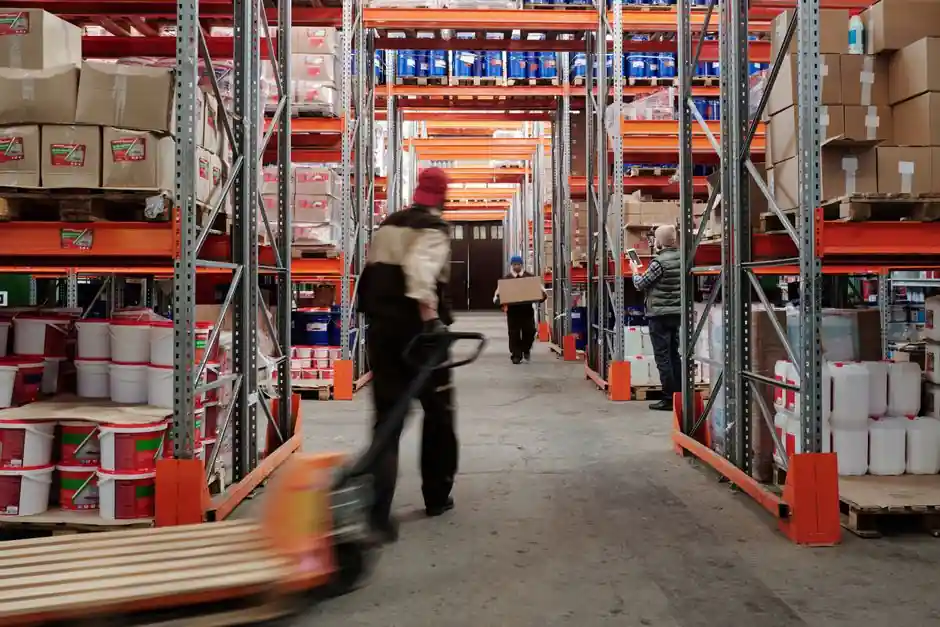
For e-commerce fulfillment, pallet rack specification starts with the SKU-velocity map: fast-moving A-items suit selective or carton-flow racks, slow-moving bulk suits drive-in, while long or odd freight pushes the spec to cantilever [S3][S6].
Distributor inventories now stock selective, push-back, drive-in/drive-thru, pallet-flow, carton-flow, cantilever, galvanized, rivet, wide-span, and mezzanine configurations in one catalog, with boltless teardrop uprights as the de-facto North American interface [S3]. E-commerce integrators report lead times of 2–6 weeks for stocked selective bays and 8–14 weeks for engineered flow or ASRS-adjacent systems [S4][S5].
Main rack types and what they actually do
Selective pallet rack remains the default for mixed-SKU e-commerce because every pallet is individually addressable from the aisle, with typical capacities of 8,000–25,000 lb per beam pair and uprights rated 20,000–40,000 lb per frame [S3][S4]. Distributors list it as the baseline product and the most-stocked SKU on Atlantic Rack's 25-year-old Miami inventory [S3].
Drive-in and drive-thru racks trade selectivity for density, common in low-SKU-count reserve storage where a 6-pallet-deep block can lift floor-space utilization from ~33% (selective) to ~70–80% [S3][S5]. Pallet-flow and push-back add gravity or cart-on-rail dynamics to that density model, suiting FIFO reserve (flow) or LIFO reserve (push-back) lanes [S3].
Cantilever racks are not a pallet rack substitute for general SKUs; they exist to hold pipe, lumber, furniture, and long-tail e-commerce freight that cannot sit on standard 42 in. or 48 in. cross beams [S3]. Galvanized and rivet-style racks round out the catalog for corrosive or low-budget installs where welded teardrop is over-specified [S3][S5].
Selection criteria: capacity, footprint, velocity, fire/seismic
Engineered selective rack frames are commonly rated 20,000–40,000 lb per upright pair, with beam capacities scaling from ~4,000 lb step-beams to 10,000 lb+ for heavy-pallet A-frames; engineer-of-record stamps are required wherever seismic design category C or higher applies or where the rack exceeds 8 ft to the top beam [S3][S4].
E-commerce throughput drives type more than capacity: a 5,000-SKU DC shipping 20,000+ orders/day typically needs selective at the pick face plus a high-density reserve behind it, while a 200-SKU bulk-fulfillment site can run almost entirely on drive-in or push-back to compress footprint [S3][S6]. NJ/NY/PA distributors and Midwest integrators consistently pitch selective-plus-reserve as the standard two-zone layout for 3PL e-commerce tenants [S4][S6].
Storage rack code compliance in the US routes through the Rack Manufacturers Institute (RMI/ANSI MH16.1) for design loads, with seismic mapping per IBC and fire-sprinkler geometry per NFPA 13; high-pile e-commerce storage over 12 ft usually triggers ESFR sprinkler redesign, and that geometry, in turn, dictates beam-spacing and flue widths on the rack drawing [S3][S4]. The cap set is not a marketing preference; it is the floor on what an Authority Having Jurisdiction will accept on a Certificate of Occupancy.
Who this is for, and who it is not for
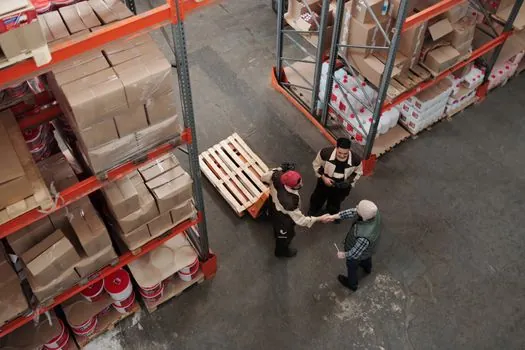
Pallet rack is the right tool for operations moving full pallets on fork trucks, pallet jacks, or pallet stacker units at throughputs above ~50 pallets/day, where the mix of SKUs and order lines justifies addressable storage [S3][S6]. It also fits 3PL and multi-tenant fulfillment centers that need re-configurable bays as tenant rosters churn [S1][S4].
It is the wrong tool for bin-and-piece picking under ~5 lb SKUs at high velocity, where carton-flow shelving or a plastic pallet tote-on-shelf system outperforms rack; and it is also wrong for cold-chain sub-zero DC where galvanized rack plus insulated enclosures, not standard teardrop, is the minimum entry spec [S3][S5]. Single-SKU pallet-only operations at very high volume sometimes bypass rack entirely with block-stacking or manual pallet jack floor moves.
Comparison: rack type against decision criteria
Pallet-flow and push-back both reach ~65–75% density while keeping roughly 50–70% selectivity; flow suits FIFO reserve and is the most common e-commerce reserve lane, while push-back is the LIFO counterpart and is often specified for replenishment-heavy bulk SKUs [S3][S6]. Cantilever is a non-comparable outlier, scoring low on density and selectivity but is the only one of the five that holds long freight, so it is specified by SKU geometry rather than velocity [S3].
Capital cost per pallet position is consistently lowest for used or teardrop selective, mid for drive-in and flow (more components per bay), and highest for engineered push-back, mobile-base, and ASRS-adjacent shuttle systems; lead time follows the same curve, with stocked selective shipping fastest and engineered systems requiring 8–14 week factory slots [S4][S5][S6]. For the broader industrial-spec context on racking and material handling, see this AGV robot selection map for air cargo terminals for the automation-tier companion decision.
Real use cases from the distributor channel
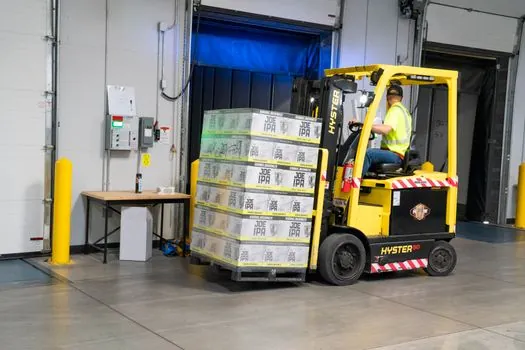
Florida-based 3PLs pitch 30,000–80,000 sq ft e-commerce fulfillment builds on selective rack at the pick face plus a high-density drive-in or push-back reserve, with mezzanines added to recover the cubic footage lost to low-ceiling tilt panels [S1][S3]. Midwest integrators describe a 50,000+ position job where carton-flow rack on the pick level feeds a selective reserve below, cutting pick-path travel by an order of magnitude relative to a flat selective layout [S6].
Wholesale channels concentrate heavy-duty steel pallet rack in the 2,000–4,000 kg per layer range (≈4,400–8,800 lb) with CE-marked welded frames, sold in container-load quantities to Latin America, the Caribbean, and Southeast Asia, while US domestic channels still anchor on teardrop selective for replaceability [S2][S3]. For cold-storage and sub-zero operations, galvanized rack plus insulated enclosures is the standard entry spec, and a related spec map for wire-rod in cold storage sits at this cold-storage wire-rod spec page.
Limitations, failure modes, and the safety floor
Unanchored or poorly anchored rack is the dominant failure mode cited across the distributor channel, alongside overloaded beams, forklift impact at the aisle-side upright, and beam-dislodgement from missing safety clips; the fix is row spacers, column protectors, anchor bolts torqued to the rack drawing, and beam end-locks on every beam-to-upright interface [S3][S4][S6].
Seismic design category D and above, plus any high-pile combustible storage over 12 ft, forces engineered rack with stamped calculations, ESFR sprinkler geometry, and flued cross-aisle spacing; the floor cannot be undercut, so the rack drawing has to be in the building permit set, not added later [S3][S4]. Galvanized or epoxy-coated rack is required where humidity, wash-down, or cold-chain condensation will chew through standard powder coat inside 5–7 years [S3].
Sourcing, standards, and the verifiable next node

US specs anchor on RMI/ANSI MH16.1 for steel rack design and on NFPA 13 for sprinkler geometry around the rack envelope; the European reference is EN 15635 for the use-and-maintenance side and EN 15512 for design, with CE marking on welded frames common in the wholesale channel [S2][S3][S4]. Buyers should require stamped calculations, a PE/SE seal in seismic zones, and a documented load-application poster at every rack row [S4][S6].
Track the next signal in this space: the August 2026 distributor inventory refresh at the major Miami, NJ, and Midwest integrators will set the effective stock lead time for teardrop selective versus engineered flow systems into 2027 [S3][S4][S6]. Cross-check that against any IBC or NFPA 13 code-cycle commentary on high-pile storage thresholds before locking a 12+ ft rack layout, and confirm the floor flatness tolerance (commonly ±1/4 in. over 10 ft for selective) is written into the slab spec, not the rack spec [S4].